School of Psychological Science, University of Bristol, Bristol, BS8 1TU, UK.
University of Coimbra, 3004-531, Coimbra, Portugal.
Sci Rep. 2023 Jul 17;13(1):11219. doi: 10.1038/s41598-023-30883-7.
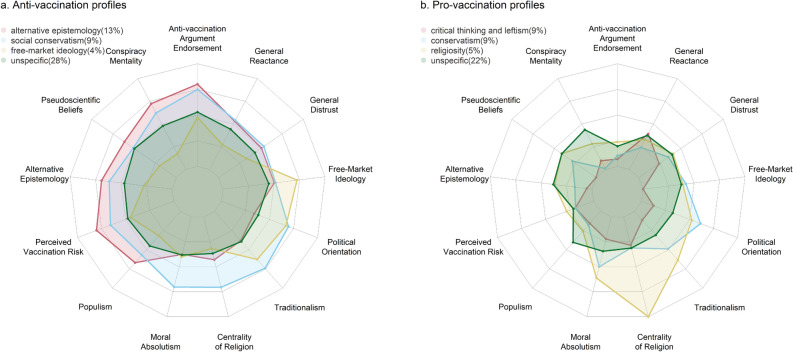
The proliferation of anti-vaccination arguments online can threaten immunisation programmes, including those targeting COVID-19. To effectively refute misinformed views about vaccination, communicators need to go beyond providing correct information and debunking of misconceptions, and must consider the underlying motivations of people who hold contrarian views. Drawing on a taxonomy of anti-vaccination arguments that identified 11 "attitude roots"-i.e., psychological attributes-that motivate an individual's vaccine-hesitant attitude, we assessed whether these attitude roots were identifiable in argument endorsements and responses to psychological construct measures corresponding to the presumed attitude roots. In two UK samples (total n = 1250), we found that participants exhibited monological belief patterns in their highly correlated endorsements of anti-vaccination arguments drawn from different attitude roots, and that psychological constructs representing the attitude roots significantly predicted argument endorsement strength and vaccine hesitancy. We identified four different latent anti-vaccination profiles amongst our participants' responses. We conclude that endorsement of anti-vaccination arguments meaningfully dovetails with attitude roots clustering around anti-scientific beliefs and partisan ideologies, but that the balance between those attitudes differs considerably between people. Communicators must be aware of those individual differences.
网络上大量反疫苗言论可能会威胁到免疫计划,包括针对 COVID-19 的免疫计划。为了有效反驳有关疫苗接种的错误观点,传播者不仅需要提供正确的信息并揭穿误解,还必须考虑到持有相反观点的人的潜在动机。本研究借鉴了一种反疫苗言论分类法,该分类法确定了 11 种“态度根源”——即影响个体疫苗犹豫态度的心理属性——我们评估了这些态度根源是否可以在对心理结构测量的反疫苗言论赞同和回应中被识别出来,这些心理结构与假定的态度根源相对应。在两个英国样本(共 1250 人)中,我们发现参与者在高度相关的反疫苗言论赞同中表现出单一思维的信念模式,这些言论源于不同的态度根源,代表态度根源的心理结构显著预测了言论赞同的强度和疫苗犹豫程度。我们在参与者的回应中确定了四种不同的潜在反疫苗特征。我们的结论是,对反疫苗言论的赞同与围绕反科学信仰和党派意识形态的态度根源密切相关,但这些态度之间的平衡在人与人之间存在很大差异。传播者必须意识到这些个体差异。