Misión Biológica de Galicia (MBG-CSIC), Apartado de correos 28, Pontevedra, Galicia, 36080, Spain.
Department of Ecology and Evolutionary Biology, University of California-Irvine, Irvine, CA, 92697, USA.
J Chem Ecol. 2023 Oct;49(9-10):507-517. doi: 10.1007/s10886-023-01445-y. Epub 2023 Jul 18.
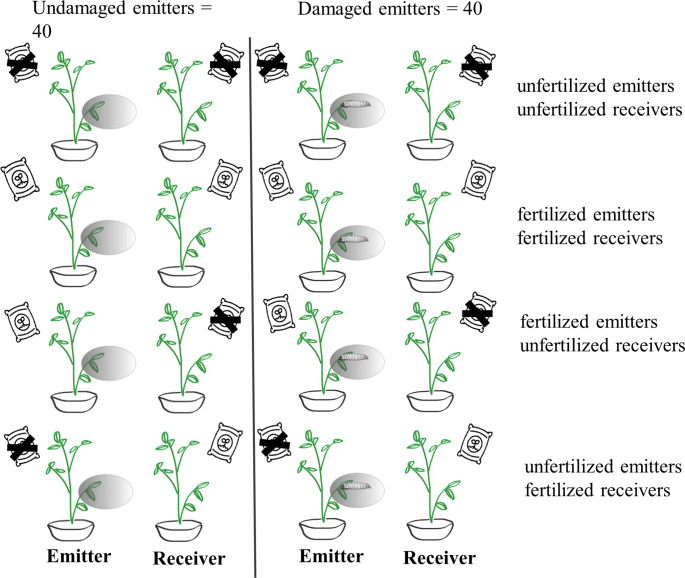
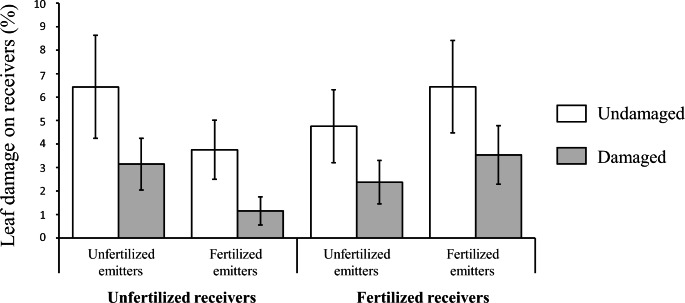
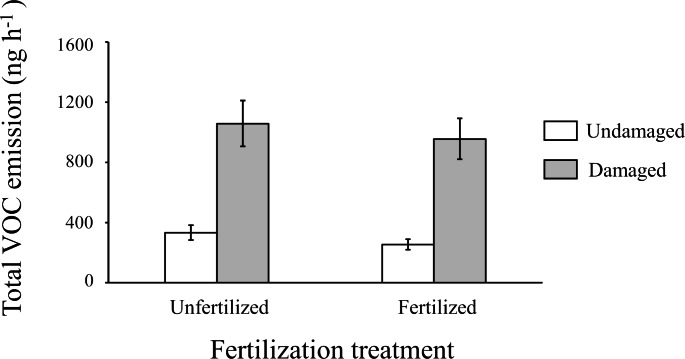
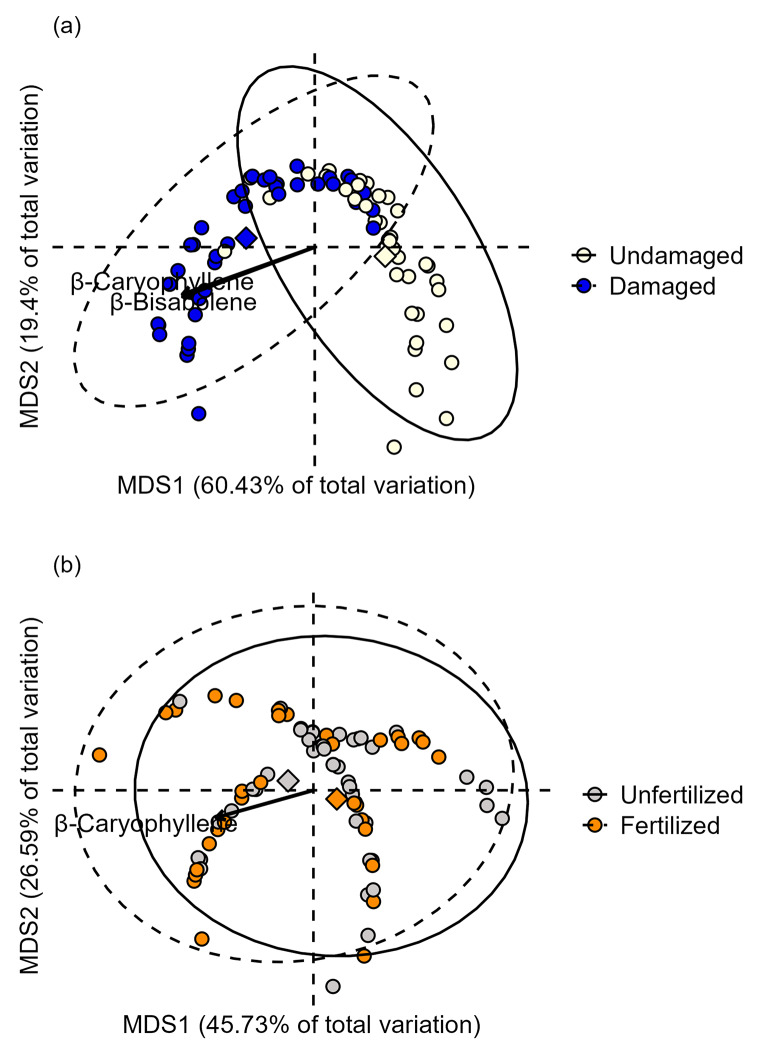
Plant-plant signalling via volatile organic compounds (VOCs) has been studied intensively, but its contingency on abiotic conditions (e.g., soil nutrients, drought, warming) is poorly understood. To address this gap, we carried out a greenhouse experiment testing whether soil nutrients influenced signalling between potato (Solanum tuberosum) plants in response to insect leaf herbivory by the generalist caterpillar Spodoptera exigua. We placed pairs of plants in plastic cages, where one plant acted as a VOC emitter and the other as a receiver. We factorially manipulated soil nutrients for both emitter and receiver plants, namely: unfertilized (baseline soil nutrients) vs. fertilized (augmented nutrients). Then, to test for signalling effects, half of the emitters within each fertilization level were damaged by S. exigua larvae and the other half remained undamaged. Three days after placing larvae, we collected VOCs from emitter plants to test for herbivory and fertilization effects on VOC emissions and placed S. exigua larvae on receivers to test for signalling effects on leaf consumption and larval mass gain as proxies of induced resistance. We found that herbivory increased total VOC emissions and altered VOC composition by emitter plants, but these effects were not contingent on fertilization. In addition, bioassay results showed that receivers exposed to VOCs from herbivore-damaged emitters had lower levels of herbivory compared to receivers exposed to undamaged emitters. However, and consistent with VOC results, fertilization did not influence herbivore-induced signalling effects on receiver resistance to herbivory. In sum, we found evidence of S. exigua-induced signalling effects on resistance to herbivory in potato plants but such effects were not affected by increased soil nutrients. These results call for further work testing signalling effects under broader range of nutrient concentration levels (including nutrient limitation), teasing apart the effects of specific nutrients, and incorporating other abiotic factors likely to interact or covary with soil nutrients.
植物通过挥发性有机化合物(VOCs)进行的信号传递已经得到了深入研究,但人们对其与非生物条件(例如土壤养分、干旱、变暖)的关系了解甚少。为了解决这一差距,我们进行了一项温室实验,测试土壤养分是否会影响马铃薯(Solanum tuberosum)植株对一般毛虫烟青虫(Spodoptera exigua)叶食性的信号传递。我们将一对植株放在塑料笼中,其中一株作为 VOC 发射器,另一株作为接收器。我们对发射器和接收器植株的土壤养分进行了因子操纵,即:未施肥(基础土壤养分)与施肥(增加养分)。然后,为了测试信号传递效应,我们在每个施肥水平下的一半发射器植株上用烟青虫幼虫造成损伤,另一半则保持未损伤。在放置幼虫三天后,我们从发射器植株中收集 VOC 以测试对 VOC 排放的取食和施肥效应,并将烟青虫幼虫放在接收器植株上以测试对叶片消耗和幼虫质量增益的信号传递效应作为诱导抗性的替代指标。我们发现,取食增加了发射器植株的总 VOC 排放并改变了 VOC 组成,但这些效应并不取决于施肥。此外,生物测定结果表明,与暴露于未受损发射器植株 VOC 的接收器相比,暴露于受虫害发射器植株 VOC 的接收器的取食水平较低。然而,与 VOC 结果一致的是,施肥并没有影响烟青虫诱导的信号传递效应对接收器抗取食的影响。总之,我们发现了烟青虫对马铃薯植株抗取食性的诱导信号传递效应的证据,但这些效应不受增加的土壤养分的影响。这些结果呼吁进一步研究在更广泛的养分浓度水平(包括养分限制)下测试信号传递效应,分解特定养分的作用,并纳入可能与土壤养分相互作用或共变的其他非生物因素。