Ibañez Kristina, Jadhav Bharati, Zanovello Matteo, Gagliardi Delia, Clarkson Christopher, Facchini Stefano, Garg Paras, Martin-Trujillo Alejandro, Gies Scott J, Deforie Valentina Galassi, Dalmia Anupriya, Hensman Moss Davina J, Vandrovcova Jana, Rocca Clarissa, Moutsianas Loukas, Marini-Bettolo Chiara, Walker Helen, Turner Chris, Shoai Maryam, Long Jeffrey D, Fratta Pietro, Langbehn Douglas R, Tabrizi Sarah J, Caulfield Mark J, Cortese Andrea, Escott-Price Valentina, Hardy John, Houlden Henry, Sharp Andrew J, Tucci Arianna
William Harvey Research Institute, Queen Mary University of London, London, EC1M 6BQ, UK.
Department of Genetics and Genomic Sciences and Mindich Child Health and Development Institute, Icahn School of Medicine at Mount Sinai, New York, NY 10029.
medRxiv. 2024 Jul 8:2023.07.03.23292162. doi: 10.1101/2023.07.03.23292162.
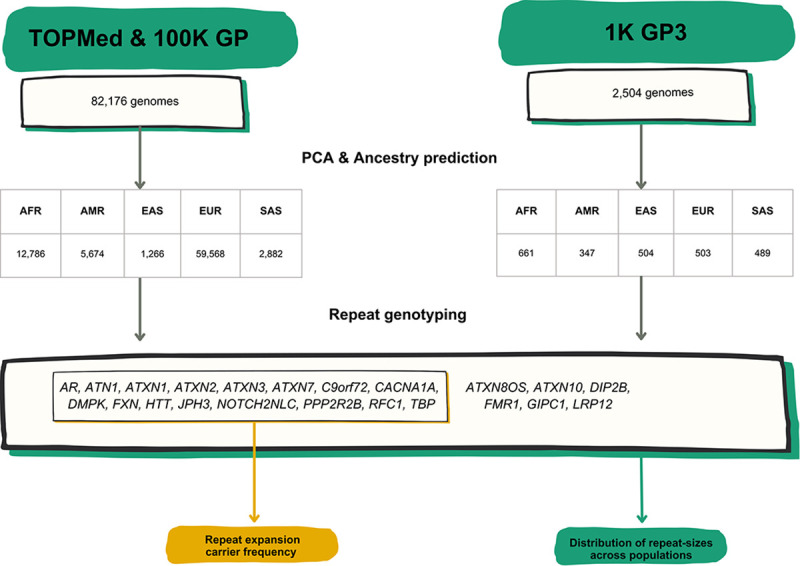
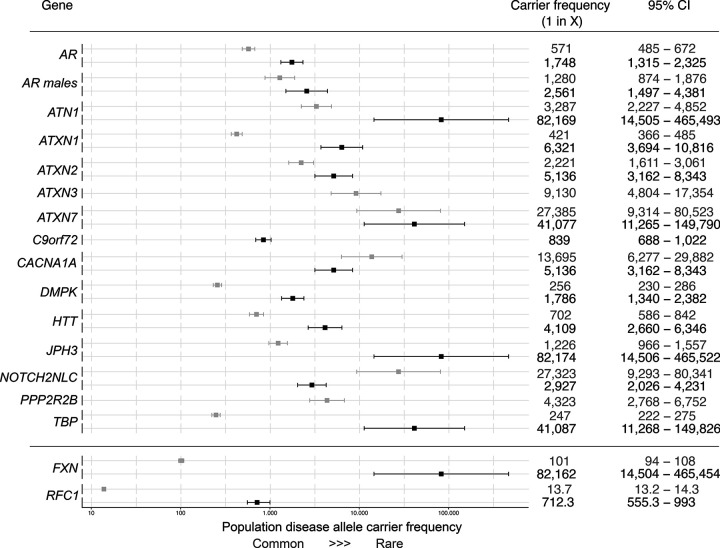
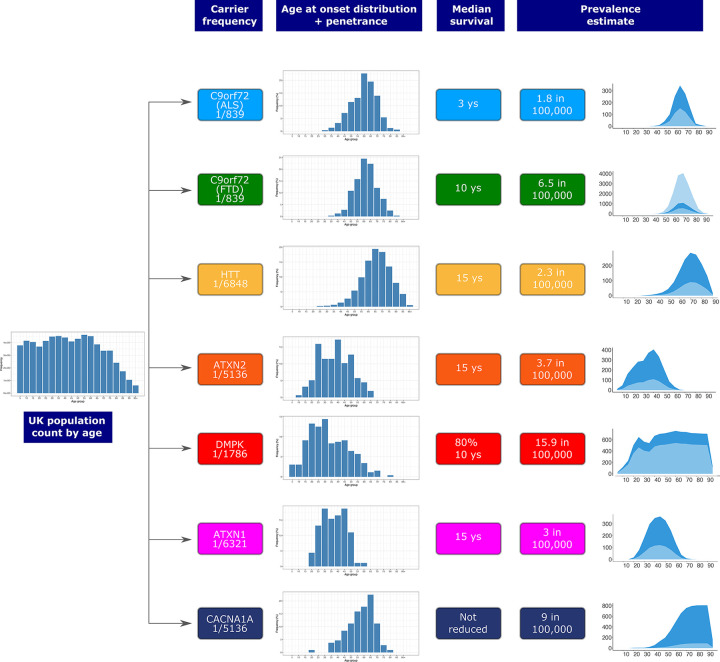
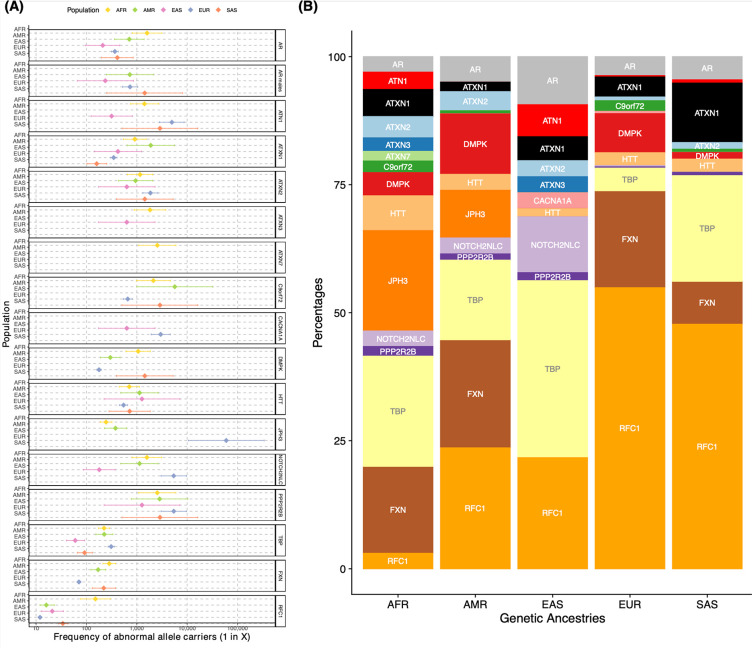
Repeat expansion disorders (REDs) are a devastating group of predominantly neurological diseases. Together they are common, affecting 1 in 3,000 people worldwide with population-specific differences. However, prevalence estimates of REDs are hampered by heterogeneous clinical presentation, variable geographic distributions, and technological limitations leading to under-ascertainment. Here, leveraging whole genome sequencing data from 82,176 individuals from different populations, we found an overall disease allele frequency of REDs of 1 in 283 individuals. Modelling disease prevalence using genetic data, age at onset and survival, we show that the expected number of people with REDs would be two to three times higher than currently reported figures, indicating under-diagnosis and/or incomplete penetrance. While some REDs are population-specific, e.g. Huntington disease-like 2 in Africans, most REDs are represented in all broad genetic ancestries (i.e. Europeans, Africans, Americans, East Asians, and South Asians), challenging the notion that some REDs are found only in specific populations. These results have worldwide implications for local and global health communities in the diagnosis and counselling of REDs.
重复序列扩增疾病(REDs)是一组主要为神经系统疾病的灾难性疾病。它们总体较为常见,在全球每3000人中就有1人受其影响,且存在人群特异性差异。然而,REDs的患病率估计受到临床表现异质性、地理分布多变以及技术限制等因素的阻碍,导致确诊不足。在此,利用来自不同人群的82176人的全基因组测序数据,我们发现REDs的总体疾病等位基因频率为每283人中就有1人。通过使用遗传数据、发病年龄和生存率对疾病患病率进行建模,我们表明REDs患者的预期人数将比目前报告的数字高出两到三倍,这表明存在诊断不足和/或不完全显性的情况。虽然有些REDs具有人群特异性,例如非洲人中的2型亨廷顿病样疾病,但大多数REDs在所有广泛的遗传血统(即欧洲人、非洲人、美洲人、东亚人和南亚人)中都有出现,这对某些REDs仅在特定人群中存在的观点提出了挑战。这些结果对全球和地方卫生社区在REDs的诊断和咨询方面具有广泛的影响。