Epidemiology Branch, Division of Intramural Population Health Research, Eunice Kennedy Shriver National Institute of Child Health and Human Development, National Institutes of Health, 6710B Rockledge Drive, Room 3204, Bethesda, MD, 20817, USA.
School of Medicine, University of Adelaide, Adelaide, SA, Australia.
BMC Med. 2018 May 24;16(1):70. doi: 10.1186/s12916-018-1061-3.
Birthweight is an important predictor of infant morbidity and mortality, and is associated with cardiovascular diseases, obesity, and diabetes in childhood and adulthood. Birthweight and fetal growth show regional and population variations even under similar maternal conditions, and a large proportion of these differences are not explained by environmental factors. Whether and to what extent population genetic variations at key birthweight-associated loci account for the residual birthweight disparities not explained by environmental determinants is unknown. We hypothesized that the cumulative burden of genetic variants with a birthweight-lowering effect (GRB) is different among ancestrally diverse populations.
Genotype data were extracted from phase 3 of the 1000 Genomes Project for 2504 participants from 26 global populations grouped into five super-populations. GRB was calculated in offspring as the weighted sum of the number of birthweight-lowering genetic variants of 59 autosomal single-nucleotide polymorphisms associated with birthweight, and comparisons were made between Europeans and non-Europeans.
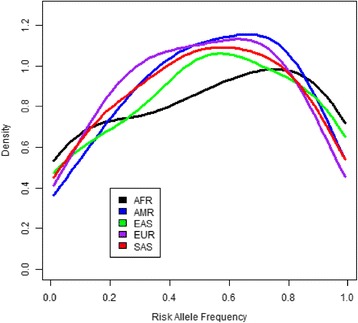
GRB was significantly higher in Africans (mean difference 3.15; 95% confidence interval 2.64, 3.66), admixed Americans (3.02; 2.34, 3.70), East Asians (2.85; 2.29, 3.41), and South Asians (1.07; 0.49, 1.65) compared to Europeans. Birthweight-lowering genetic variants in Africans and East Asians were enriched for rare and frequency-fixed alleles (P < 0.001). African and Asian populations had the greatest deviation from the expectation of the common disease-common variant hyothesis. Compared to Europeans, the GRB of ancestral alleles was significantly higher and that of derived alleles was significantly lower in non-Europeans (P < 0.001).
The burden of birthweight-lowering genetic variants is higher in Africans and East Asians. This finding is consistent with the high incidence of low birthweight in the two populations. The genetic variants we studied may not be causal and the extent to which they tag the causal variants in non-Europeans is unknown; however, our findings highlight that genetic variations contribute to population differences in birthweight.
出生体重是婴儿发病率和死亡率的重要预测指标,与儿童和成年期的心血管疾病、肥胖和糖尿病有关。即使在相似的产妇条件下,出生体重和胎儿生长也表现出区域和人群差异,而且这些差异很大一部分不能用环境因素来解释。关键出生体重相关基因座的人群遗传变异是否以及在多大程度上解释了环境决定因素无法解释的剩余出生体重差异尚不清楚。我们假设,具有降低出生体重作用的遗传变异的累积负担(GRB)在具有不同祖先的人群中是不同的。
从 1000 基因组计划第三阶段提取了 26 个超级人群中 2504 名参与者的基因型数据,这些参与者分为五个超级人群。在后代中,GRB 是通过对 59 个与出生体重相关的常染色体单核苷酸多态性的出生体重降低遗传变异的数量进行加权求和来计算的,并比较了欧洲人和非欧洲人之间的差异。
与欧洲人相比,非洲人(平均差异 3.15;95%置信区间 2.64,3.66)、混合美国人(3.02;2.34,3.70)、东亚人(2.85;2.29,3.41)和南亚人(1.07;0.49,1.65)的 GRB 明显更高。非洲人和东亚人的出生体重降低遗传变异富集了罕见和频率固定的等位基因(P<0.001)。非洲和亚洲人群与常见疾病-常见变异假说的预期偏差最大。与欧洲人相比,非欧洲人的祖先等位基因的 GRB 明显更高,而衍生等位基因的 GRB 明显更低(P<0.001)。
非洲人和东亚人的出生体重降低遗传变异负担更高。这一发现与这两个人群中低出生体重的高发率一致。我们研究的遗传变异可能不是因果关系,而且它们在非欧洲人中标记因果变异的程度尚不清楚;然而,我们的研究结果强调了遗传变异对出生体重的人群差异的贡献。