Department of Rehabilitation Medicine and Biomedical Research Institute, Pusan National University Hospital, Busan, Republic of Korea.
Department of Rehabilitation Medicine and Biomedical Research Institute, Pusan National University Hospital and Pusan National University School of Medicine, Busan, Republic of Korea.
Ther Adv Respir Dis. 2023 Jan-Dec;17:17534666231186732. doi: 10.1177/17534666231186732.
In patients with interstitial lung disease (ILD), decreased oxygen saturation (SpO2) reduces physical performance and causes exertional dyspnea. Portable oxygen concentrator (POC) and pursed-lip breathing (PLB) have the potential to improve these parameters in ILD patients.
To evaluate the effects of PLB while using a POC during walking in ILD patients.
Prospective, randomized crossover trial.
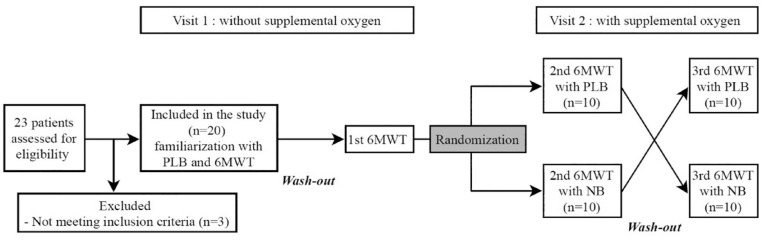
We compared two breathing techniques. Participants not trained in PLB received a familiarization session before the first 6-min walking test (6MWT). During the first visit, patients performed the 6MWT under natural breathing (NB1) without oxygen (O); during the second visit, they performed the 6MWT twice, once each with PLB (PLB1) and natural breathing (NB2) under O supplementation, to compare the effectiveness of NB and PLB.
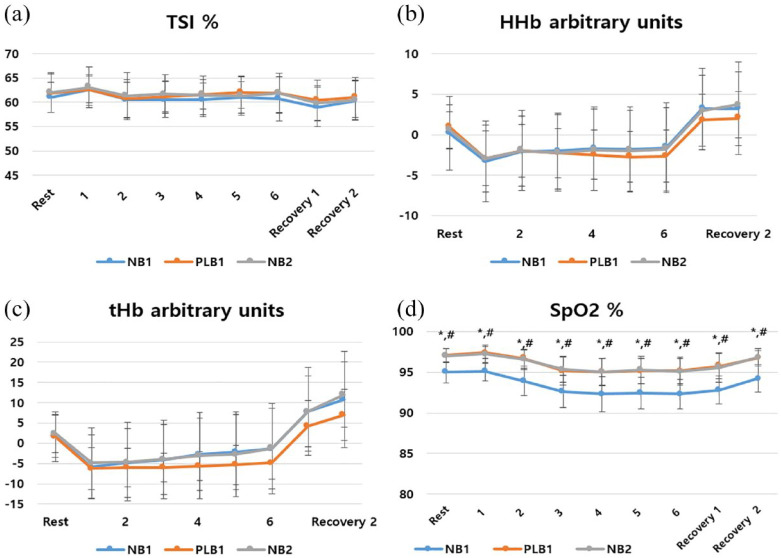
Twenty participants were recruited; half had exercise-induced desaturation (EID) and half normal SpO. In the normoxemia group (NG), the difference in the 6-min walking distance (6MWD) between NB1 and PLB1 was 28.8 ± 24.0 m, indicating reduced exercise capacity in PLB1. There were no significant differences in the quadriceps tissue saturation index (TSI), SpO, and 6MWD between the PLB1 and NB2 in any patient or subgroup. All participants showed a significant increase in the SpO at rest, nadir SpO, and mean SpO during the 6MWT with PLB and NB2 using a POC than with NB1. TSI showed a significant improvement at the beginning of 6MWT in ILD patients with EID in the PLB and NB2 condition.
Acute exposure to PLB did not improve symptoms, muscle oxygenation, or SpO; however, it decreased the walking distance in the normoxemia group. POC improved leg muscle oxygenation in ILD patients with EID. The use of PLB and POC should be prescribed according to disease characteristics and severity.
在患有间质性肺疾病(ILD)的患者中,氧饱和度(SpO2)降低会降低身体机能,并导致运动性呼吸困难。便携式氧气浓缩器(POC)和缩唇呼吸(PLB)有可能改善ILD 患者的这些参数。
评估在ILD 患者行走时使用 POC 的同时进行 PLB 的效果。
前瞻性、随机交叉试验。
我们比较了两种呼吸技术。未接受 PLB 训练的参与者在第一次 6 分钟步行测试(6MWT)前接受了一个熟悉阶段。在第一次就诊时,患者在不吸氧(O)的自然呼吸(NB1)下进行 6MWT;在第二次就诊时,他们在两次分别进行 PLB(PLB1)和吸氧(O)下的自然呼吸(NB2)的 6MWT,以比较 NB 和 PLB 的有效性。
共招募了 20 名参与者;一半有运动性低氧血症(EID),一半氧饱和度正常。在正常氧血症组(NG)中,NB1 和 PLB1 之间的 6 分钟步行距离(6MWD)差异为 28.8±24.0m,表明 PLB1 时运动能力降低。在任何患者或亚组中,PLB1 和 NB2 之间的股四头肌组织饱和度指数(TSI)、SpO2 和 6MWD 均无显著差异。所有参与者在使用 POC 的 PLB 和 NB2 时,休息时、最低 SpO2 和 6MWT 时的平均 SpO2 均显著升高,而在 NB1 时则没有。ILD 患者在 EID 中,PLB 和 NB2 条件下,6MWT 开始时 TSI 显著改善。
急性暴露于 PLB 并未改善症状、肌肉氧合或 SpO2;然而,它降低了正常氧血症组的步行距离。POC 改善了有 EID 的 ILD 患者的腿部肌肉氧合。PLB 和 POC 的使用应根据疾病特征和严重程度来规定。