CHU Lille, Department of Respiratory Diseases, F-59000 Lille and Univ. Lille, Center for Infection and Immunity of Lille, INSERM U1019 - CNRS UMR 8204, F-59000, Lille, France.
Department of Respiratory Diseases, Maison Blanche Hospital, CHU de Reims, INSERM UMRS 1250, Reims, France.
Int J Chron Obstruct Pulmon Dis. 2019 Jul 2;14:1399-1410. doi: 10.2147/COPD.S188412. eCollection 2019.
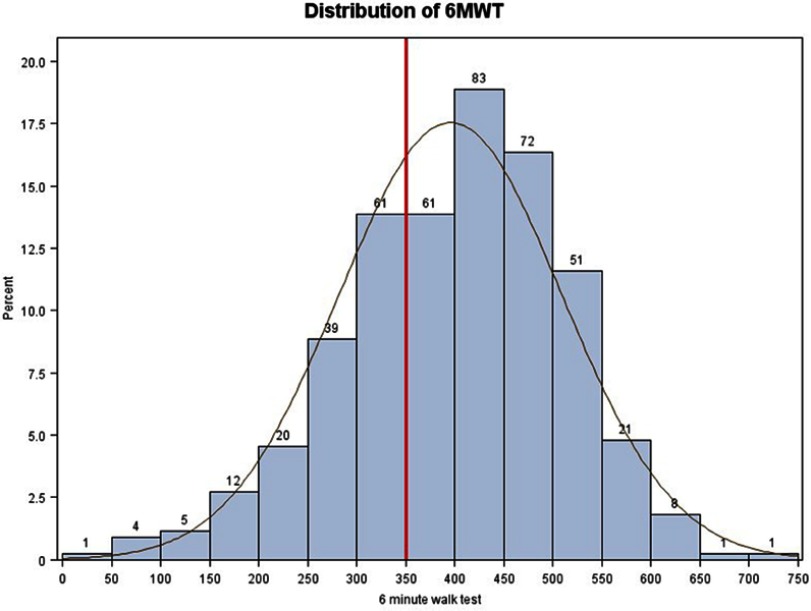
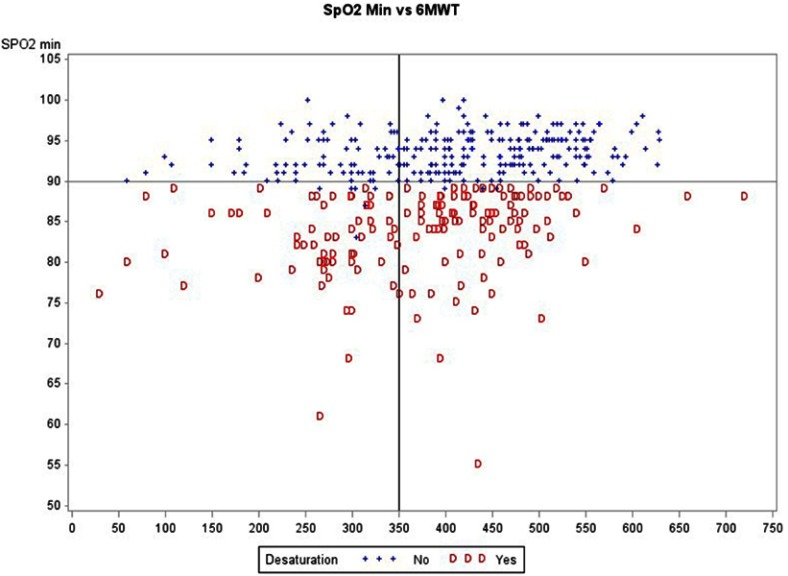
The 6-min walk test (6MWT) allows exercise tolerance to be assessed, and it has a significant prognostic value in COPD. The goal of this study was to analyse the determinants (obtained in routine practice) of a low 6-min walking distance (6MWD) and exercise-induced desaturation (EID) in COPD, including comorbidities. Patients were recruited from the real-life French COPD cohort "Initiatives BPCO". A low 6MWD was defined as <350 m. EID was defined by a minimum pulse oxygen saturation (SpO2)<90% and delta SpO2≥4% from baseline. Multivariate logistic regression analyses assessed the influence on 6MWD and EID of age, sex, obesity (body mass index, BMI >30 kg/m), low BMI (BMI <18.5 kg/m), modified Medical Research Council (mMRC) dyspnea scale, FEV1% pred, FVC % pred, hyperinflation and comorbidities including cardiovascular diseases. Among 440 patients with available 6MWT data, a 6MWD <350 m was found in 146 patients (33%), which was positively associated in multivariate analyses with age and mMRC and negatively with resting SpO2 and FVC % pred (rescaled r=0.34), whereas no comorbidity was associated with a low 6WMD. EID was found in 155 patients (35%). This was positively associated with hypertension and negatively with age, obesity, FEV1% pred and resting SpO2 (rescaled r=0.37). 6MWD and EID exhibit different determinants in COPD with a minor impact of comorbidities limited to hypertension in EID and to obesity, which was unexpectedly associated with less EID. Other variables including age, routine resting lung function and SpO2 were weakly associated with 6MWD and EID. Altogether, these results suggest that 6MWT performance remains difficult to predict with routine clinical/functional parameters.
6 分钟步行试验(6MWT)可评估运动耐量,对 COPD 具有重要的预后价值。本研究旨在分析 COPD 患者(在常规实践中获得)6 分钟步行距离(6MWD)较低和运动诱导性低氧血症(EID)的决定因素,包括合并症。患者来自真实世界的法国 COPD 队列“COPD 倡议”。6MWD 较低定义为<350m。EID 通过最低脉搏血氧饱和度(SpO2)<90%和基线时 SpO2 下降≥4%定义。多变量逻辑回归分析评估了年龄、性别、肥胖(体重指数,BMI>30kg/m)、低 BMI(BMI<18.5kg/m)、改良医学研究委员会(mMRC)呼吸困难量表、FEV1%预测值、FVC%预测值、过度充气和合并症(包括心血管疾病)对 6MWD 和 EID 的影响。在 440 名有可用 6MWT 数据的患者中,146 名(33%)患者的 6MWD<350m,多变量分析显示与年龄和 mMRC 呈正相关,与静息 SpO2 和 FVC%预测值呈负相关(校正 r=0.34),而无合并症与 6MWD 较低相关。155 名患者(35%)出现 EID。这与高血压呈正相关,与年龄、肥胖、FEV1%预测值和静息 SpO2 呈负相关(校正 r=0.37)。6MWD 和 EID 在 COPD 中有不同的决定因素,合并症的影响较小,仅在 EID 中与高血压相关,在肥胖中与 EID 相关,这出乎意料地与较少的 EID 相关。其他变量,包括年龄、常规静息肺功能和 SpO2,与 6MWD 和 EID 呈弱相关。总之,这些结果表明,6MWT 性能仍然难以用常规临床/功能参数预测。