Australian Centre for Health Engagement Evidence and Values, University of Wollongong, Wollongong, NSW, 2522, Australia.
Cairns and Hinterland Hospital and Health Service, Cairns, QLD, Australia.
Patient. 2023 Sep;16(5):555-567. doi: 10.1007/s40271-023-00640-z. Epub 2023 Jul 18.
Identify Australian public preferences for antibiotic treatments in the context of antibiotic stewardship.
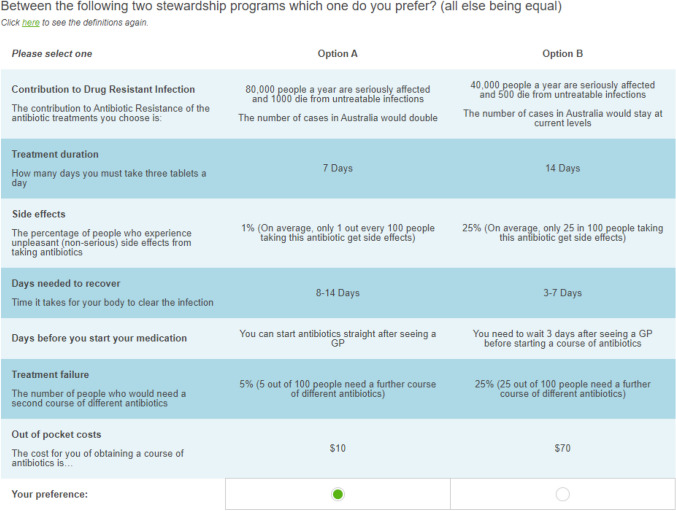
A discrete choice experiment (DCE) was conducted in Australia to investigate the importance of seven attributes associated with antibiotic treatments and related stewardship practices: contribution to antimicrobial resistance (AMR), treatment duration, side effects, days needed to recover, days before taking antibiotics, treatment failure and out-of-pocket costs. The DCE data were analysed using conditional logit, mixed logit and latent class conditional logit models. The relative importance of each attribute was calculated.
A total of 1882 respondents completed the survey; the main study sample consist of 1658 respondents (mean age 48 years) who passed quality checks. All seven attributes significantly influenced respondents' preferences for antibiotic treatments. Based on the designed attribute levels in the DCE, on average, out-of-pocket costs (32.8%) and contribution to antibiotic resistance (30.3%) were the most important attributes, followed by side effects (12.9%). Days before starting medication was least important (3.9%). Three latent classes were identified. Class 1 (including respondents who were more likely to be older and more health literate; 24.5%) gave contribution to antibiotic resistance greater importance in treatment preferences. Class 2 (including respondents more likely to report poorer health; 25.2%) gave out-of-pocket costs greater importance. The remaining (50.4%), who were generally healthier, perceived side effects as the most important attribute.
Despite concerted public awareness raising campaigns, our results suggest that several factors may influence the preferences of Australians when considering antibiotic use. However, for those more likely to be aware of the need to preserve antibiotics, out-of-pocket costs and limiting the contribution to antibiotic resistance are the dominant influence. Delays in starting treatment were not important for any latent class, suggesting public tolerance for this measure. These results could help inform strategies to promote prudent antibiotic stewardship.
在抗生素管理的背景下,确定澳大利亚公众对抗生素治疗的偏好。
在澳大利亚进行了一项离散选择实验(DCE),以调查与抗生素治疗和相关管理实践相关的七个属性的重要性:对抗微生物药物耐药性(AMR)的贡献、治疗持续时间、副作用、恢复所需天数、开始使用抗生素前的天数、治疗失败和自付费用。使用条件逻辑回归、混合逻辑回归和潜在类别条件逻辑回归模型分析 DCE 数据。计算每个属性的相对重要性。
共有 1882 名受访者完成了调查;主要研究样本由 1658 名通过质量检查的受访者(平均年龄 48 岁)组成。所有七个属性都显著影响了受访者对抗生素治疗的偏好。基于 DCE 中的设计属性水平,平均而言,自付费用(32.8%)和对抗生素耐药性的贡献(30.3%)是最重要的属性,其次是副作用(12.9%)。开始用药前的天数是最不重要的(3.9%)。确定了三个潜在类别。类别 1(包括更可能年龄较大且健康素养较高的受访者;24.5%)在治疗偏好中更重视对抗生素耐药性的贡献。类别 2(包括更可能报告健康状况较差的受访者;25.2%)更重视自付费用。其余(50.4%)的人通常更健康,认为副作用是最重要的属性。
尽管开展了集中的公众意识提高运动,但我们的结果表明,在考虑使用抗生素时,可能有几个因素会影响澳大利亚人的偏好。然而,对于那些更有可能意识到需要保存抗生素的人来说,自付费用和限制对抗生素耐药性的贡献是主要影响因素。任何潜在类别都不重要的是开始治疗的延迟,这表明公众对此措施有一定的容忍度。这些结果可以帮助制定促进审慎抗生素管理的策略。