Primary Care Clinical Unit, Faculty of Medicine, The University of Queensland, Brisbane, Australia.
Department of Health, Medicine and Caring Sciences, Linköping University, Sweden.
Scand J Prim Health Care. 2022 Mar;40(1):95-103. doi: 10.1080/02813432.2022.2036494. Epub 2022 Feb 15.
Antimicrobial resistance is a growing worldwide problem and is considered to be one of the biggest threats to global health by the World Health Organization. Insights into the determinants of antibiotic prescribing may be gained by comparing the antibiotic usage patterns of Australia and Sweden.
Publicly available data on dispensed use of antibiotics in Australia and Sweden between 2006 and 2018. Medicine use was measured using defined daily dose per 1,000 inhabitants per day (DDD/1000/day) and the number of dispensed prescriptions per 1000 inhabitants (prescriptions/1000).
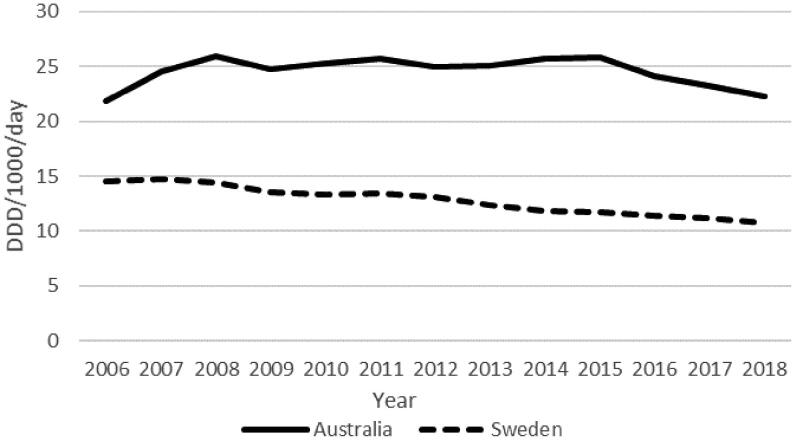
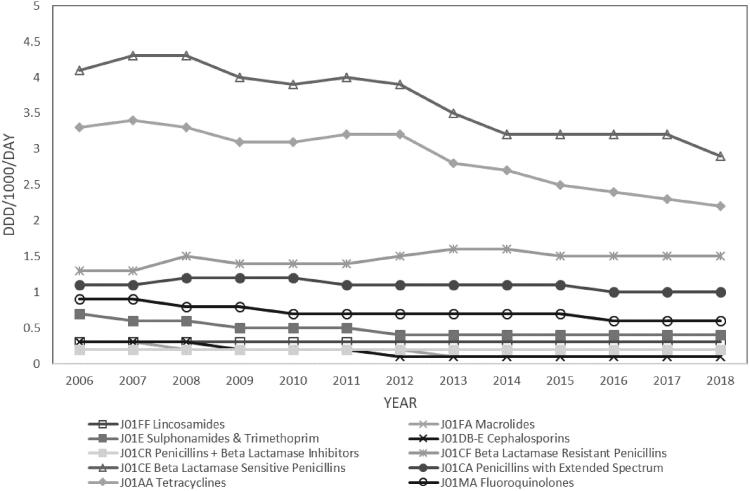
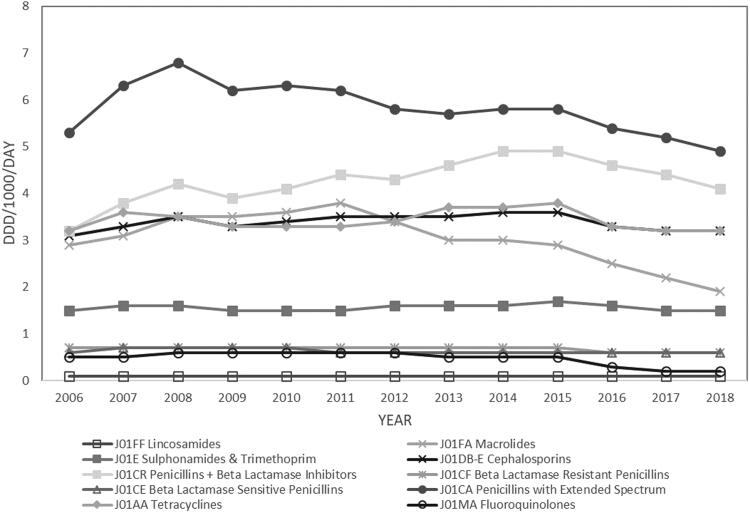
The use of antibiotics increased over the study period in Australia by 1.8% and decreased in Sweden by 26.3%. Use was consistently higher in Australia, double that of Sweden in 2018. Penicillin with extended spectrum was the most used class of antibiotics in Australia followed by penicillin with beta lactamase inhibitors. In Sweden, the most used class was beta lactamase-sensitive penicillin and the least used class was penicillin with beta lactamase inhibitors.
Antibiotic use in Australia is higher than in Sweden, with a higher proportion of broad-spectrum penicillin, including combinations with beta lactamase inhibitors, and cephalosporins. Factors that may contribute to these differences in antibiotic use include differences in guidelines, the duration of national antimicrobial stewardship programs, and differences in funding mechanisms.Key pointsAustralia has had a consistently higher dispensed use of antibiotics compared to Sweden from 2006 to 2018; and up to twice the use in 2018•A higher proportion of dispensed antibiotics in Australia were broad-spectrum penicillin, including combinations with beta lactamase inhibitors, and cefalosporins.•The most commonly used class of antibiotics in Australia is penicillin with extended spectrum, compared to beta lactamase sensitive penicillin in Sweden.•Use of macrolides, sulphonamides and trimethoprim, cephalosporins, penicillin with beta lactamase inhibitors and penicillin with extended spectrum was consistently higher in Australia, whereas in Sweden use of fluoroquinolones, lincosamides, beta lactamase-resistant penicillin and beta lactamase sensitive penicillin was higher.•The observed differences could be explained by antibiotic choice recommended in guidelines, prevalence of point-of-care testing, models of primary care funding, the presence and duration of national antimicrobial stewardship programmes, and cultural differences.
抗微生物药物耐药性是一个全球性的日益严重的问题,世界卫生组织认为这是对全球健康的最大威胁之一。通过比较澳大利亚和瑞典的抗生素使用模式,可以了解抗生素处方决定因素。
澳大利亚和瑞典 2006 年至 2018 年期间公开的抗生素配药使用的可用数据。使用的药物使用了每 1000 居民 1 天的定义日剂量(DDD/1000 天)和每 1000 居民的配药处方数量(处方/1000)来衡量。
在研究期间,澳大利亚的抗生素使用量增加了 1.8%,瑞典的抗生素使用量减少了 26.3%。澳大利亚的使用量一直较高,2018 年是瑞典的两倍。在澳大利亚,最常用的抗生素类别是具有广谱的青霉素,其次是具有β-内酰胺酶抑制剂的青霉素。在瑞典,最常用的抗生素类别是β-内酰胺酶敏感的青霉素,最不常用的类别是具有β-内酰胺酶抑制剂的青霉素。
与瑞典相比,澳大利亚的抗生素使用量较高,包括广谱青霉素(包括与β-内酰胺酶抑制剂的组合)和头孢菌素。导致这些抗生素使用差异的因素可能包括指南的差异、国家抗菌药物管理项目的持续时间以及供资机制的差异。
2006 年至 2018 年期间,与瑞典相比,澳大利亚的配药抗生素使用量一直较高;2018 年,澳大利亚的抗生素使用量是瑞典的两倍多。
在澳大利亚,配给的抗生素中更广泛使用的是广谱青霉素,包括与β-内酰胺酶抑制剂的组合和头孢菌素。
在澳大利亚,最常用的抗生素类别是具有扩展谱的青霉素,而在瑞典则是β-内酰胺酶敏感的青霉素。
在澳大利亚,大环内酯类、磺胺类和甲氧苄啶、头孢菌素、青霉素与β-内酰胺酶抑制剂和青霉素与扩展谱一直使用量较高,而在瑞典,氟喹诺酮类、林可酰胺类、β-内酰胺酶耐药青霉素和β-内酰胺酶敏感青霉素的使用量较高。
观察到的差异可以用指南中推荐的抗生素选择、即时检测的流行程度、初级保健供资模式、国家抗菌药物管理计划的存在和持续时间以及文化差异来解释。