Department of Pathology, Aarhus University Hospital, Aarhus, Denmark.
Department of Clinical Medicine, Aarhus University, Aarhus, Denmark.
Leukemia. 2023 Sep;37(9):1792-1801. doi: 10.1038/s41375-023-01950-9. Epub 2023 Jul 18.
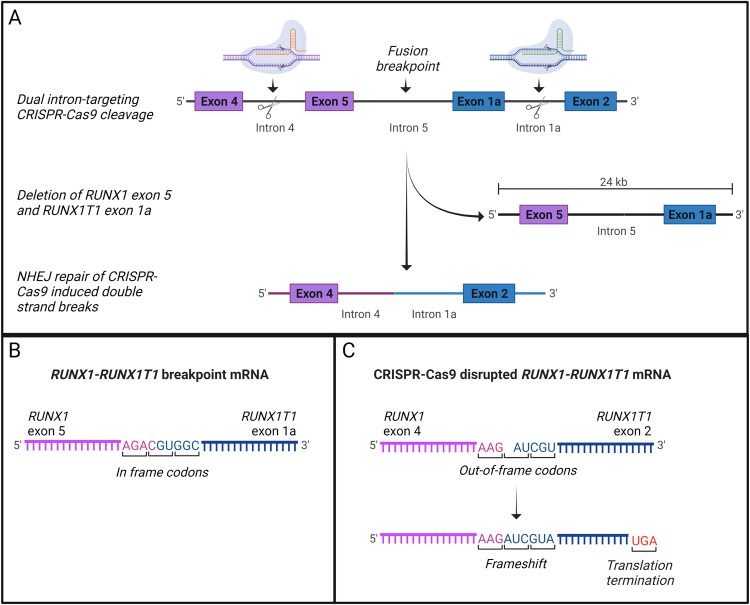
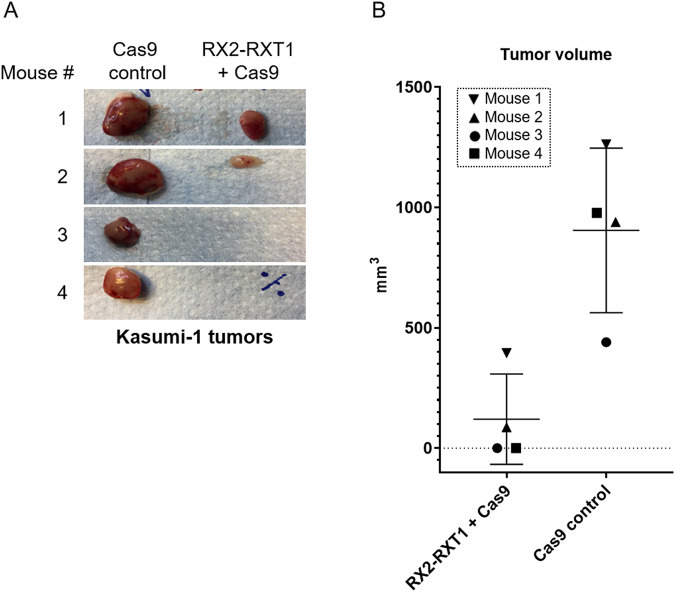
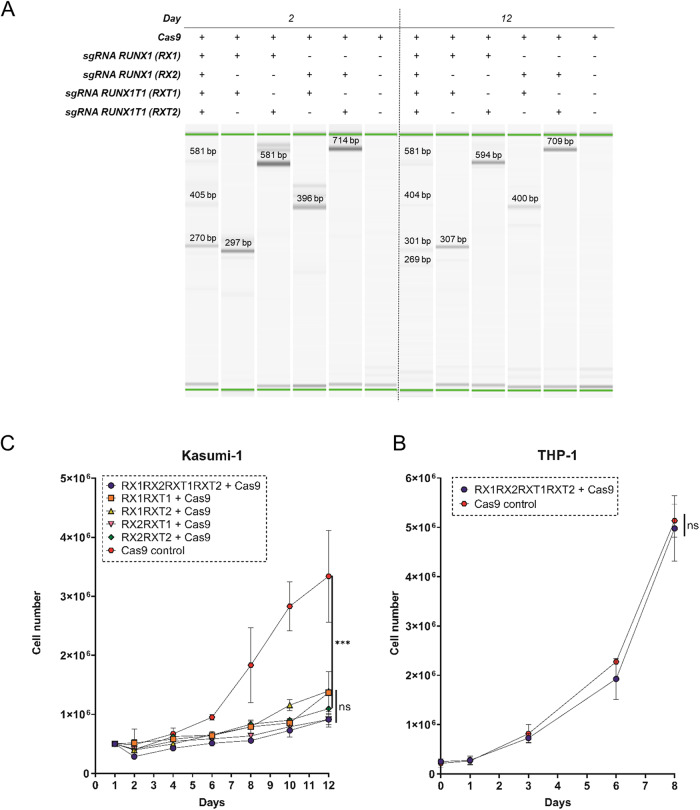
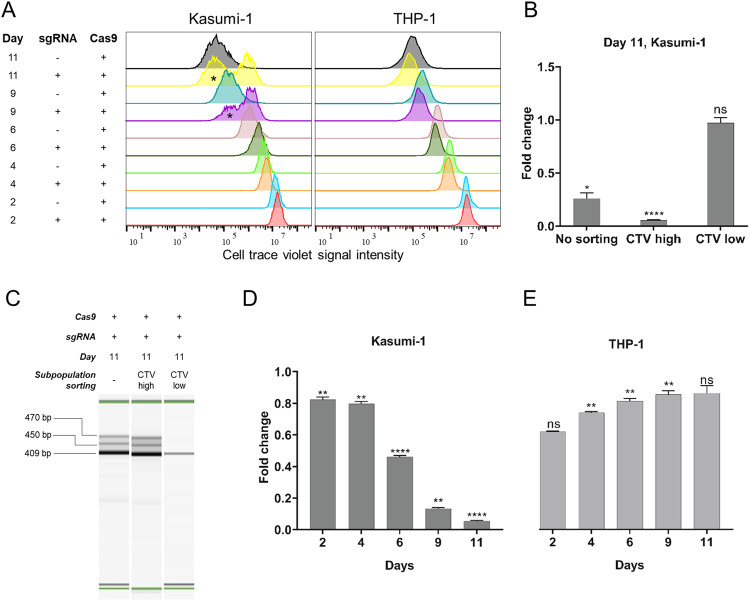
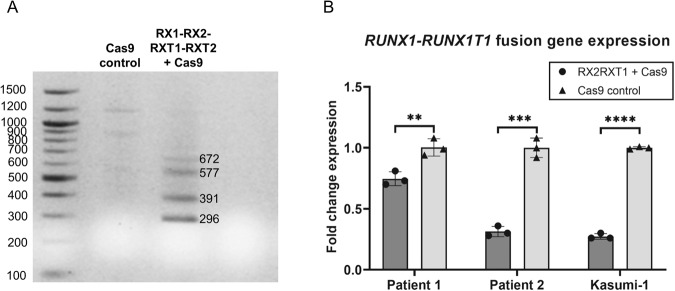
Oncogenic fusion drivers are common in hematological cancers and are thus relevant targets of future CRISPR-Cas9-based treatment strategies. However, breakpoint-location variation in patients pose a challenge to traditional breakpoint-targeting CRISPR-Cas9-mediated disruption strategies. Here we present a new dual intron-targeting CRISPR-Cas9 treatment strategy, for targeting t(8;21) found in 5-10% of de novo acute myeloid leukemia (AML), which efficiently disrupts fusion genes without prior identification of breakpoint location. We show in vitro growth rate and proliferation reduction by 69 and 94% in AML t(8;21) Kasumi-1 cells, following dual intron-targeted disruption of RUNX1-RUNX1T1 compared to a non t(8;21) AML control. Furthermore, mice injected with RUNX1-RUNX1T1-disrupted Kasumi-1 cells had in vivo tumor growth reduction by 69 and 91% compared to controls. Demonstrating the feasibility of RUNX1-RUNX1T1 disruption, these findings were substantiated in isolated primary cells from a patient diagnosed with AML t(8;21). In conclusion, we demonstrate proof-of-principle of a dual intron-targeting CRISPR-Cas9 treatment strategy in AML t(8;21) without need for precise knowledge of the breakpoint location.
致癌融合驱动基因在血液系统恶性肿瘤中很常见,因此是未来基于 CRISPR-Cas9 的治疗策略的相关靶点。然而,患者中的断点位置变化给传统的基于断点靶向的 CRISPR-Cas9 介导的破坏策略带来了挑战。在这里,我们提出了一种新的双内含子靶向 CRISPR-Cas9 治疗策略,用于靶向 5-10%新发急性髓系白血病(AML)中的 t(8;21),该策略无需预先确定断点位置即可有效破坏融合基因。我们在体外显示,与非 t(8;21)AML 对照相比,RUNX1-RUNX1T1 的双内含子靶向破坏使 AML t(8;21)Kasumi-1 细胞的生长速度和增殖减少了 69%和 94%。此外,与对照相比,注射 RUNX1-RUNX1T1 破坏的 Kasumi-1 细胞的小鼠体内肿瘤生长减少了 69%和 91%。这些发现证明了 RUNX1-RUNX1T1 破坏的可行性,并在从诊断为 AML t(8;21)的患者中分离的原始细胞中得到了证实。总之,我们证明了无需精确了解断点位置即可在 AML t(8;21)中进行双内含子靶向 CRISPR-Cas9 治疗策略的原理验证。