Bargiela Rafael, Korzhenkov Aleksei A, McIntosh Owen A, Toshchakov Stepan V, Yakimov Mikhail M, Golyshin Peter N, Golyshina Olga V
School of Natural Sciences and Centre for Environmental Biotechnology, Bangor University, Bangor, UK.
Kurchatov Center for Genome Research, NRC Kurchatov Institute, Moscow, Russia.
Environ Microbiome. 2023 Jul 18;18(1):61. doi: 10.1186/s40793-023-00518-5.
Archaea of the order Thermoplasmatales are widely distributed in natural acidic areas and are amongst the most acidophilic prokaryotic organisms known so far. These organisms are difficult to culture, with currently only six genera validly published since the discovery of Thermoplasma acidophilum in 1970. Moreover, known great diversity of uncultured Thermoplasmatales represents microbial dark matter and underlines the necessity of efforts in cultivation and study of these archaea. Organisms from the order Thermoplasmatales affiliated with the so-called "alphabet-plasmas", and collectively dubbed "E-plasma", were the focus of this study. These archaea were found predominantly in the hyperacidic site PM4 of Parys Mountain, Wales, UK, making up to 58% of total metagenomic reads. However, these archaea escaped all cultivation attempts.
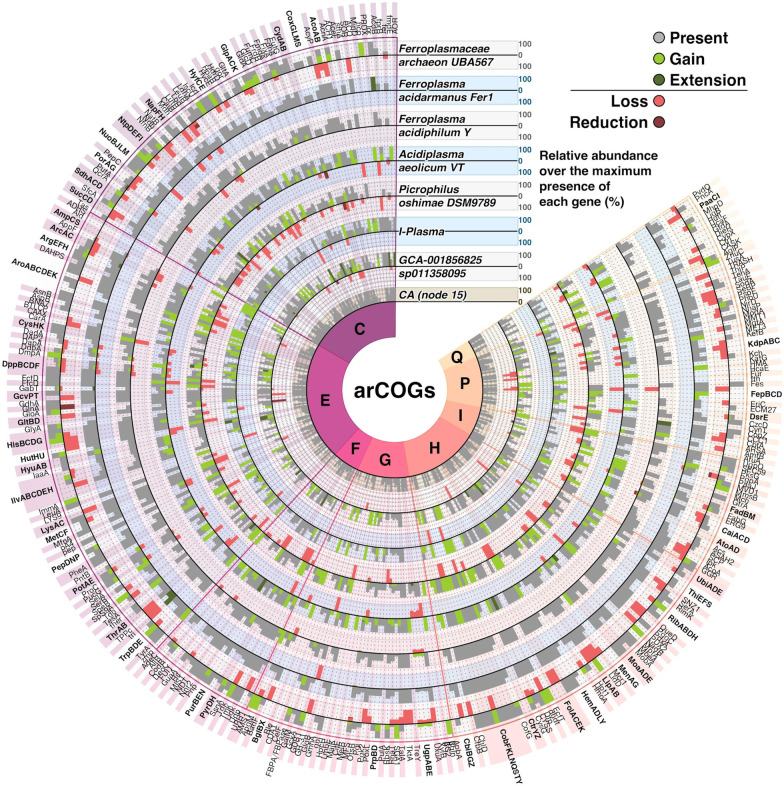
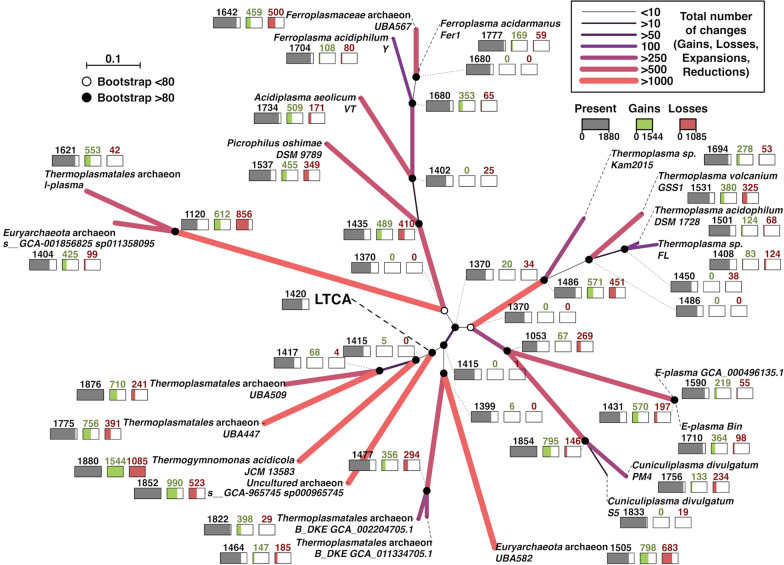
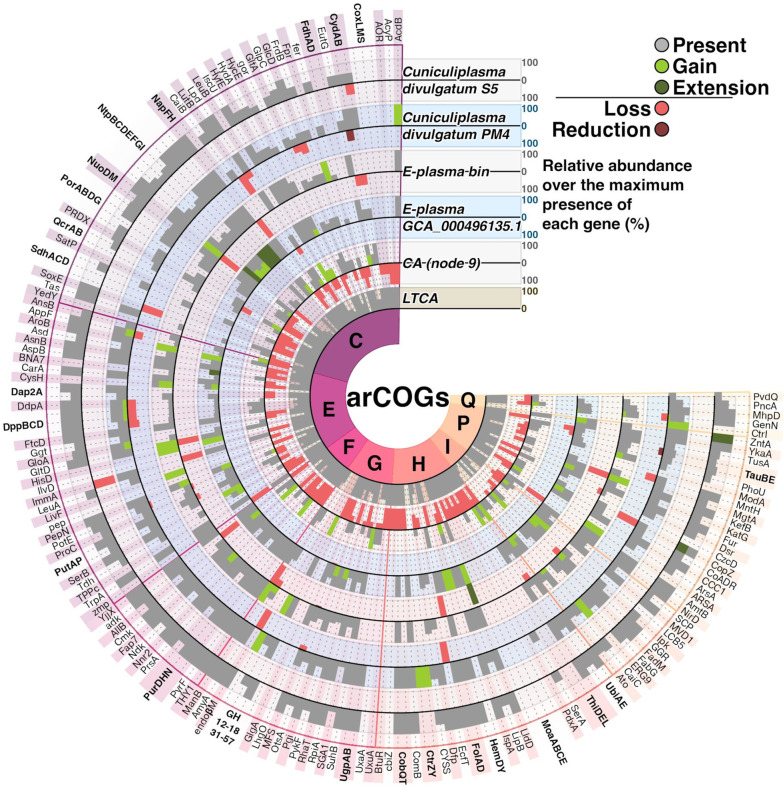
Their genome-based metabolism revealed its peptidolytic potential, in line with the physiology of the previously studied Thermoplasmatales isolates. Analyses of the genome and evolutionary history reconstruction have shown both the gain and loss of genes, that may have contributed to the success of the "E-plasma" in hyperacidic environment compared to their community neighbours. Notable genes among them are involved in the following molecular processes: signal transduction, stress response and glyoxylate shunt, as well as multiple copies of genes associated with various cellular functions; from energy production and conversion, replication, recombination, and repair, to cell wall/membrane/envelope biogenesis and archaella production. History events reconstruction shows that these genes, acquired by putative common ancestors, may determine the evolutionary and functional divergences of "E-plasma", which is much more developed than other representatives of the order Thermoplasmatales. In addition, the ancestral hereditary reconstruction strongly indicates the placement of Thermogymnomonas acidicola close to the root of the Thermoplasmatales.
This study has analysed the metagenome-assembled genome of "E-plasma", which denotes the basis of their predominance in Parys Mountain environmental microbiome, their global ubiquity, and points into the right direction of further cultivation attempts. The results suggest distinct evolutionary trajectories of organisms comprising the order Thermoplasmatales, which is important for the understanding of their evolution and lifestyle.
嗜热栖热菌目古菌广泛分布于天然酸性区域,是目前已知的嗜酸原核生物中嗜酸程度最高的一类。这些生物难以培养,自1970年嗜热栖热菌被发现以来,目前仅有六个属被有效发表。此外,已知未培养的嗜热栖热菌目具有丰富的多样性,这代表了微生物暗物质,并凸显了努力培养和研究这些古菌的必要性。隶属于所谓“字母等离子体”并统称为“E - 等离子体”的嗜热栖热菌目生物是本研究的重点。这些古菌主要发现于英国威尔士帕里斯山的超酸性位点PM4,占宏基因组读数总数的58%。然而,这些古菌的所有培养尝试均告失败。
基于基因组的代谢分析揭示了其蛋白水解潜力,这与先前研究的嗜热栖热菌目分离株的生理学特征一致。对基因组的分析和进化历史重建表明,基因既有获得也有丢失,这可能是“E - 等离子体”在超酸性环境中比其群落邻居更成功的原因。其中值得注意的基因参与以下分子过程:信号转导、应激反应和乙醛酸循环,以及与各种细胞功能相关的多个基因拷贝;从能量产生和转换、复制、重组和修复,到细胞壁/膜/包膜生物发生和鞭毛产生。历史事件重建表明,这些由假定的共同祖先获得的基因可能决定了“E - 等离子体”的进化和功能差异,“E - 等离子体”比嗜热栖热菌目的其他代表更为发达。此外,祖先遗传重建强烈表明嗜酸嗜热单胞菌位于嗜热栖热菌目根部附近。
本研究分析了“E - 等离子体”的宏基因组组装基因组,这表明了它们在帕里斯山环境微生物群落中占优势的基础、它们在全球的普遍存在,并为进一步的培养尝试指明了正确方向。结果表明,构成嗜热栖热菌目的生物具有不同的进化轨迹,这对于理解它们的进化和生活方式很重要。