Department of Orthopedics, Tongji Hospital, School of Medicine, Tongji University, Shanghai, 200065, China.
Department of Orthopedics, Karamay Central Hospital, Karamay, 834000, China.
J Orthop Surg Res. 2023 Jul 18;18(1):507. doi: 10.1186/s13018-023-04007-w.
This study explores the latest epidemiological characteristics of posterior malleolus fracture and compares the epidemiological differences of posterior malleolus fracture in different periods, regions, and adult age groups.
Clinical information of inpatients with posterior malleolus fracture in Shanghai Tongji Hospital and Karamay Central Hospital from January 2014 to February 2022 was reviewed and collected. The imaging data of patients were acquired using the Picture Archiving and Communication Systems. A statistical analysis was performed as to gender, current age, year of admission, injury mechanism, fracture type, and posterior malleolus fracture classification. Moreover, a comparative analysis was conducted on the injury mechanisms and morphological differences of posterior malleolus fracture at different periods, regions, and age groups.
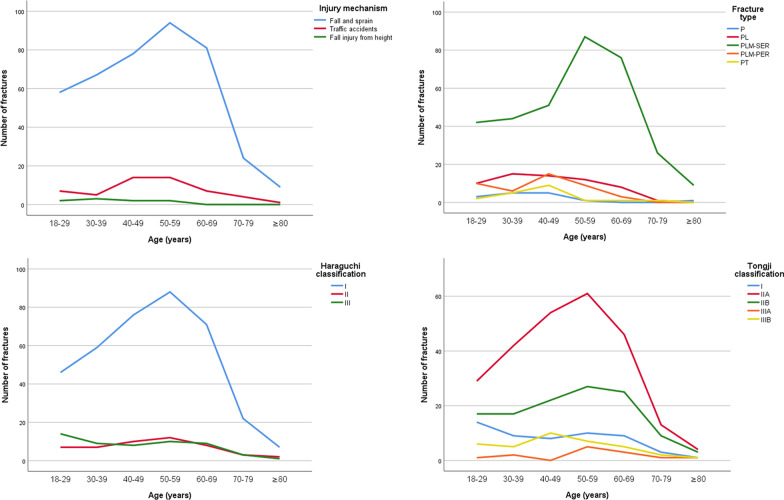
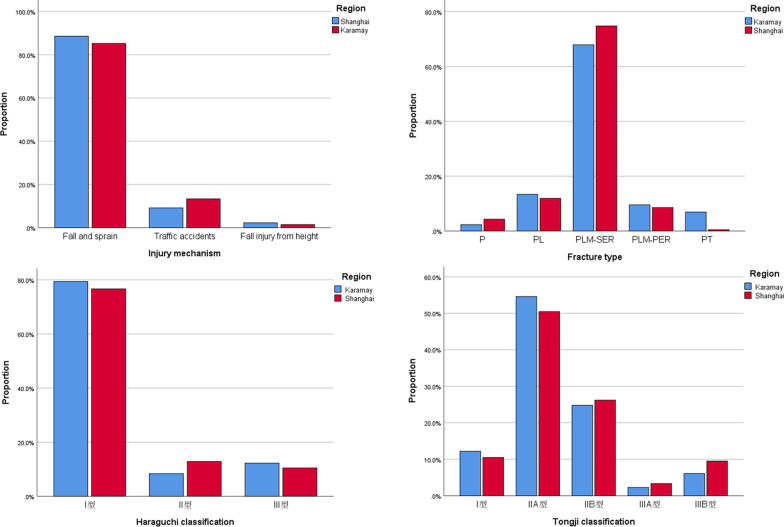
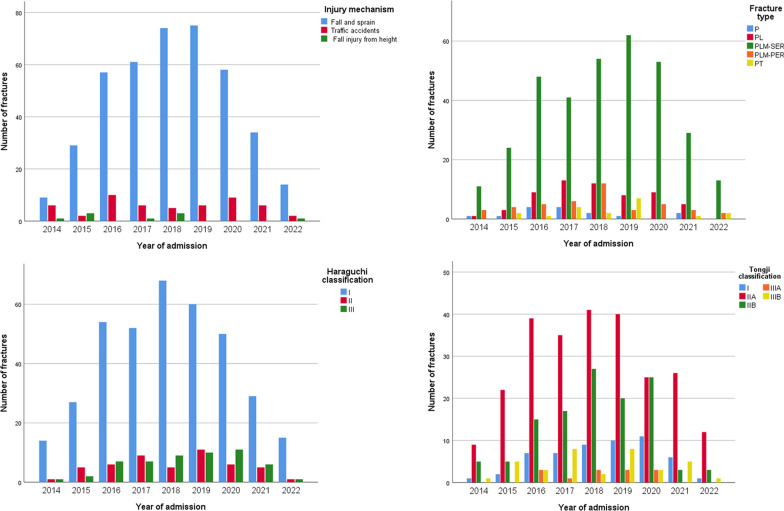
A total of 472 patients (210 patients from Shanghai Tongji Hospital and 262 patients from Karamay Central Hospital) with posterior malleolus fracture and an average age of 48.7 ± 15.6 were included in this study. The peak of posterior malleolus fracture occurs in the age group of 50-59. The injury mechanisms mainly involve low-energy fall and sprain (411 cases, 87.1%), followed by traffic accidents (52 cases, 11.0%), and fall injury from height (9 cases, 1.9%). With aging, the number of fall and sprain cases increases and reaches the peak at the age of 50-59, followed by progressive decline. Traffic accidents presents a relatively flat small peak in the age group of 40-59. The number of cases according to different fracture types shows the following ascending order: trimalleolar fracture-supination external rotation (335 cases, 71.0%) > bimalleolar fracture (60 cases, 12.7%) > trimalleolar fracture-pronation extorsion (43 cases, 9.1%) > posterior malleolus + tibial shaft fracture (19 cases, 4.0%) > simple posterior malleolus fracture (15 cases, 3.2%). The numbers of cases corresponding to the Haraguchi I Type, II Type, and III Type of posterior malleolus fractures were 369 (78.2%), 49 (10.4%), and 54 (11.4%), respectively. The Tongji IIA Type represented the highest number of cases (249 cases, 52.8%), followed by the IIB Type (120 cases, 25.4%), I Type (54 cases, 11.4%), IIIB Type (36 cases, 7.6%), and IIIA type (13 cases, 2.8%). The trimalleolar fracture-supination external rotation, Haraguchi I Type and Tongji IIA Type of posterior malleolus fractures all presented an obvious peak of incidence in the age group of 50-59. However, no obvious statistical difference was observed in the injury mechanism, Haraguchi classification, and Tongji classification of posterior malleolus fractures among different years and regions in recent years (P > 0.05).
The injury mechanism of posterior malleolus fracture mainly involves low-energy fall and sprain cases. The trimalleolar fracture-supination external rotation, Haraguchi I type and Tongji IIA type of posterior malleolus fracture are predilection fracture types, and all present an obvious incidence peak in the age group of 50-59. Elderly patients have high risks of falling and their bones are more fragile, conditions which are potential risk factors of posterior malleolus fracture. Early positive control has important significance. This study provides references for relevant basic and clinical studies of posterior malleolus fracture.
本研究探讨了后踝骨折的最新流行病学特征,并比较了不同时期、不同地区和不同成年年龄组后踝骨折的流行病学差异。
回顾性分析 2014 年 1 月至 2022 年 2 月上海同济大学医院和克拉玛依中心医院住院的后踝骨折患者的临床资料,使用影像存档与通信系统获取患者的影像学资料。对性别、当前年龄、入院年份、损伤机制、骨折类型和后踝骨折分类进行统计分析。此外,还对不同时期、不同地区和不同年龄组后踝骨折的损伤机制和形态学差异进行了对比分析。
本研究共纳入 472 例(上海同济大学医院 210 例,克拉玛依中心医院 262 例)后踝骨折患者,平均年龄为 48.7±15.6 岁。后踝骨折的发病高峰在 50-59 岁年龄组。损伤机制主要涉及低能量跌倒和扭伤(411 例,87.1%),其次是交通事故(52 例,11.0%)和高处坠落伤(9 例,1.9%)。随着年龄的增长,跌倒和扭伤的病例数逐渐增加,并在 50-59 岁年龄组达到高峰,随后逐渐下降。交通事故在 40-59 岁年龄组呈现出相对平坦的小高峰。根据不同骨折类型的病例数呈以下递增顺序:三踝骨折-旋后外旋(335 例,71.0%)>双踝骨折(60 例,12.7%)>三踝骨折-旋前外展(43 例,9.1%)>后踝+胫骨骨干骨折(19 例,4.0%)>单纯后踝骨折(15 例,3.2%)。Haraguchi Ⅰ型、Ⅱ型和Ⅲ型后踝骨折的病例数分别为 369 例(78.2%)、49 例(10.4%)和 54 例(11.4%)。TongjiⅡA型的病例数最多(249 例,52.8%),其次是 TongjiⅡB 型(120 例,25.4%)、Ⅰ型(54 例,11.4%)、ⅢB 型(36 例,7.6%)和 ⅢA型(13 例,2.8%)。三踝骨折-旋后外旋、Haraguchi Ⅰ型和 TongjiⅡA型后踝骨折在 50-59 岁年龄组的发病率均明显升高。然而,近年来不同年份和地区后踝骨折的损伤机制、Haraguchi 分类和 Tongji 分类在统计学上均无明显差异(P>0.05)。
后踝骨折的损伤机制主要涉及低能量跌倒和扭伤病例。三踝骨折-旋后外旋、Haraguchi Ⅰ型和 TongjiⅡA型后踝骨折是偏好性骨折类型,在 50-59 岁年龄组均有明显的发病率高峰。老年患者跌倒风险较高,骨骼较脆弱,这些都是后踝骨折的潜在危险因素。早期积极控制具有重要意义。本研究为后踝骨折的相关基础和临床研究提供了参考。