Department of Nutritional Care and Counseling, University of Gondar Specialized Hospital, Gondar, Ethiopia.
Department of Reproductive Health, College of Medicine and Health Sciences, Institute of Public Health, University of Gondar, Gondar, Ethiopia.
Front Public Health. 2023 Jul 3;11:1124173. doi: 10.3389/fpubh.2023.1124173. eCollection 2023.
Undernutrition is a major public health concern affecting the health, growth, development, and academic performance of adolescents studying in school. During this crucial period, dietary patterns have a vital impact on lifetime nutritional status and health. The problem of undernutrition among particular groups of adolescents attending traditional schools has not previously been studied. Therefore, this study aimed to assess the prevalence of undernutrition and associated factors among adolescents aged 10-19 years attending Orthodox Church schools in northwest Ethiopia.
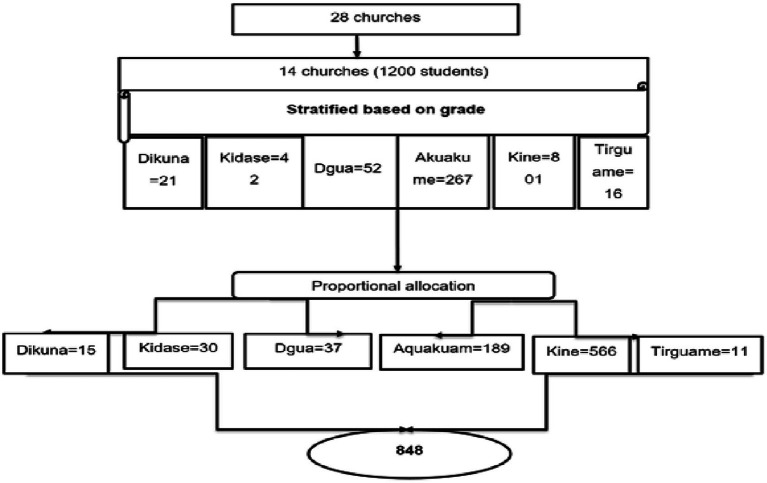
An institution-based, cross-sectional study design was employed, with data collected from March 1 to 30, 2021. A simple random sampling technique was used to recruit a total of 848 male attendees of traditional schools. Data were collected via an interviewer-administered semi-structured questionnaire. The nutritional status of participants was assessed using anthropometric measurements. The WHO Anthroplus software was used for analysis. Both bivariable and multivariable logistic regression analyses were conducted to identify the factors associated with nutritional status. The degree of association between the independent variables and the dependent variable was assessed using odds ratios, reported with 95% confidence intervals, and a threshold of ≤ 0.05.
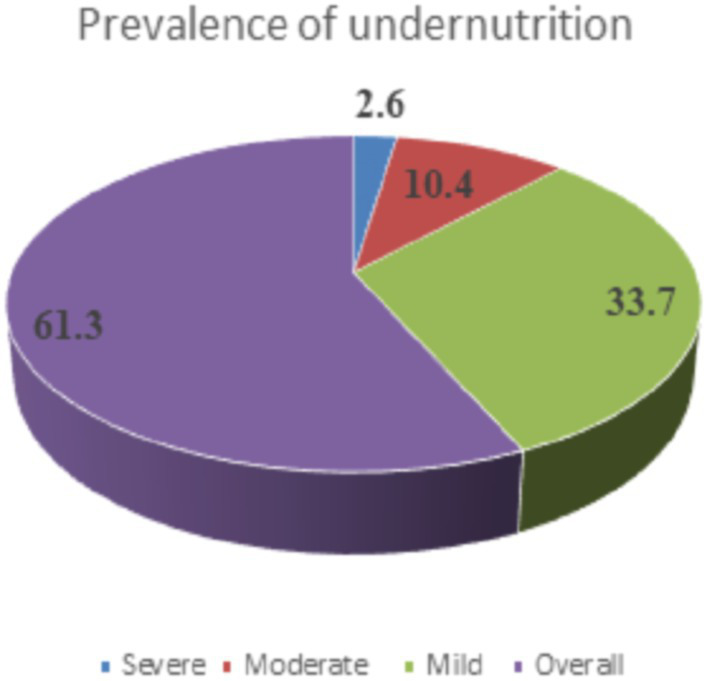
The prevalence of undernutrition was found to be 61.3% [95% CI: 58.1, 64.6]. The likelihood of developing undernutrition was elevated among those adolescents who were following the traditional school levels of (AOR = 4.3, 95% CI = 1.3, 13.6), (AOR = 4.5, 95% CI = 1.4, 14.6), (AOR = 9.9, 95% CI = 2.5, 39.88), (AOR = 6.4, 95% CI = 1.6, 25.6), and among those whose mothers had no formal education [AOR = 3.7, 95% CI: 1.2, 12.8]. In contrast, those adolescents who always washed their hands after a toilet visit had lower odds of undernutrition than their counterparts [AOR = 0.7, 95%CI: 0.5, 0.98].
More than three out of five participating male adolescents were undernourished. Thus, to improve the nutritional status of adolescents studying in traditional church schools, extensive health education for these adolescents is essential. Moreover, the establishment of well-resourced traditional religious school, equipped for the provision of an adequate, diversified diet, is important. Developing the habit of handwashing after visiting the toilet and before and after food preparation is also recommended for adolescent students.
营养不良是一个主要的公共卫生问题,影响着青少年的健康、生长、发育和学业成绩。在这个关键时期,饮食模式对终生营养状况和健康有着至关重要的影响。之前并没有研究过传统学校中特定群体青少年的营养不良问题。因此,本研究旨在评估在埃塞俄比亚西北部的正统教会学校就读的 10-19 岁青少年的营养不良发生率和相关因素。
采用基于机构的横断面研究设计,于 2021 年 3 月 1 日至 30 日期间收集数据。采用简单随机抽样技术招募了总共 848 名传统学校的男性参与者。通过访谈者管理的半结构式问卷收集数据。使用人体测量学测量来评估参与者的营养状况。使用 WHO Anthroplus 软件进行分析。进行了单变量和多变量逻辑回归分析,以确定与营养状况相关的因素。使用比值比(OR)评估独立变量与因变量之间的关联程度,报告 95%置信区间,临界值为≤0.05。
营养不良的发生率为 61.3%(95%CI:58.1,64.6)。那些正在接受传统学校 (AOR=4.3,95%CI=1.3,13.6)、 (AOR=4.5,95%CI=1.4,14.6)、 (AOR=9.9,95%CI=2.5,39.88)、 (AOR=6.4,95%CI=1.6,25.6)水平教育的青少年,以及那些母亲没有接受正规教育的青少年(AOR=3.7,95%CI:1.2,12.8),更容易出现营养不良。相比之下,那些经常在如厕后洗手的青少年出现营养不良的可能性低于他们的同龄人(AOR=0.7,95%CI:0.5,0.98)。
超过五分之三的参与男性青少年存在营养不良。因此,为了改善传统教会学校学生的营养状况,需要对这些青少年进行广泛的健康教育。此外,建立资源充足的传统宗教学校,提供充足、多样化的饮食也很重要。建议青少年学生养成在如厕后、准备食物前后洗手的习惯。