Ali Mohammed Sied, Kassahun Chanyalew Worku, Wubneh Chalachew Adugna
Department of Pediatrics and Child Health Nursing, School of Nursing, College of Medicine and Health Sciences, University of Gondar, Gondar, Ethiopia.
Department of Comprehensive Nursing, College of Medicine and Health Sciences, University of Gondar, Gondar, Ethiopia.
J Nutr Metab. 2020 Oct 1;2020:3670895. doi: 10.1155/2020/3670895. eCollection 2020.
Childhood overnutrition is a public health problem in low- and middle-income countries because its effect is likely to progress into adulthood that results in developing noncommunicable diseases at a younger age. There is no such previous comparative study that investigated this issue. Therefore, the aim of this study is to assess the prevalence and associated factors of overnutrition among government and private primary school students in Gondar town, northwest Ethiopia.
Institution-based comparative cross-sectional study was conducted from March 5 to April 9, 2019. A multistage sampling technique was used to select 736 participants. Data were collected through face-to-face interview. Data was entered into EPI-info version 7.2.1.0 and exported to SPSS version 20 for analysis. Bivariable and multivariable logistic regressions were carried out to identify associated factors with overnutrition. Statistical significance was declared using value< 0.05.
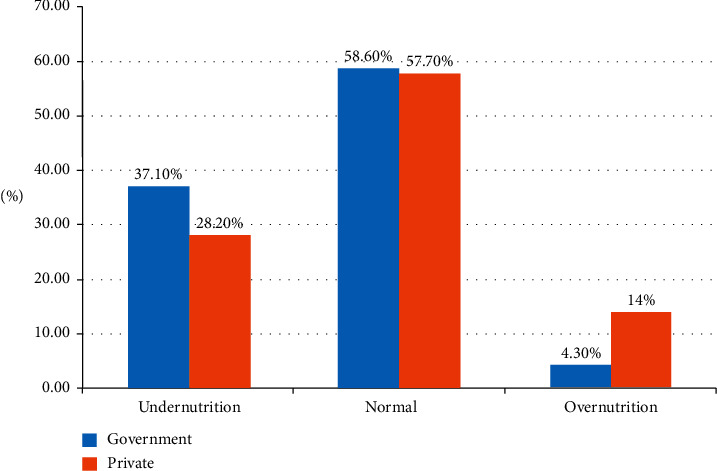
The overall prevalence of overnutrition was 9.1%. The prevalence was higher among private schools (51 (14%)) than government (16 (4.3%)). Eating habit while watching television (AOR = 4.08, 95%CI: 1.10-15.16) and not having close friend (AOR = 3.72, 95%: CI: 1.21-2 11.48) were significantly associated with overnutrition in the government schools, while no father education (AOR = 2.59, 95%:CI:1.05-6.39), sweet food preference (AOR = 2.86, 95%:1.19-6.87), fat consumption more than three days per week (AOR = 3.79, 95%CI:1.61-8.91), eating habit while reading (AOR = 4.95, 95%CI:2.29-10.70), and vigorous-intensity sports (AOR = 2.23, 95%:1.02-4.86) were associated with overnutrition in private schools.
Prevalence of overnutrition was higher among private than government schools. Hence, it requires attention through creating awareness about healthy diet, healthy lifestyle, and physical activity in collaboration with health and education sectors.
儿童营养过剩在低收入和中等收入国家是一个公共卫生问题,因为其影响可能会延续至成年,导致在更年轻的年龄患上非传染性疾病。此前没有比较研究调查过这个问题。因此,本研究的目的是评估埃塞俄比亚西北部贡德尔镇公立和私立小学学生营养过剩的患病率及相关因素。
2019年3月5日至4月9日进行了基于机构的比较横断面研究。采用多阶段抽样技术选取736名参与者。通过面对面访谈收集数据。数据录入EPI - info 7.2.1.0版本,并导出到SPSS 20版本进行分析。进行双变量和多变量逻辑回归以确定与营养过剩相关的因素。使用P值<0.05表示统计学显著性。
营养过剩的总体患病率为9.1%。私立学校的患病率(51例(14%))高于公立学校(16例(4.3%))。在公立学校,边看电视边吃东西(比值比[AOR]=4.08,95%置信区间[CI]:1.10 - 15.16)和没有亲密朋友(AOR = 3.72,95%CI:1.21 - 11.48)与营养过剩显著相关;而在私立学校,父亲未接受教育(AOR = 2.59,95%CI:1.05 - 6.39)、偏爱甜食(AOR = 2.86,95%CI:1.19 - 6.87)、每周食用脂肪类食物超过三天(AOR = 3.79,95%CI:1.61 - 8.91)、边读书边吃东西(AOR = 4.95,95%CI:2.29 - 10.70)以及剧烈强度运动(AOR = 2.23,95%CI:1.02 - 4.86)与营养过剩相关。
私立学校营养过剩的患病率高于公立学校。因此,需要与卫生和教育部门合作,通过提高对健康饮食、健康生活方式和体育活动的认识来加以关注。