Vargas Duarte Prado, Reggiori Fulvio
Department of Biomedicine, Aarhus University, Aarhus C, Denmark.
Aarhus Institute of Advanced Studies (AIAS), Aarhus University, Aarhus C, Denmark.
Contact (Thousand Oaks). 2023 Jul 12;6:25152564231183898. doi: 10.1177/25152564231183898. eCollection 2023 Jan-Dec.
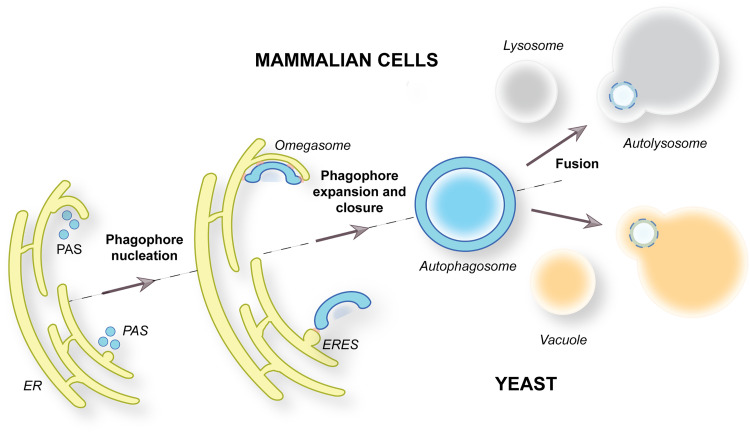
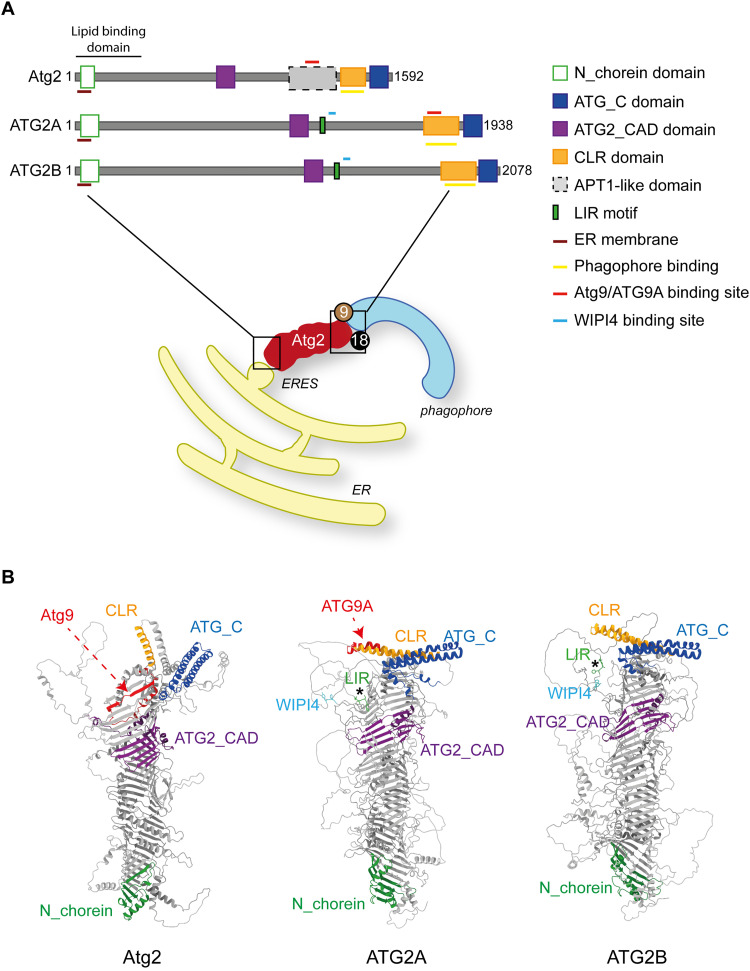
Macroautophagy is characterized by the formation of double-membrane vesicles termed autophagosomes. The precursor structure of autophagosomes is a membrane cistern called phagophore, which elongates through a massive acquisition of lipids until closure. The phagophore establishes membrane-contact sites (MCSs) with the endoplasmic reticulum (ER), where conserved ATG proteins belonging to the ATG9 lipid scramblase, ATG2 lipid transfer and Atg18/WIPI4 β-propeller families concentrate. Several recent and studies have uncovered the relevance of these proteins and MCSs in the lipid supply required for autophagosome formation. Although important conceptual advances have been reached, the functional interrelationship between ATG9, ATG2 and Atg18/WIPI4 proteins at the phagophore-ER MCSs and their role in the phagophore expansion are not completely understood. In this review, we describe the current knowledge about the structure, interactions, localizations, and molecular functions of these proteins, with a particular emphasis on the yeast and mammalian systems.
巨自噬的特征是形成称为自噬体的双膜囊泡。自噬体的前体结构是一种称为吞噬泡的膜池,它通过大量获取脂质而延长直至封闭。吞噬泡与内质网(ER)建立膜接触位点(MCSs),属于ATG9脂质翻转酶、ATG2脂质转移和Atg18/WIPI4β-螺旋桨家族的保守ATG蛋白在那里聚集。最近的一些研究已经揭示了这些蛋白质和MCSs在自噬体形成所需的脂质供应中的相关性。尽管已经取得了重要的概念进展,但吞噬泡-内质网MCSs处的ATG9、ATG2和Atg18/WIPI4蛋白之间的功能相互关系及其在吞噬泡扩展中的作用尚未完全了解。在这篇综述中,我们描述了关于这些蛋白质的结构、相互作用、定位和分子功能的当前知识,特别强调酵母和哺乳动物系统。