Krieger Julie Fregerslev, Kristensen Ellids, Marquardsen Mikkel, Ofer Shlomy, Mortensen Erik Lykke, Giraldi Annamaria
Sexological Clinic, Mental Health Centre Copenhagen, Mental Health Services - Capital Region of Denmark 2200, Denmark.
Department of Clinical Medicine, University of Copenhagen, Copenhagen 2200, Denmark.
Sex Med. 2023 Jul 14;11(3):qfad033. doi: 10.1093/sexmed/qfad033. eCollection 2023 Jun.
Mindfulness facets can be trained with structured mindfulness interventions, but little is known regarding application on a broader level within sex therapy (e.g. men, partners and different sexual dysfunctions).
To evaluate the feasibility and preliminary efficacy of an 8-week intervention-specifically, mindfulness for sex and intimacy in relationships (MSIR)-as a supplement to treatment as usual (TAU) as compared with only TAU in a clinical sample of men and women referred for sexual difficulties with or without a partner.
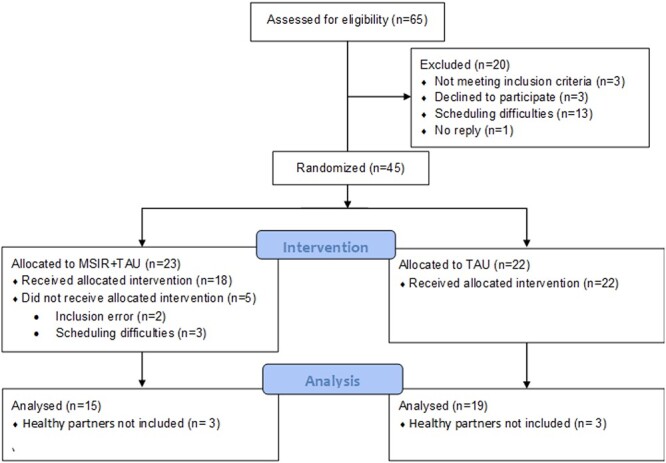
In this randomized controlled feasibility pilot study, 34 participants were randomized to MSIR + TAU (n = 15) or TAU (n = 19). Six healthy partners were also included in the study. MSIR was administered as 2 individual evaluations and six 2-hour group sessions of mixed gender and different types of sexual dysfunction.
The primary outcome measures were as follows: (1) feasibility, defined as the implementation of recruitment, acceptance, and attendance of intervention in daily clinical practice and the MSIR completion rate; (2) sexual functioning, as measured on a visual analog scale ("bothered by problem") and by validated questionnaires (Changes in Sexual Function Questionnaire for Females and Males, Female Sexual Function Index, Female Sexual Distress Scale, International Index of Erectile Function).
MSIR was feasible and well received by patients, with high rates of acceptance and intervention completion. As compared with pretreatment, the MSIR + TAU group and TAU control group were significantly less bothered by their sexual problems at the end of treatment, but the change was significantly larger in the MSIR + TAU group ( = .04). Participants in the MSIR + TAU group did not receive fewer TAU sessions than the TAU group (MSIR + TAU mean, 6 sessions; TAU mean, 8 sessions).
MSIR could be effectively used in a clinical setting as an add-on to TAU in the treatment of female and male sexual dysfunction and healthy partners.
The major strength of the study is that it is a randomized controlled study. This study is novel in the sense that it included men and women with different types of sexual dysfunction in the same mindfulness group. Limitations include the pilot nature of the study (e.g. a small sample size), and statistical conclusions should be made with caution. More accurate results may be found in a larger sample.
Results from this study support already existing evidence that mindfulness-based interventions are feasible and effective for targeting sexual dysfunctions in men and women.
正念的各个方面可以通过结构化的正念干预进行训练,但对于其在性治疗更广泛层面上的应用(例如男性、伴侣以及不同的性功能障碍)知之甚少。
评估一项为期8周的特定干预措施——关系中的性与亲密正念训练(MSIR)——作为常规治疗(TAU)补充的可行性和初步疗效,并将其与仅接受TAU治疗的情况进行比较,研究对象为因性问题前来就诊的有或没有伴侣的男性和女性临床样本。
在这项随机对照可行性试点研究中,34名参与者被随机分为MSIR + TAU组(n = 15)或TAU组(n = 19)。研究还纳入了6名健康伴侣。MSIR包括2次个体评估和6次为期2小时的混合性别、针对不同类型性功能障碍的小组课程。
主要结果指标如下:(1)可行性,定义为在日常临床实践中招募、接受干预和出勤情况以及MSIR完成率;(2)性功能,通过视觉模拟量表(“受问题困扰程度”)和经过验证的问卷(《女性和男性性功能变化问卷》《女性性功能指数》《女性性困扰量表》《国际勃起功能指数》)进行测量。
MSIR是可行的,且受到患者的好评,接受率和干预完成率都很高。与治疗前相比,MSIR + TAU组和TAU对照组在治疗结束时性问题的困扰程度均显著降低,但MSIR + TAU组的变化更为显著(P = 0.04)。MSIR + TAU组接受的TAU治疗次数并不比TAU组少(MSIR + TAU组平均为6次;TAU组平均为8次)。
MSIR可在临床环境中有效地作为TAU的补充,用于治疗男性和女性性功能障碍以及健康伴侣。
该研究的主要优点是它是一项随机对照研究。这项研究的新颖之处在于,它将患有不同类型性功能障碍的男性和女性纳入了同一个正念小组。局限性包括研究的试点性质(例如样本量小),统计结论应谨慎得出。在更大的样本中可能会得到更准确的结果。
本研究结果支持了现有的证据,即基于正念的干预措施对于针对男性和女性的性功能障碍是可行且有效的。