Morris Victoria L, Mendoza Carolina, Stevens Gowri S, Wilson Jessica L, Kosoko Adeola A
University of Texas Health Sciences Center at Houston, Department of Emergency Medicine, Houston, TX.
J Educ Teach Emerg Med. 2023 Apr 30;8(2):S1-S34. doi: 10.21980/J8ZS9M. eCollection 2023 Apr.
This simulation is appropriate for emergency medicine (EM) residents of all levels.
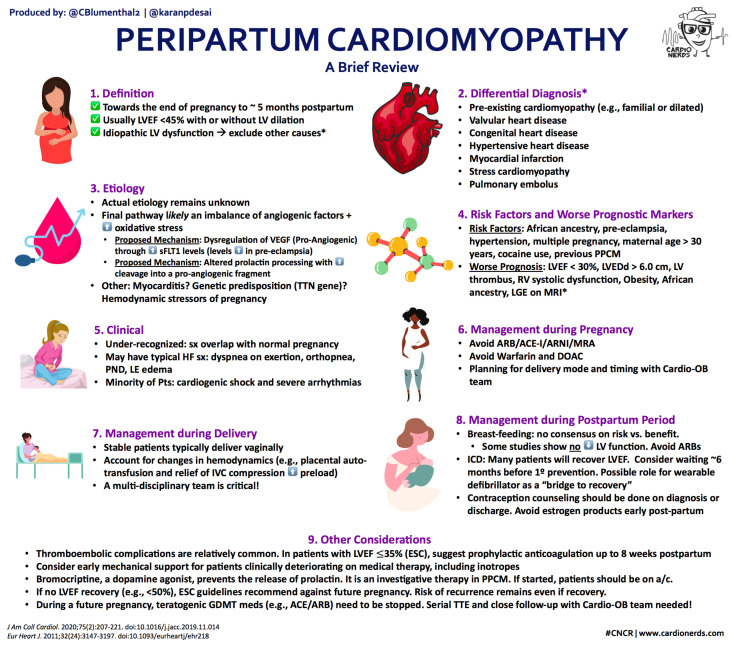
Peripartum cardiomyopathy (PPCM) is a rare, idiopathic condition that occurs in the mother around the time of childbirth. Heart failure with reduced ejection fraction and/or reduced systolic function diagnosed in patients during the last month of pregnancy or up to five months following delivery defines PCCM.1 Another broader definition from the European Society of Cardiology defines PPCM as heart failure that occurs "towards the end of pregnancy or in the months following delivery, where no other cause of heart failure is found."2 Though PPCM occurs worldwide, most data is extracted from the United States (incidence 1:900 to 1:4000 live births), Nigeria, Haiti, and South Africa.3,4Risk factors for PPCM include pre-eclampsia, multiparity, and advanced maternal age. Unfortunately, the complete pathophysiology of PPCM remains unclear. However, it is important for emergency physicians to be aware of this rare diagnosis because though 50-80% of women with PPCM may eventually recover normal left ventricle systolic function,5 positive outcomes depend on timely recognition of PPCM as a disease and the appropriate management of heart failure. Symptomatic PPCM is an emergent condition that requires an attentive and knowledgeable emergency medicine physician for rapid recognition and treatment. A simulation of this rare condition can give residents the experience of identifying and managing this disease that they might not otherwise see personally during their training.
By the end of this simulation session, learners will be able to: 1) initiate a workup of a pregnant patient who presents with syncope, 2) accurately diagnose peripartum cardiomyopathy, 3) demonstrate care of a gravid patient in respiratory distress due to peripartum cardiomyopathy, 4) appropriately manage cardiogenic shock due to peripartum cardiomyopathy.
This simulation was conducted as a high-fidelity medical simulation case followed by a debriefing. It could potentially be adapted for use as a low-fidelity case or an oral boards exam case.
The educational content and clinical applicability of this simulation was evaluated by oral and written feedback from participant groups at a large three-year emergency medicine residency training program. Each participant completed the case and the facilitated debriefing afterwards. Case facilitators also provided their personal observations on the implementation of the simulation.
The participants gave the simulation positive feedback (n=18). Seventeen EM residents and one pediatric emergency medicine (PEM) fellow participated in the feedback survey. Learners overall agreed (18.75%) or strongly agreed (81.25%) that participating in this simulation would improve their performance in a live clinical setting.
Peripartum cardiomyopathy is a low frequency, high acuity illness that requires a synthesis of the learner's knowledge of complex physiology, navigation of logistical and systems-based challenges, and advanced communication and leadership skills to ensure the best possible patient outcome. All EM physicians will be expected to expertly manage this illness after completion of an EM training program, yet not every EM resident will encounter this type of patient during training. Supplementing the EM resident's standard training with this simulation experience provides a psychologically and educationally safe space to learn and possibly make mistakes without causing patient harm. Practically all residents were able to correctly diagnose the patient with a cardiomyopathy even if they were not familiar with the diagnosis of "peripartum cardiomyopathy." The residents particularly enjoyed the case to explore concepts of benefits and risks of medical therapeutics (ie, positive pressure ventilation, vasopressors/inotropes) and safe practice for the gravid patient. This case and the associated high yield debriefing session were effective teaching tools for emergency medicine residents about PPCM.
Medical simulation, peripartum cardiomyopathy, pregnancy, respiratory failure, cardiogenic shock, emergent cesarian section.
该模拟适用于各级急诊医学(EM)住院医师。
围产期心肌病(PPCM)是一种罕见的特发性疾病,发生在产妇分娩前后。在妊娠最后一个月或分娩后长达五个月内被诊断为射血分数降低和/或收缩功能降低的心力衰竭定义为PCCM。1欧洲心脏病学会的另一个更广泛的定义将PPCM定义为“在妊娠末期或分娩后的几个月内发生的心力衰竭,且未发现其他心力衰竭原因”。2尽管PPCM在全球范围内都有发生,但大多数数据来自美国(发病率为1:900至1:4000活产)、尼日利亚、海地和南非。3,4PPCM的危险因素包括先兆子痫、多胎妊娠和高龄产妇。不幸的是,PPCM的完整病理生理学仍不清楚。然而,对于急诊医生来说,了解这种罕见的诊断很重要,因为尽管50-80%的PPCM女性最终可能恢复正常的左心室收缩功能,5但积极的结果取决于及时将PPCM识别为一种疾病并对心力衰竭进行适当管理。有症状的PPCM是一种紧急情况,需要一位细心且知识渊博的急诊医生进行快速识别和治疗。对这种罕见疾病的模拟可以让住院医师获得识别和管理这种疾病的经验,而他们在培训期间可能无法亲自见到这种疾病。
在本次模拟课程结束时,学习者将能够:1)对出现晕厥的孕妇进行检查,2)准确诊断围产期心肌病,3)展示对因围产期心肌病而出现呼吸窘迫的孕妇的护理,4)适当管理因围产期心肌病导致的心源性休克。
本次模拟作为一个高保真医学模拟病例进行,随后进行总结汇报。它有可能被改编为低保真病例或口试病例。
通过一个为期三年的大型急诊医学住院医师培训项目中参与者小组的口头和书面反馈,对该模拟的教育内容和临床适用性进行了评估。每位参与者完成病例并随后参加总结汇报。病例引导者也提供了他们对模拟实施的个人观察。
参与者对模拟给予了积极反馈(n = 18)。17名急诊医学住院医师和1名儿科急诊医学(PEM)专科医生参与了反馈调查。学习者总体上同意(18.75%)或强烈同意(81.25%)参加该模拟将提高他们在实际临床环境中的表现。
围产期心肌病是一种低频、高急症的疾病,需要综合学习者对复杂生理学的知识、应对后勤和基于系统的挑战以及具备先进的沟通和领导技能,以确保获得最佳的患者治疗结果。所有急诊医学医生在完成急诊医学培训项目后都应能够熟练管理这种疾病,但并非每个急诊医学住院医师在培训期间都会遇到这种类型的患者。用这种模拟经验补充急诊医学住院医师的标准培训,提供了一个心理和教育上安全的学习空间,在不造成患者伤害的情况下学习并可能犯错。实际上,即使住院医师不熟悉“围产期心肌病”的诊断,几乎所有人都能够正确诊断该患者患有心肌病。住院医师特别喜欢这个病例,以探索医学治疗(即正压通气、血管加压药/强心药)的益处和风险概念以及对孕妇的安全操作。这个病例和相关的高收益总结汇报环节是针对急诊医学住院医师关于PPCM的有效教学工具。
医学模拟、围产期心肌病、妊娠、呼吸衰竭、心源性休克、紧急剖宫产