Instituto Nacional de Infectologia Evandro Chagas, Fundação Oswaldo Cruz, Rio de Janeiro, Brasil.
Cad Saude Publica. 2023 Jul 17;39(6):e00232522. doi: 10.1590/0102-311XEN232522. eCollection 2023.
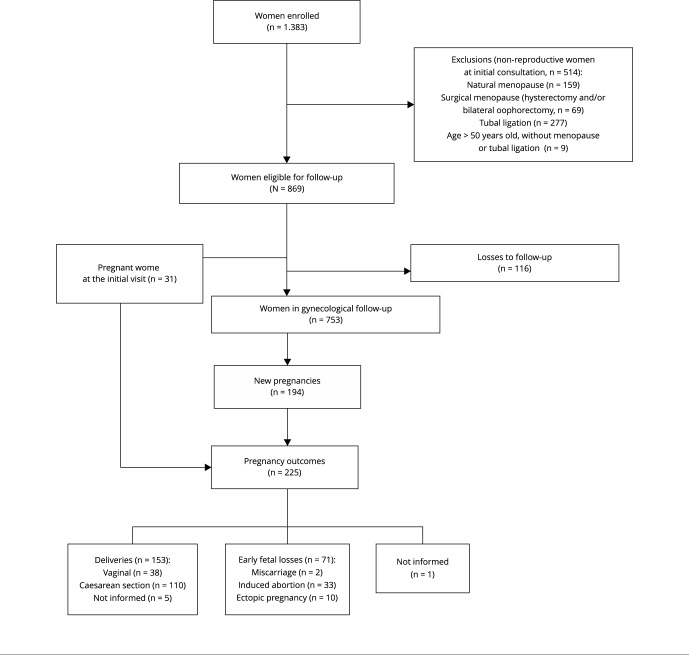
The aim of this research was to analyze pregnancy incidence and associated factors in a cohort of 753 women living with HIV/AIDS (WLWHA) in Rio de Janeiro, Brazil, from 1996 to 2016. Women aged 18-49 years who were not on menopause (surgical or natural) and did not have a tubal ligation were eligible for the study. Data were collected by medical professionals during initial and follow-up visits. Person-time pregnancy incidence rates were calculated throughout the follow-up period. Pregnancy incidence-associated factors were investigated by univariate and multiple analyzes, using an extension of the Cox survival model. Follow-up visits recorded 194 pregnancies, with an incidence rate of 4.01/100 person-years (95% CI: 3.47; 4.60). A higher pregnancy incidence was associated with CD4 nadir ≥ 350 cells/mm³, use of an antiretroviral regimen not containing Efavirenz, and prior teenage pregnancy. In turn, women with a viral load ≥ 50 copies/mL, age ≥ 35 years old, with two or more children and using a highly effective contraceptive method showed a lower incidence. Results showed a significant reduction in pregnancy incidence after 2006, a significant reduction in female sterilization from 1996 to 2016, and a high rate of cesarean sections. The association found between pregnancy incidence and the use of contraceptive methods and virological control markers suggests a good integration between HIV/AIDS and reproductive health services. The high rate of cesarean section delivery indicates the need to improve childbirth care.
本研究旨在分析巴西里约热内卢 753 名 HIV/AIDS 存活女性(WLWHA)的妊娠发生率及其相关因素。1996 年至 2016 年期间,研究对象为年龄在 18 至 49 岁之间、未绝经(手术或自然)且未进行输卵管结扎的女性。数据由医疗专业人员在初次就诊和随访期间收集。通过 Cox 生存模型扩展,采用单变量和多变量分析,研究妊娠发生率相关因素。随访期间共记录到 194 例妊娠,发生率为 4.01/100 人年(95%CI:3.47;4.60)。CD4 最低点≥350 个细胞/mm³、未使用含依非韦伦的抗逆转录病毒方案以及青少年时期怀孕的女性,妊娠发生率更高。而病毒载量≥50 拷贝/mL、年龄≥35 岁、有两个或更多孩子以及使用高效避孕方法的女性,妊娠发生率更低。结果显示,2006 年后妊娠发生率显著下降,1996 年至 2016 年女性绝育率显著下降,剖宫产率较高。妊娠发生率与避孕方法和病毒学控制标志物的关联表明,HIV/AIDS 与生殖健康服务之间的整合良好。较高的剖宫产率表明需要改善分娩护理。