Department of Otorhinolaryngology-Head and Neck Surgery, Ruhr-University Bochum, St. Elisabeth-Hospital Bochum, Bochum, Germany.
Department of Translational Neurosciences, Faculty of Medicine and Health Sciences, University of Antwerp, Antwerp, Belgium.
Eur Arch Otorhinolaryngol. 2024 Jan;281(1):43-49. doi: 10.1007/s00405-023-08064-z. Epub 2023 Jul 19.
In cochlear implantation with flexible lateral wall electrode arrays, a cochlear coverage (CC) range between 70% and 80% is considered ideal for optimal speech perception. To achieve this CC, the cochlear implant (CI) electrode array has to be chosen according to the individual cochlear duct length (CDL). Here, we mathematically analyzed the suitability of different flexible lateral wall electrode array lengths covering between 70% and 80% of the CDL.
In a retrospective cross-sectional study preoperative high-resolution computed tomography (HRCT) from patients undergoing cochlear implantation was investigated. The CDL was estimated using an otosurgical planning software and the CI electrode array lengths covering 70-80% of the CDL was calculated using (i) linear and (ii) non-linear models.
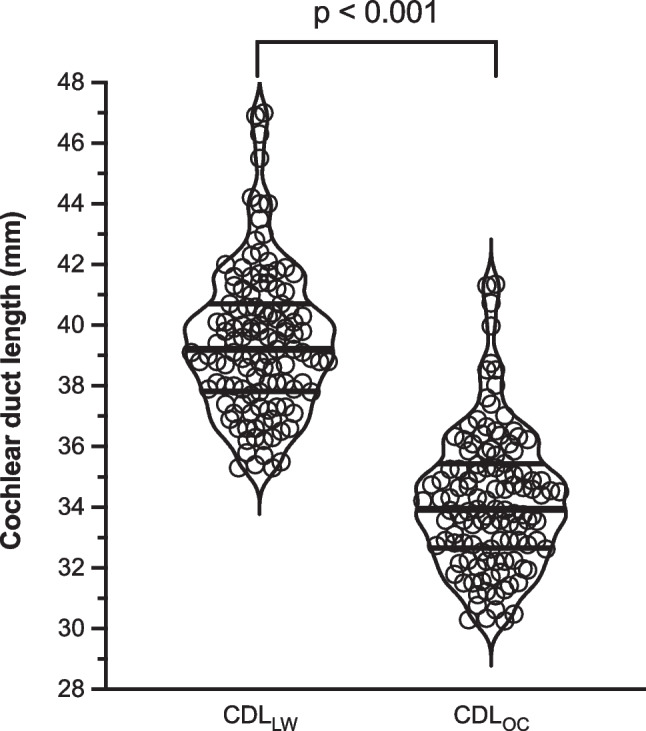
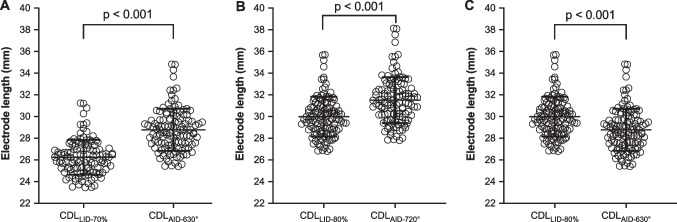
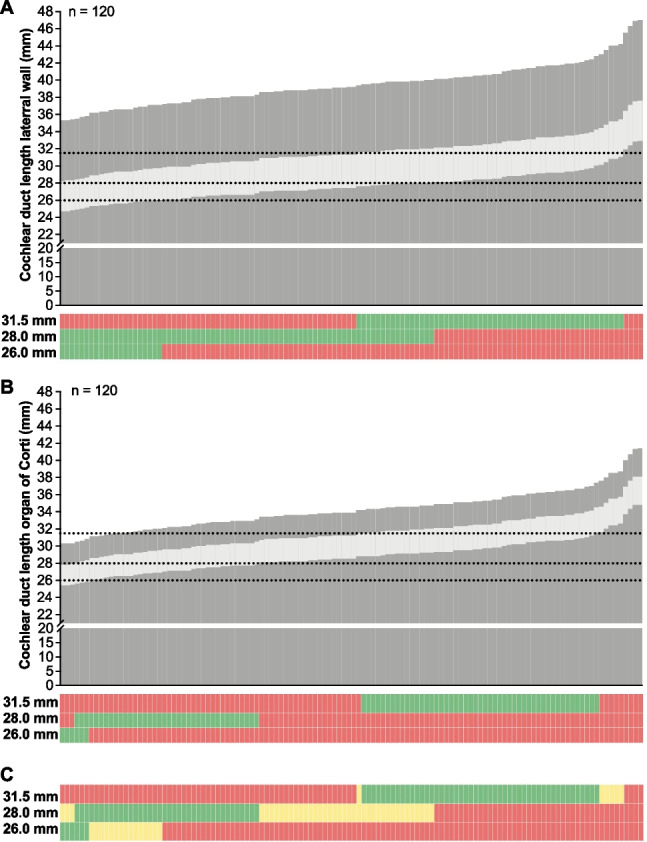
The analysis of 120 HRCT data sets showed significantly different model-dependent CDL. Significant differences between the CC of 70% assessed from linear and non-linear models (mean difference: 2.5 mm, p < 0.001) and the CC of 80% assessed from linear and non-linear models (mean difference: 1.5 mm, p < 0.001) were found. In up to 25% of the patients none of the existing flexible lateral wall electrode arrays fit into this range. In 59 cases (49,2%) the models did not agree on the suitable electrode arrays.
The CC varies depending on the underlying CDL approximation, which critically influences electrode array choice. Based on the literature, we hypothesize that the non-linear method systematically overestimates the CC and may lead to rather too short electrode array choices. Future studies need to assess the accuracy of the individual mathematical models.
在使用柔性侧墙电极阵列进行人工耳蜗植入时,耳蜗覆盖率(CC)在 70%至 80%之间被认为是获得最佳言语感知效果的理想范围。为了达到这个 CC,人工耳蜗(CI)电极阵列必须根据个体耳蜗管长度(CDL)来选择。在这里,我们通过数学分析了不同柔性侧墙电极阵列长度在覆盖 70%至 80%CDL 时的适用性。
在一项回顾性的横截面研究中,我们对接受人工耳蜗植入术的患者的术前高分辨率计算机断层扫描(HRCT)进行了研究。使用手术规划软件估计 CDL,并使用(i)线性和(ii)非线性模型计算覆盖 CDL 的 70%-80%的 CI 电极阵列长度。
对 120 个 HRCT 数据集的分析显示,模型依赖性的 CDL 存在显著差异。线性和非线性模型评估的 70%CC 之间(平均差异:2.5mm,p<0.001)和线性和非线性模型评估的 80%CC 之间(平均差异:1.5mm,p<0.001)存在显著差异。在多达 25%的患者中,现有的任何一种柔性侧墙电极阵列都无法适应这个范围。在 59 例(49.2%)中,两种模型对合适的电极阵列意见不一致。
CC 取决于所使用的 CDL 近似值,这对电极阵列的选择有很大影响。基于文献,我们假设非线性方法系统地高估了 CC,可能导致电极阵列选择过于短。未来的研究需要评估各个数学模型的准确性。