Department of Anthropology, University of Toronto Scarborough, Toronto, ON, Canada.
Department of Anthropology, University of Toronto, Toronto, ON, Canada.
Sci Rep. 2023 Jul 19;13(1):11624. doi: 10.1038/s41598-023-37536-9.
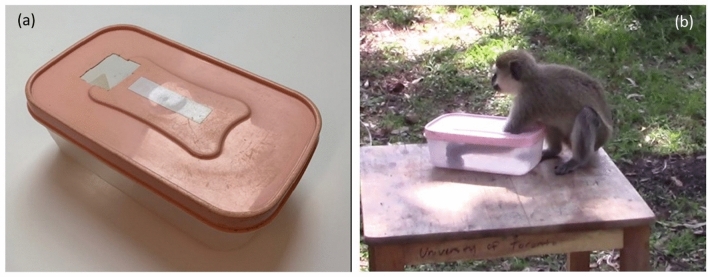
Animals must learn foraging skills to successfully survive and reproduce but the sources of interindividual variation in learning are poorly understood. For example, there is little consensus on the role motivation plays, even though it is a key factor impacting learning outcomes in humans. Here, we conduct a field experiment on a wild primate to investigate whether an individual's vulnerability to feeding competition impacts their motivation to learn a beneficial foraging technique. We provided a group of monkeys with a food reward (i.e., a half banana) that needed to be retrieved from a box. The monkeys discovered an efficient technique that consistently allowed them to retrieve the banana quickly, decreasing the risk of food loss to competitors. We found that individuals who frequently experienced feeding competition learned this efficient technique significantly faster than individuals who rarely foraged in the presence of a dominant competitor. They appeared to use social learning to learn faster as they were more attentive to the handling techniques others used and improved their foraging skills after opportunities to observe a skilled demonstrator. These findings support that an individual's vulnerability to feeding competition impacts their motivation to learn foraging skills that reduce food loss to competitors.
动物必须学习觅食技能才能成功生存和繁殖,但个体间学习差异的来源却知之甚少。例如,动机在学习中的作用虽说是影响人类学习成果的关键因素之一,但却没有达成共识。在这里,我们在野生灵长类动物中进行了一项现场实验,以调查个体对摄食竞争的脆弱性是否会影响他们学习有益觅食技术的动机。我们为一组猴子提供了食物奖励(即半根香蕉),这些奖励需要从盒子里取出来。猴子们发现了一种高效的技术,可以让它们快速取回香蕉,减少了食物被竞争对手抢走的风险。我们发现,那些经常经历摄食竞争的个体学习这种高效技术的速度明显快于那些在占优势的竞争对手面前很少觅食的个体。他们似乎通过社会学习来更快地学习,因为他们更关注其他猴子使用的处理技巧,并在有机会观察到熟练的示范者后,提高了自己的觅食技能。这些发现支持了这样一种观点,即个体对摄食竞争的脆弱性会影响他们学习减少食物损失给竞争对手的觅食技能的动机。