SILVIS Lab, Department of Forest and Wildlife Ecology, University of Wisconsin-Madison, Madison, WI, USA.
Department of Biology and Environment, University of Haifa at Oranim, Kiryat Tivon, Israel.
Nature. 2023 Sep;621(7977):94-99. doi: 10.1038/s41586-023-06320-0. Epub 2023 Jul 19.
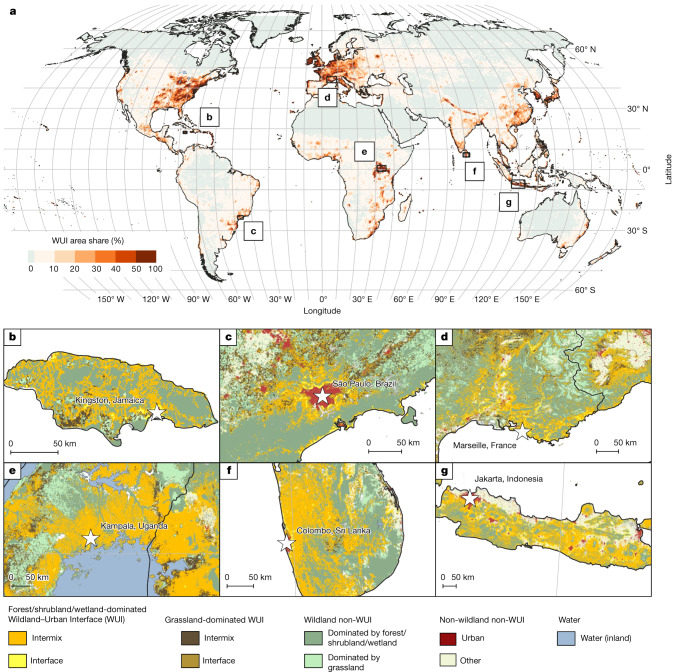
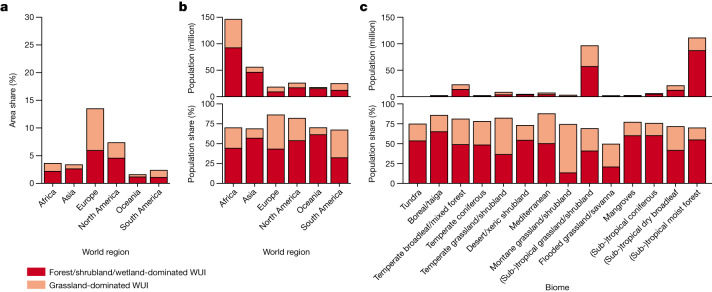
The wildland-urban interface (WUI) is where buildings and wildland vegetation meet or intermingle. It is where human-environmental conflicts and risks can be concentrated, including the loss of houses and lives to wildfire, habitat loss and fragmentation and the spread of zoonotic diseases. However, a global analysis of the WUI has been lacking. Here, we present a global map of the 2020 WUI at 10 m resolution using a globally consistent and validated approach based on remote sensing-derived datasets of building area and wildland vegetation. We show that the WUI is a global phenomenon, identify many previously undocumented WUI hotspots and highlight the wide range of population density, land cover types and biomass levels in different parts of the global WUI. The WUI covers only 4.7% of the land surface but is home to nearly half its population (3.5 billion). The WUI is especially widespread in Europe (15% of the land area) and the temperate broadleaf and mixed forests biome (18%). Of all people living near 2003-2020 wildfires (0.4 billion), two thirds have their home in the WUI, most of them in Africa (150 million). Given that wildfire activity is predicted to increase because of climate change in many regions, there is a need to understand housing growth and vegetation patterns as drivers of WUI change.
荒地-城市交界带(WUI)是指建筑物和野生植被相遇或混合的地方。这里是人类与环境冲突和风险集中的地方,包括房屋和生命因野火、栖息地丧失和破碎化以及人畜共患疾病传播而损失。然而,目前还缺乏对 WUI 的全球分析。在这里,我们使用基于遥感衍生的建筑物面积和野生植被数据集的全球一致且经过验证的方法,呈现了一张分辨率为 10 米的 2020 年 WUI 全球地图。我们表明,WUI 是一种全球性现象,确定了许多以前未记录的 WUI 热点,并突出显示了全球 WUI 不同地区人口密度、土地覆盖类型和生物量水平的广泛范围。WUI 仅覆盖 4.7%的土地表面,但却容纳了近一半的人口(35 亿)。WUI 在欧洲(占土地面积的 15%)和温带阔叶林和混合林生物群落(18%)中尤为广泛。在所有生活在 2003-2020 年野火附近的人(4 亿)中,三分之二的人居住在 WUI,其中大部分在非洲(1.5 亿)。由于气候变化预计会在许多地区增加野火活动,因此需要了解住房增长和植被模式作为 WUI 变化的驱动因素。