SaBio, Instituto de Investigación en Recursos Cinegéticos IREC-CSIC-UCLM-JCCM, Ronda de Toledo s/n, 13005, Ciudad Real, Spain.
Biochemistry Section, Faculty of Sciences and Chemical Technologies, Universidad de Castilla-La Mancha, Ave. Camilo José Cela 10, 13071, Ciudad Real, Spain.
Parasit Vectors. 2023 Jul 19;16(1):242. doi: 10.1186/s13071-023-05874-2.
Alpha-Gal syndrome (AGS) is a tick-borne food allergy caused by IgE antibodies against the glycan galactose-alpha-1,3-galactose (α-Gal) present in glycoproteins and glycolipids from mammalian meat. To advance in the diagnosis and treatment of AGS, further research is needed to unravel the molecular and immune mechanisms underlying this syndrome. The objective of this study is the characterization of tick salivary components and proteins with and without α-Gal modifications involved in modulating human immune response against this carbohydrate.
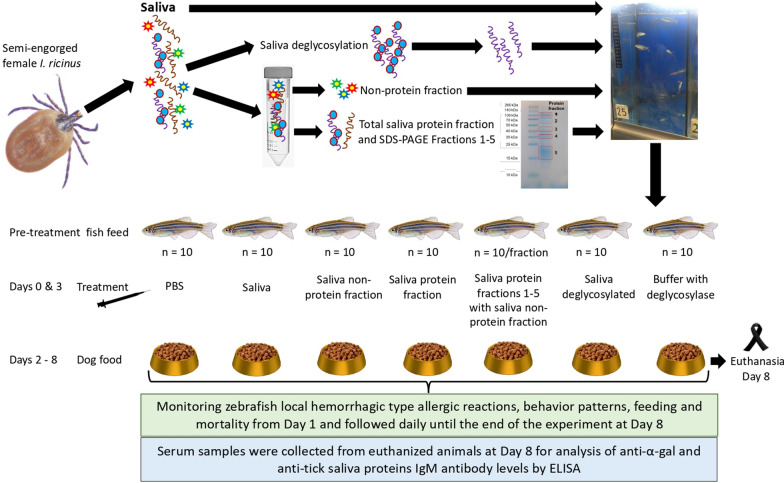
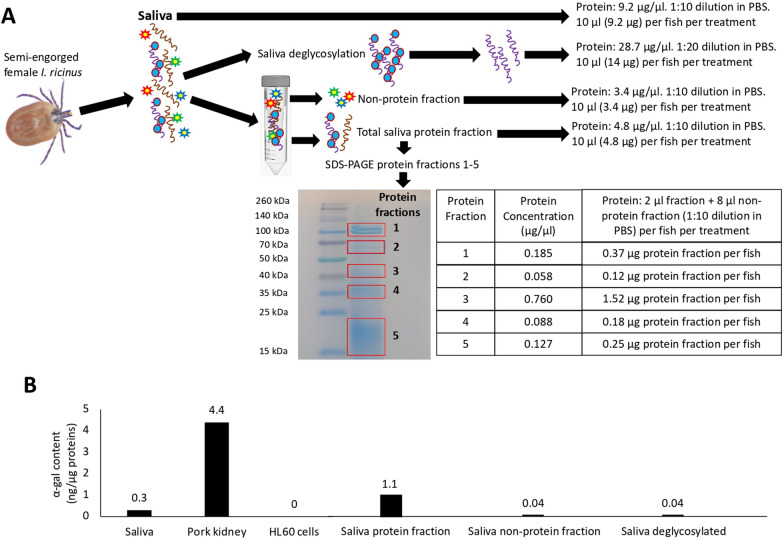
Protein and α-Gal content were determined in tick saliva components, and proteins were identified by proteomics analysis of tick saliva fractions. Pathophysiological changes were recorded in the zebrafish (Danio rerio) model after exposure to distinct Ixodes ricinus tick salivary components. Serum samples were collected from zebrafish at day 8 of exposure to determine anti-α-Gal, anti-glycan, and anti-tick saliva protein IgM antibody titers by enzyme-linked immunosorbent assay (ELISA).
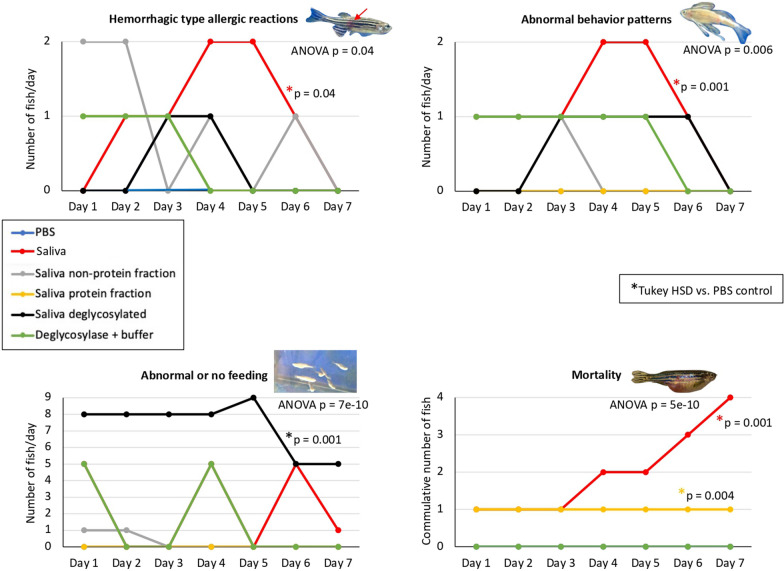
Zebrafish treated with tick saliva and saliva protein fractions combined with non-protein fractions demonstrated significantly higher incidence of hemorrhagic type allergic reactions, abnormal behavioral patterns, or mortality when compared to the phosphate-buffered saline (PBS)-treated control group. The main tick salivary proteins identified in these fractions with possible functional implication in AGS were the secreted protein B7P208-salivary antigen p23 and metalloproteases. Anti-α-Gal and anti-tick salivary gland IgM antibody titers were significantly higher in distinct saliva protein fractions and deglycosylated saliva group when compared with PBS-treated controls. Anti-glycan antibodies showed group-related profiles.
Results support the hypothesis that tick salivary biomolecules with and without α-Gal modifications are involved in modulating immune response against this carbohydrate.
α-半乳糖综合征(AGS)是一种由 IgE 抗体引起的蜱传食物过敏,这些抗体针对的是哺乳动物肉中的糖蛋白和糖脂中的半乳糖-α-1,3-半乳糖(α-Gal)。为了在 AGS 的诊断和治疗方面取得进展,需要进一步研究以揭示该综合征的分子和免疫机制。本研究的目的是对参与调节人体对该碳水化合物免疫反应的 tick 唾液成分和带有或不带有α-Gal 修饰的蛋白质进行表征。
通过蛋白质组学分析 tick 唾液级分来确定 tick 唾液成分中的蛋白质和α-Gal 含量,并鉴定蛋白质。在暴露于不同的 Ixodes ricinus tick 唾液成分后,在斑马鱼(Danio rerio)模型中记录病理生理变化。在暴露于 tick 唾液 8 天后收集斑马鱼的血清样本,通过酶联免疫吸附试验(ELISA)测定抗-α-Gal、抗聚糖和抗 tick 唾液蛋白 IgM 抗体滴度。
与用磷酸盐缓冲盐水(PBS)处理的对照组相比,用 tick 唾液和唾液蛋白级分与非蛋白级分组合处理的斑马鱼出现出血性过敏反应、异常行为模式或死亡的发生率显著更高。在这些级分中鉴定的主要 tick 唾液蛋白具有可能在 AGS 中具有功能意义的分泌蛋白 B7P208-唾液抗原 p23 和金属蛋白酶。与用 PBS 处理的对照组相比,在不同的唾液蛋白级分和去糖基化唾液组中,抗-α-Gal 和抗 tick 唾液腺 IgM 抗体滴度显著更高。抗聚糖抗体显示出与组相关的特征。
结果支持 tick 唾液生物分子与带有或不带有α-Gal 修饰的分子参与调节对该碳水化合物的免疫反应的假说。