Department of Systems Aging Science and Medicine, Tokyo Metropolitan Institute for Geriatrics and Gerontology, Itabashi-ku, Tokyo 173-0015, Japan.
Integrated Research Initiative for Living Well with Dementia, Tokyo Metropolitan Institute for Geriatrics and Gerontology, Itabashi-ku, Tokyo 173-0015, Japan.
Proc Natl Acad Sci U S A. 2024 Sep 10;121(37):e2406854121. doi: 10.1073/pnas.2406854121. Epub 2024 Sep 4.
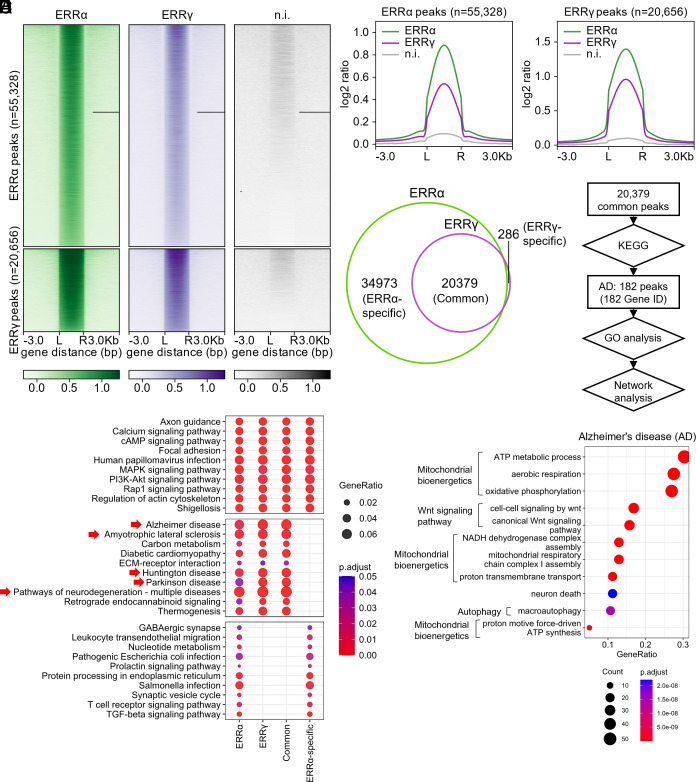
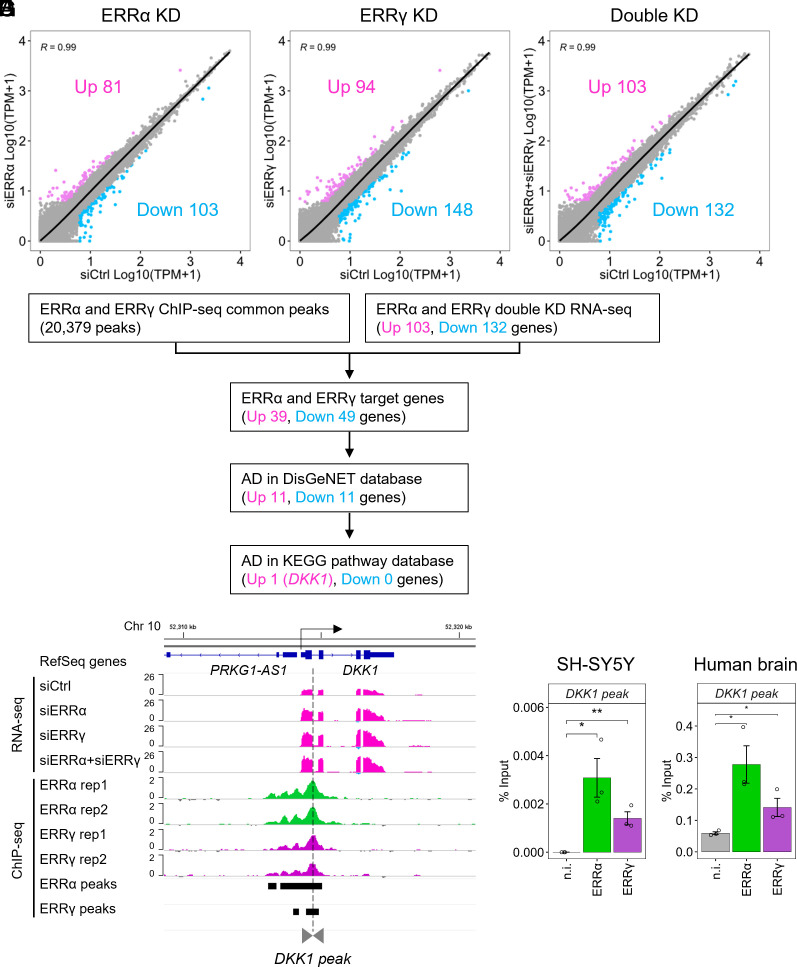
Alzheimer's disease (AD) is a prevalent neurodegenerative disease characterized by cognitive decline and learning/memory impairment associated with neuronal cell loss. Estrogen-related receptor α (ERRα) and ERRγ, which are highly expressed in the brain, have emerged as potential AD regulators, with unelucidated underlying mechanisms. Here, we identified genome-wide binding sites for ERRα and ERRγ in human neuronal cells. They commonly target a subset of genes associated with neurodegenerative diseases, including AD. Notably, Dickkopf-1 (DKK1), a Wnt signaling pathway antagonist, was transcriptionally repressed by both ERRα and ERRγ in human neuronal cells and brain. ERRα and ERRγ repress RNA polymerase II (RNAP II) accessibility at the promoter by modulating a specific active histone modification, histone H3 lysine acetylation (H3K9ac), with the potential contribution of their corepressor. This transcriptional repression maintains Wnt signaling activity, preventing tau phosphorylation and promoting a healthy neuronal state in the context of AD.
阿尔茨海默病(AD)是一种常见的神经退行性疾病,其特征是认知能力下降和学习/记忆障碍,伴有神经元细胞丢失。在大脑中高度表达的雌激素相关受体 α(ERRα)和 ERRγ 已成为潜在的 AD 调节剂,但潜在的机制尚不清楚。在这里,我们确定了人类神经元细胞中 ERRα 和 ERRγ 的全基因组结合位点。它们通常靶向与神经退行性疾病(包括 AD)相关的一组基因。值得注意的是,Dickkopf-1(DKK1),一种 Wnt 信号通路拮抗剂,在人类神经元细胞和大脑中被 ERRα 和 ERRγ 转录抑制。ERRα 和 ERRγ 通过调节特定的活性组蛋白修饰,组蛋白 H3 赖氨酸乙酰化(H3K9ac),来抑制 RNA 聚合酶 II(RNAP II)在启动子处的可及性,其核心抑制剂可能有贡献。这种转录抑制维持了 Wnt 信号活性,防止 tau 磷酸化,并在 AD 背景下促进健康的神经元状态。