Laboratory of Toxicology, Department of Bioanalysis, Faculty of Pharmaceutical Sciences, Ghent University, Campus Heymans, Ottergemsesteenweg 460, B-9000 Ghent, Belgium.
Department of Drug Design and Pharmacology, Faculty of Health and Medical Sciences, University of Copenhagen, Universitetsparken 2, DK-2100 Copenhagen, Denmark.
ACS Chem Neurosci. 2023 Aug 2;14(15):2727-2742. doi: 10.1021/acschemneuro.3c00267. Epub 2023 Jul 20.
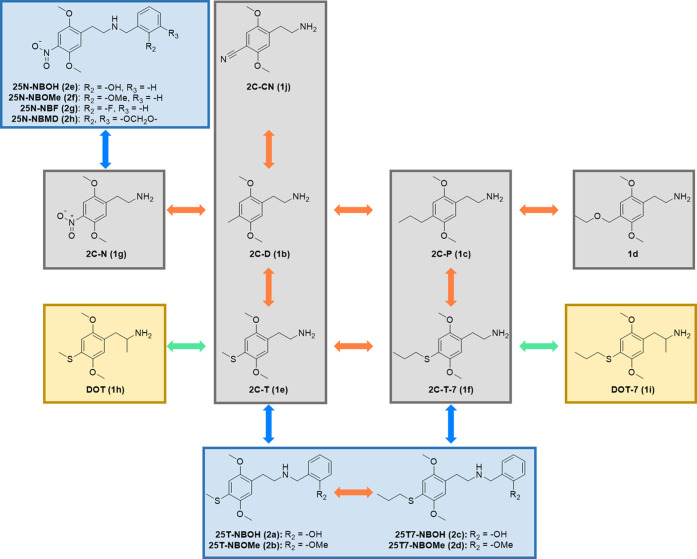
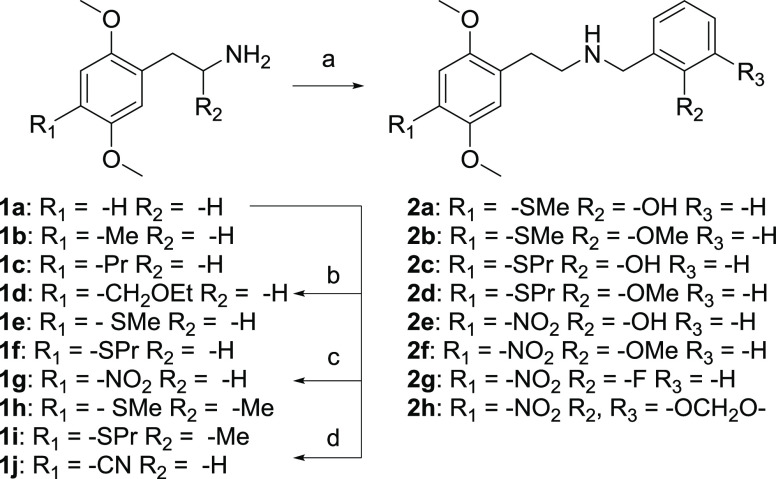
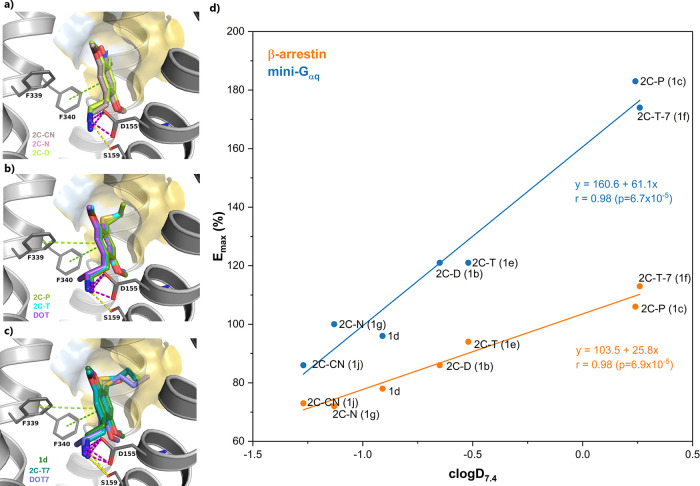
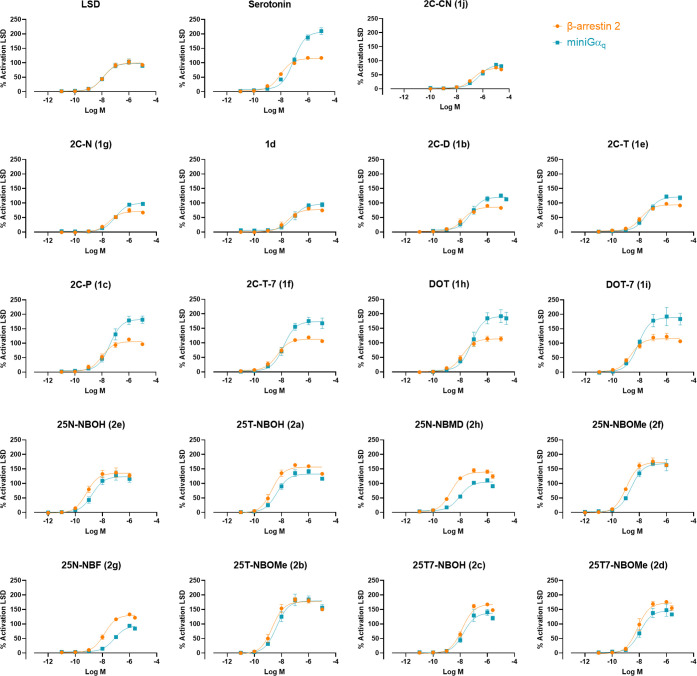
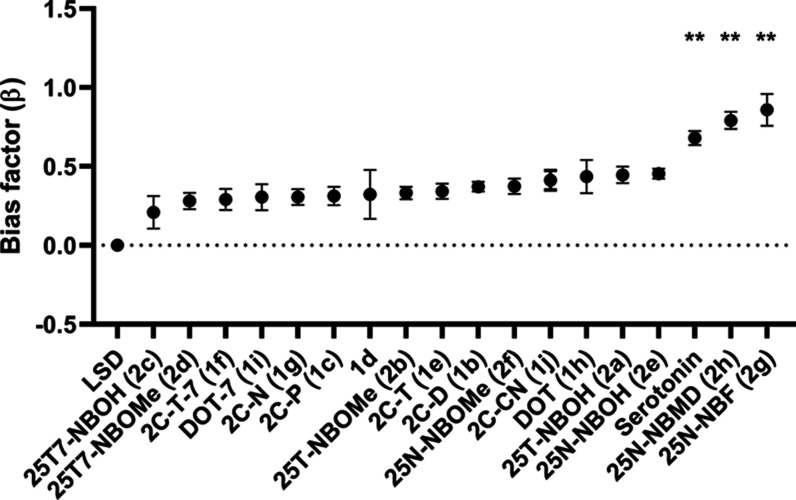
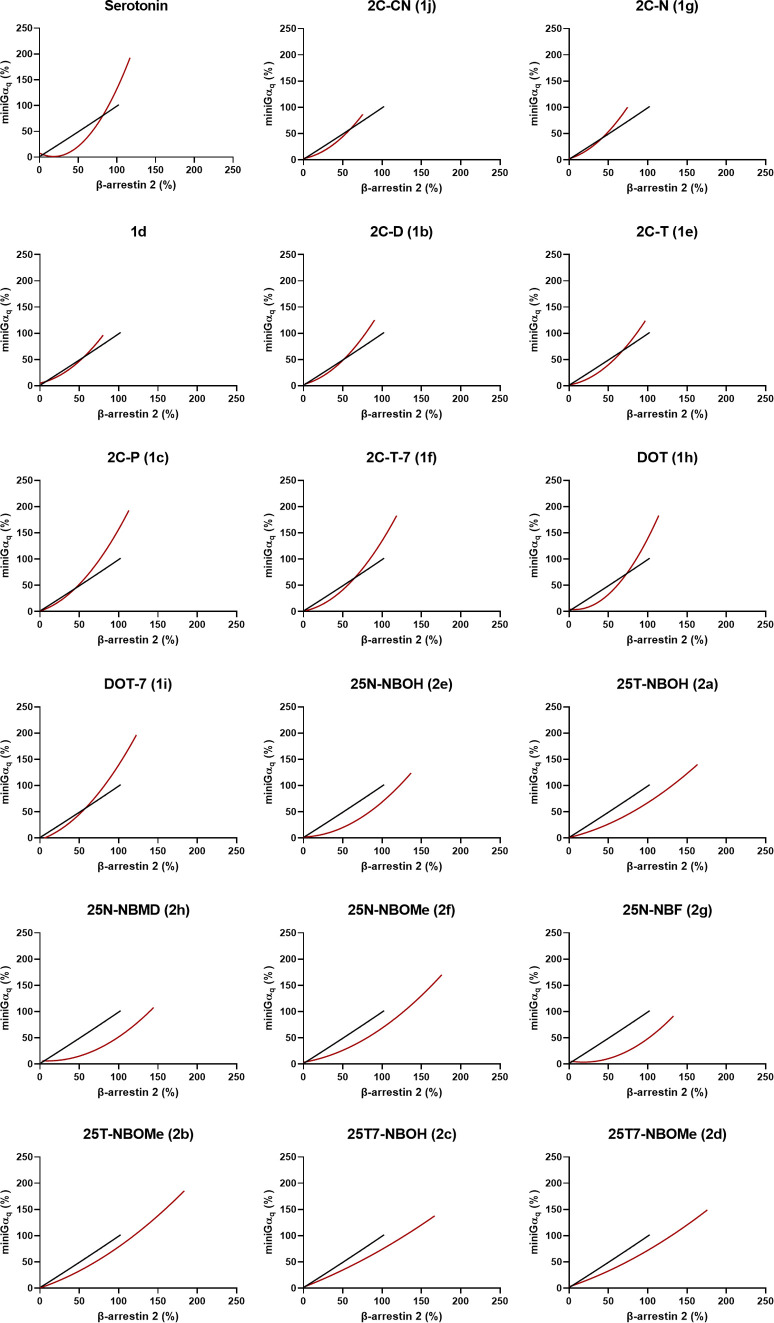
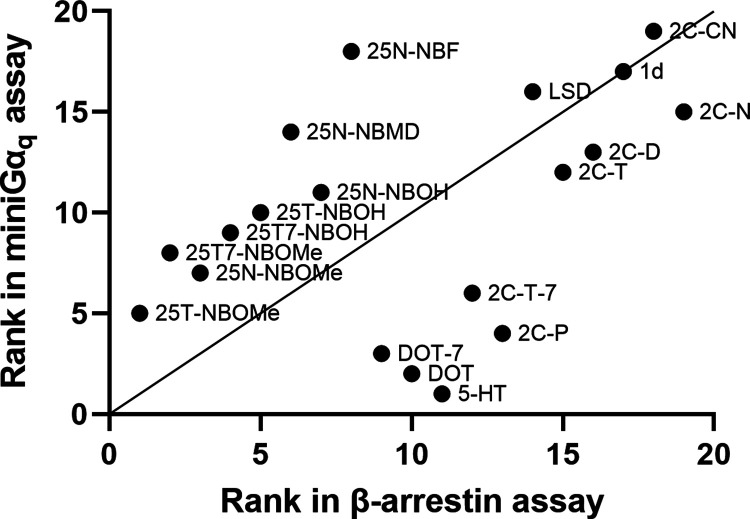
Serotonergic psychedelics are described to have activation of the serotonin 2A receptor (5-HT) as their main pharmacological action. Despite their relevance, the molecular mechanisms underlying the psychedelic effects induced by certain 5-HT agonists remain elusive. One of the proposed hypotheses is the occurrence of biased agonism, defined as the preferential activation of certain signaling pathways over others. This study comparatively monitored the efficiency of a diverse panel of 4-position-substituted (and -benzyl-derived) phenylalkylamines to induce recruitment of β-arrestin2 (βarr2) or miniGα to the 5-HT, allowing us to assess structure-activity relationships and biased agonism. All test compounds exhibited agonist properties with a relatively large range of both EC and values. Interestingly, the lipophilicity of the 2C-X phenethylamines was correlated with their efficacy in both assays but yielded a stronger correlation in the miniGα- than in the βarr2-assay. Molecular docking suggested that accommodation of the 4-substituent of the 2C-X analogues in a hydrophobic pocket between transmembrane helices 4 and 5 of 5-HT may contribute to this differential effect. Aside from previously used standard conditions (lysergic acid diethylamide (LSD) as a reference agonist and a 2 h activation profile to assess a compound's activity), serotonin was included as a second reference agonist, and the compounds' activities were also assessed using the first 30 min of the activation profile. Under all assessed circumstances, the qualitative structure-activity relationships remained unchanged. Furthermore, the use of two reference agonists allowed for the estimation of both "benchmark bias" (relative to LSD) and "physiology bias" (relative to serotonin).
血清素能致幻剂被描述为主要通过激活血清素 2A 受体(5-HT)发挥其药理学作用。尽管它们具有相关性,但某些 5-HT 激动剂引起致幻作用的分子机制仍难以捉摸。其中一个提出的假设是发生了偏向激动作用,定义为优先激活某些信号通路而不是其他信号通路。本研究比较监测了一组多样化的 4-取代(和苄基衍生)苯烷基胺对募集β-arrestin2(βarr2)或 miniGα到 5-HT 的效率,使我们能够评估结构-活性关系和偏向激动作用。所有测试化合物均表现出激动剂特性,其 EC 和 值范围相对较大。有趣的是,2C-X 苯乙胺的亲脂性与两种测定中的效力相关,但在 miniGα 测定中相关性更强。分子对接表明,2C-X 类似物的 4-取代基在 5-HT 的跨膜螺旋 4 和 5 之间的疏水性口袋中的容纳可能有助于这种差异效应。除了之前使用的标准条件(麦角酸二乙酰胺(LSD)作为参考激动剂和 2 小时激活谱评估化合物的活性)外,还将血清素作为第二种参考激动剂,并且还使用激活谱的前 30 分钟评估化合物的活性。在所有评估的情况下,定性结构-活性关系保持不变。此外,使用两种参考激动剂可以估计“基准偏向”(相对于 LSD)和“生理偏向”(相对于血清素)。