Research Laboratory in Subterranean and Surface Hydraulics, University of Biskra, Biskra, Algeria.
Faculty of Technology, University of El Oued, El Oued, PO, Algeria.
Bioengineered. 2023 Dec;14(1):290-306. doi: 10.1080/21655979.2023.2236843.
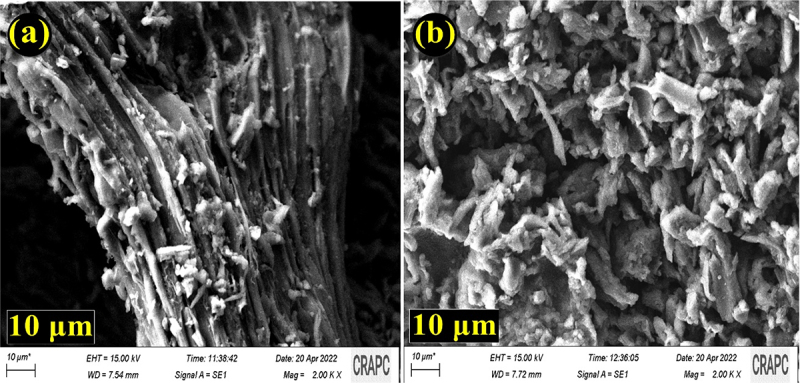
Biochar has shown large potential in water treatment because of its low cost, good textural properties, and high reusability. In this study, two porous biochars were developed from the seeds via direct pyrolysis process (B-700) and through hydrothermal carbonization followed with pyrolysis (HB-700). They were characterized by morphology, structural characteristics, and surface features and used to adsorb the crystal violet (CV) dye in water environment. Results of the isotherm approaches demonstrated that the removal capacity of these biochars reached 119.4 mg/g for B-700, and 209 mg/g for HB-700 (at 45°C). Also, the Avrami model best fitted the kinetic data. The electrostatic attraction was regarded as one of the adsorptions mechanisms of CV dye. The regeneration tests reveal that both B-700 and HB-700 are good reusable adsorbents. Finally, findings of the study showed that the hydrothermal carbonization method that precede the pyrolysis process can improve significantly the adsorption capacity of the produced biochar.
生物炭因其成本低、结构性能好、可重复使用性高等特点,在水处理领域显示出巨大的潜力。本研究通过直接热解(B-700)和水热碳化后热解(HB-700)两种方法,从种子中开发出两种多孔生物炭。采用形貌、结构特征和表面特征对其进行了表征,并将其用于吸附水环境中的结晶紫(CV)染料。等温线方法的结果表明,B-700 的去除容量达到 119.4 mg/g,HB-700 的去除容量达到 209 mg/g(在 45°C 时)。此外,Avrami 模型最适合动力学数据。静电吸引被认为是 CV 染料吸附的机制之一。再生试验表明,B-700 和 HB-700 都是良好的可重复使用的吸附剂。最后,研究结果表明,在热解过程之前进行水热碳化方法可以显著提高所制备生物炭的吸附能力。