Park Jin Se, Woo Seung Je, Song Chang Seon, Han Jae Yong
Department of Agricultural Biotechnology and Research Institute of Agriculture and Life Sciences, Seoul National University, Seoul, Republic of Korea.
Avian Diseases Laboratory, College of Veterinary Medicine, Konkuk University, Seoul, Republic of Korea.
Front Vet Sci. 2023 Jul 6;10:1160600. doi: 10.3389/fvets.2023.1160600. eCollection 2023.
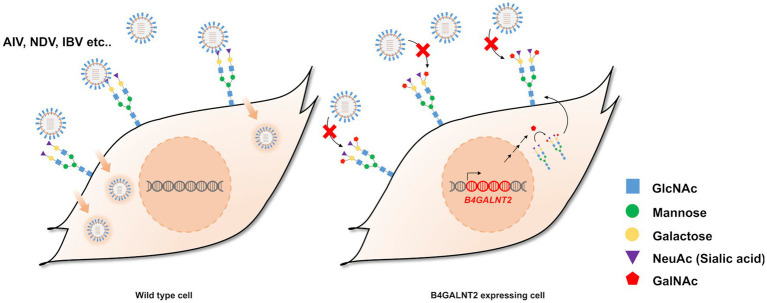
Infectious viruses in poultry, such as avian influenza virus (AIV) and Newcastle disease virus (NDV), are one of the most major threats to the poultry industry, resulting in enormous economic losses. AIVs and NDVs preferentially recognize α-2,3-linked sialic acid to bind to target cells. The human beta-1,4-N-acetyl-galactosaminyltransferase 2 (B4GALNT2) modifies α-2,3-linked sialic acid-containing glycan by transferring N-acetylgalactosamine to the sub-terminal galactose of the glycan, thus playing a pivotal role in preventing viruses from binding to cell surfaces. However, chickens lack a homolog of the gene.
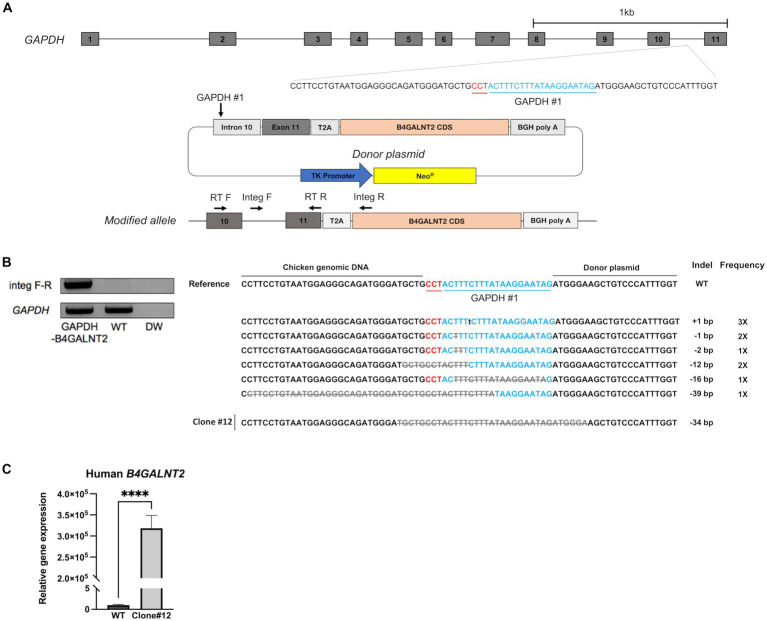
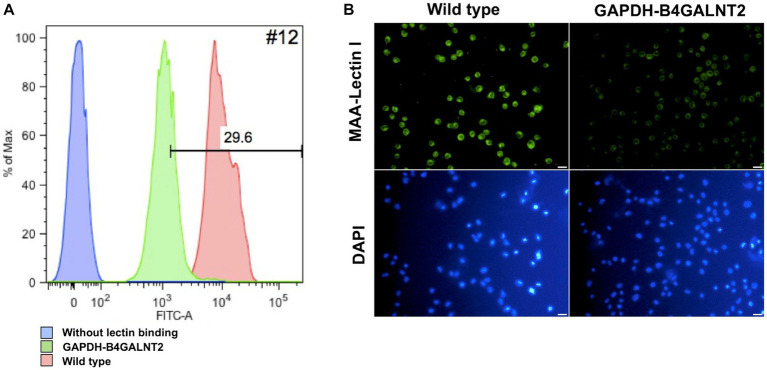
Here, we precisely tagged the human gene downstream of the chicken so that the engineered cells constitutively express the human . We performed a lectin binding assay to analyze the modification of α-2,3-linked sialic acid-containing glycan by human B4GALNT2. Additionally, we infected the cells with AIV and NDV and compared cell survivability, viral gene transcription, and viral titer using the WST-1 assay, RT-qPCR and TCID50 assay, respectively.
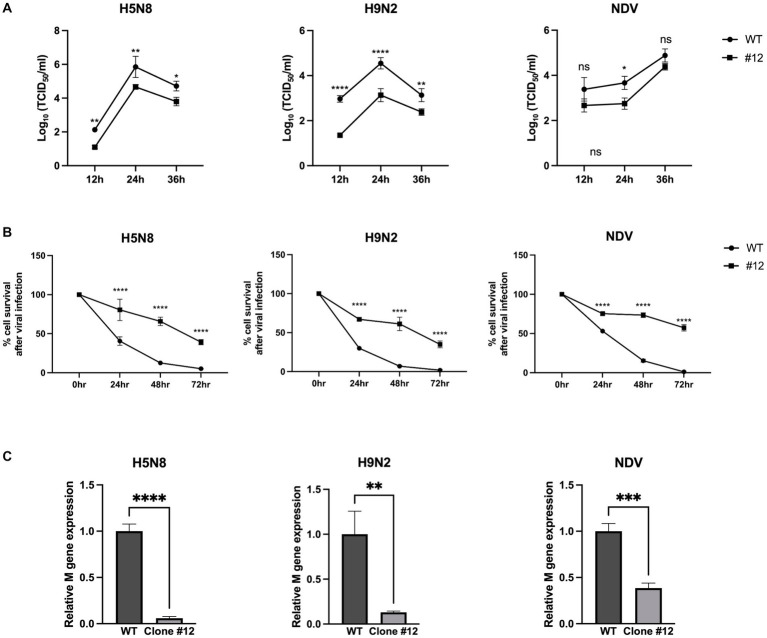
We validated human B4GALNT2 successfully modified α-2,3-linked sialic acid-containing glycan in chicken DF-1 cells. Following viral infection, we showed that human B4GALNT2 reduced infection of two AIV subtypes and NDV at 12-, 24-, and 36-hours post-infection. Moreover, cells expressing human showed significantly higher cell survivability compared to wild-type DF-1 cells, and viral gene expression was significantly reduced in the cells expressing human .
Collectively, these results suggest that artificially expressing human in chicken is a promising strategy to acquire broad resistance against infectious viruses with a preference for α-2,3-linked sialic acids such as AIV and NDV.
家禽中的传染性病毒,如禽流感病毒(AIV)和新城疫病毒(NDV),是家禽业面临的最主要威胁之一,会导致巨大的经济损失。AIV和NDV优先识别α-2,3连接的唾液酸以结合靶细胞。人β-1,4-N-乙酰半乳糖胺基转移酶2(B4GALNT2)通过将N-乙酰半乳糖胺转移到聚糖的次末端半乳糖上,修饰含α-2,3连接唾液酸的聚糖,从而在防止病毒与细胞表面结合方面发挥关键作用。然而,鸡缺乏该基因的同源物。
在此,我们在鸡的基因下游精确标记人基因,使工程细胞组成性表达人基因。我们进行了凝集素结合试验,以分析人B4GALNT2对含α-2,3连接唾液酸聚糖的修饰。此外,我们用AIV和NDV感染细胞,并分别使用WST-1试验、RT-qPCR和TCID50试验比较细胞存活率、病毒基因转录和病毒滴度。
我们验证了人B4GALNT2在鸡DF-1细胞中成功修饰了含α-2,3连接唾液酸的聚糖。病毒感染后,我们发现人B4GALNT2在感染后12、24和36小时降低了两种AIV亚型和NDV的感染。此外,与人野生型DF-1细胞相比,表达人基因的细胞显示出显著更高的细胞存活率,并且在表达人基因的细胞中病毒基因表达显著降低。
总体而言,这些结果表明,在鸡中人工表达人基因是一种有前景的策略,可获得对偏好α-2,3连接唾液酸的传染性病毒(如AIV和NDV)的广泛抗性。