Paradela Regina Silva, Cabella Brenno, Nucci Mariana Penteado, Ferreira Naomi Vidal, Torres Laura Aló, Martino Luiza Menoni, Consolim-Colombo Fernanda Marciano, Bortolotto Luiz Aparecido, da Costa Danielle Irigoyen, Irigoyen Maria Claudia
Instituto do Coracao (InCor), Hospital das Clinicas HCFMUSP, Faculdade de Medicina, Universidade de São Paulo, São Paulo, Brazil.
Institute of Theoretical Physics, São Paulo State University (IFT-UNESP), São Paulo, Brazil.
Front Neurosci. 2023 Jul 7;17:1185768. doi: 10.3389/fnins.2023.1185768. eCollection 2023.
Hypertension is associated with working memory (WM) impairment. However, the benefits of Cogmed WM training for the hypertensive population are unknown. Therefore, we aimed to evaluate Cogmed's effects on the WM performance of hypertensive individuals with executive function (EF) impairment.
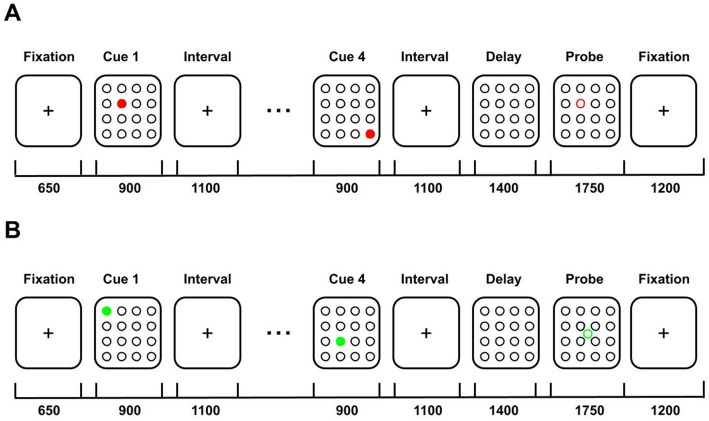
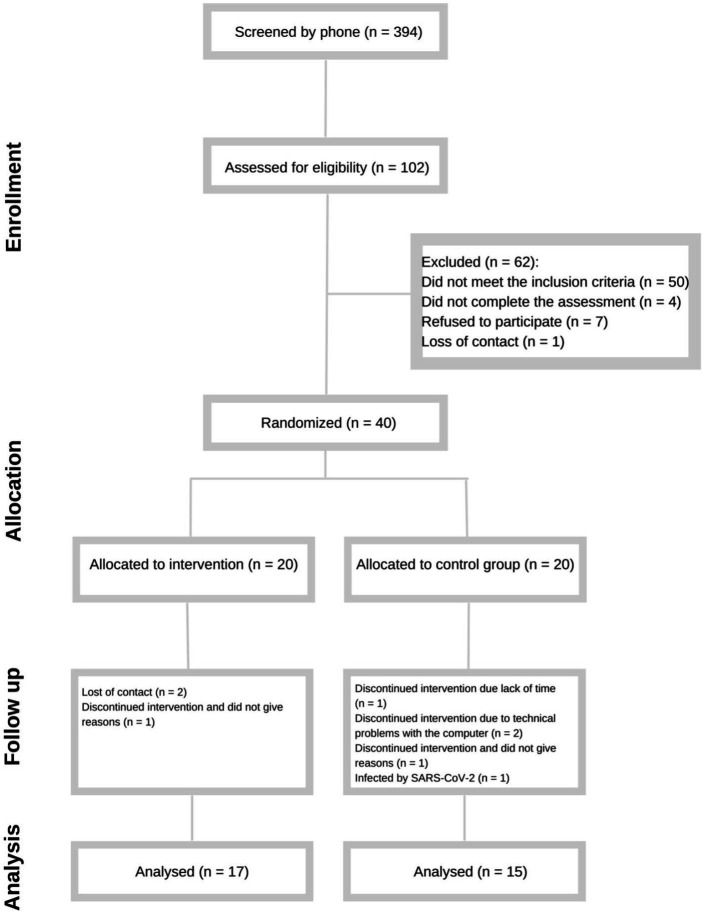
We included 40 hypertensive patients (aged 40-70 years, 68% female) with EF impairment. They were randomized in a 1:1 ratio to receive 10 weeks of adaptive Cogmed training or a non-adaptive control training based on online games. The primary outcome was the WM performance. The secondary outcomes were verbal memory, visuospatial ability, executive function, global cognition, and the neuronal activity measured using functional magnetic resonance imaging (fMRI) under two WM task conditions: low (memorization of 4 spatial locations) and high (memorization of 6 spatial locations). An intention-to-treat (ITT) and per-protocol (PP) analysis were performed.
Cogmed did not show a significant effect on WM or any other cognitive outcome post-training. However, under the WM-low load and WM-high load conditions of the fMRI, respectively, the Cogmed group had an activation decrease in the right superior parietal lobe (ITT and PP analyses) and left inferior frontal lobe (PP analysis) in comparison to the control group.
The Cogmed showed no effects on the WM performance of hypertensive individuals with EF impairment. However, activation decreases were observed in frontoparietal areas related to the WM network, suggesting a more efficient neuronal activity after training.
高血压与工作记忆(WM)损害有关。然而,Cogmed工作记忆训练对高血压人群的益处尚不清楚。因此,我们旨在评估Cogmed对有执行功能(EF)损害的高血压个体工作记忆表现的影响。
我们纳入了40名有EF损害的高血压患者(年龄40 - 70岁,68%为女性)。他们被按1:1的比例随机分组,接受为期10周的适应性Cogmed训练或基于网络游戏的非适应性对照训练。主要结局是工作记忆表现。次要结局包括言语记忆、视觉空间能力、执行功能、整体认知,以及在两种工作记忆任务条件下(低:记忆4个空间位置;高:记忆6个空间位置)使用功能磁共振成像(fMRI)测量的神经元活动。进行了意向性分析(ITT)和符合方案分析(PP)。
训练后,Cogmed对工作记忆或任何其他认知结局均未显示出显著影响。然而,在fMRI的工作记忆低负荷和高负荷条件下,与对照组相比,Cogmed组分别在右侧顶上叶(ITT和PP分析)和左侧额下回(PP分析)出现激活减少。
Cogmed对有EF损害的高血压个体的工作记忆表现没有影响。然而,在与工作记忆网络相关的额顶叶区域观察到激活减少,提示训练后神经元活动更高效。