Wang Ji, Zhang Xianyu, You Zilong, Meng Yuhuan, Fan Xijie, Qiao Guangdong, Pang Da
Medical Translational Research Institute, Guangzhou KingMed Center for Clinical Laboratory Co., Ltd, Guangzhou, China.
Department of Breast Surgery, Yantai Yuhuangding Hospital, Yantai, China.
Front Oncol. 2023 Jul 7;13:1113115. doi: 10.3389/fonc.2023.1113115. eCollection 2023.
Luminal B and triple-negative breast cancer (TNBC) are malignant subtypes of breast cancer (BC), which can be attributed to the multifaceted roles of tissue-derived exosomes (T-exos). Competing endogenous RNA (ceRNA) networks can regulate gene expression post-transcriptionally.
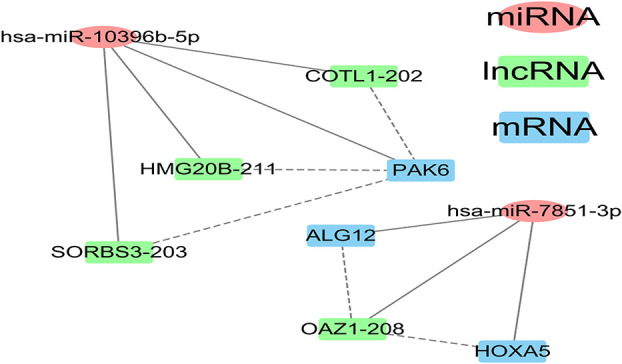
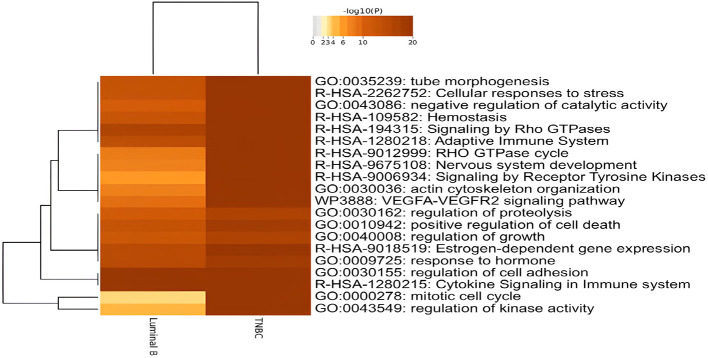
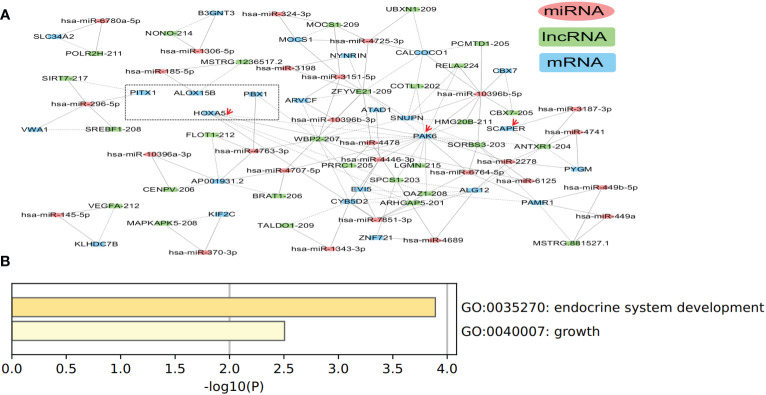
RNAs in T-exos from luminal B BC (=8) and TNBC (=8) patients were compared with those from persons with benign breast disease (=8). The differentially expressed (DE) mRNA, microRNA (miRNA), and long noncoding RNA (lncRNA) target genes were annotated using Gene Ontology (GO) and Kyoto Encyclopedia of Genes and Genomes (KEGG) to reveal the relevant biological processes.The ceRNA networks were constructed to show distinct regulation, and the mRNAs involved were annotated. The miRNAs involved in the ceRNA networks were screened with the Kaplan-Meier Plotter database to identify dysregulated ceRNAs with prognostic power.
In total, 802 DE mRNAs, 441 DE lncRNAs, and 104 DE miRNAs were identified in luminal B BC T-exos, while 1699 DE mRNAs, 590 DE lncRNAs, and 277 DE miRNAs were identified in TNBC T-exos. Gene annotation revealed that the RAS-MAPK pathway was the primary biological process in luminal B BC T-exos, while endocrine system development and growth were the main processes in TNBC T-exos. Survival analysis established seven survival-related lncRNA/miRNA/mRNA regulations in luminal B BC T-exos, and nineteen survival-related lncRNA/miRNA/mRNA regulations in TNBC T-exos.
In addition to survival-related ceRNA regulations, ceRNA regulation of RAS-MAPK in luminal B and endocrine system development and growth regulation in TNBC might contribute to the tumorigenesis of BC.
管腔B型和三阴性乳腺癌(TNBC)是乳腺癌(BC)的恶性亚型,这可归因于组织来源外泌体(T-exos)的多方面作用。竞争性内源RNA(ceRNA)网络可在转录后调节基因表达。
将管腔B型乳腺癌(n = 8)和TNBC(n = 8)患者的T-exos中的RNA与良性乳腺疾病患者(n = 8)的RNA进行比较。使用基因本体论(GO)和京都基因与基因组百科全书(KEGG)对差异表达(DE)的mRNA、微小RNA(miRNA)和长链非编码RNA(lncRNA)靶基因进行注释,以揭示相关的生物学过程。构建ceRNA网络以显示不同的调控,并对其中涉及的mRNA进行注释。利用Kaplan-Meier Plotter数据库筛选ceRNA网络中涉及的miRNA,以鉴定具有预后能力的失调ceRNA。
在管腔B型乳腺癌T-exos中总共鉴定出802个DE mRNA、441个DE lncRNA和104个DE miRNA,而在TNBC T-exos中鉴定出1699个DE mRNA、590个DE lncRNA和277个DE miRNA。基因注释显示,RAS-MAPK途径是管腔B型乳腺癌T-exos中的主要生物学过程,而内分泌系统发育和生长是TNBC T-exos中的主要过程。生存分析在管腔B型乳腺癌T-exos中建立了7种与生存相关的lncRNA/miRNA/mRNA调控,在TNBC T-exos中建立了19种与生存相关的lncRNA/miRNA/mRNA调控。
除了与生存相关的ceRNA调控外,管腔B型中RAS-MAPK的ceRNA调控以及TNBC中内分泌系统发育和生长调控可能有助于乳腺癌的肿瘤发生。