Department of Otolaryngology - Head and Neck Surgery, Oregon Health & Science University, Portland, Oregon.
Department of Cell, Developmental and Cancer Biology, Oregon Health & Science University, Portland, Oregon.
Cancer Res Commun. 2023 Jul 13;3(7):1237-1247. doi: 10.1158/2767-9764.CRC-23-0102. eCollection 2023 Jul.
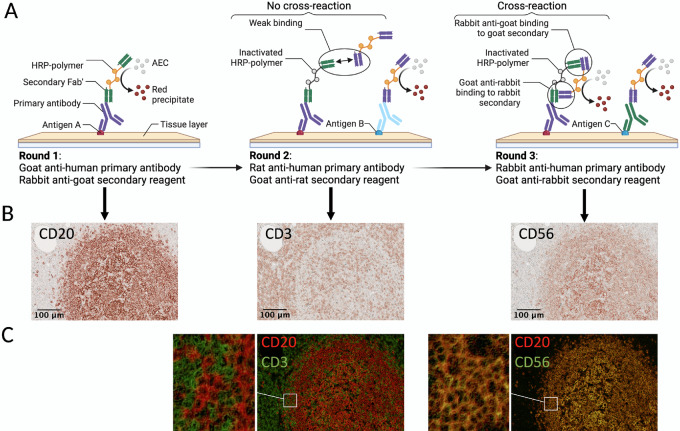
Recent clinical observations have emphasized the critical role that the spatial organization of immune cells in lymphoid structures plays in the success of cancer immunotherapy and patient survival. However, implementing sequential chromogenic IHC (scIHC) to analyze multiple biomarkers on a single tissue section has been limited because of a lack of a standardized, rigorous guide to the development of customized biomarker panels and a need for user-friendly analysis pipelines that can extract meaningful data. In this context, we provide a comprehensive guide for the development of novel biomarker panels for scIHC, using practical examples and illustrations to highlight the most common complications that can arise during the setup of a new biomarker panel, and provide detailed instructions on how to prevent and detect cross-reactivity between secondary reagents and carryover between detection antibodies. We also developed a novel analysis pipeline based on non-rigid tissue deformation correction, Cellpose-inspired automated cell segmentation, and computational network masking of low-quality data. We applied this biomarker panel and pipeline to study regional lymph nodes from patients with head and neck cancer, identifying novel contact interactions between plasmablasts and plasmacytoid dendritic cells . Given that Toll-like receptors, which are highly expressed in plasmacytoid dendritic cells, play a key role in vaccine efficacy, the significance of this cell-cell interaction decisively warrants further studies. In summary, this work provides a streamlined approach to the development of customized biomarker panels for scIHC that will ultimately improve our understanding of immune responses in cancer.
We present a comprehensive guide for developing customized biomarker panels to investigate cell-cell interactions in the context of immune responses in cancer. This approach revealed novel contact interactions between plasmablasts and plasmacytoid dendritic cells in lymph nodes from patients with head and neck cancer.
最近的临床观察强调了免疫细胞在淋巴结构中的空间组织在癌症免疫治疗和患者生存中的关键作用。然而,由于缺乏标准化、严格的指导来开发定制的生物标志物面板,以及需要用户友好的分析管道来提取有意义的数据,因此在单个组织切片上分析多个生物标志物的连续显色免疫组化(scIHC)一直受到限制。在这种情况下,我们提供了开发 scIHC 新型生物标志物面板的综合指南,使用实际示例和说明来突出在新生物标志物面板设置过程中可能出现的最常见并发症,并详细说明如何防止和检测二级试剂之间的交叉反应以及检测抗体之间的交叉污染。我们还开发了一种基于非刚性组织变形校正、基于 Cellpose 的自动细胞分割和计算网络掩蔽低质量数据的新型分析管道。我们将这个生物标志物面板和分析管道应用于研究头颈部癌症患者的区域淋巴结,发现了浆母细胞和浆细胞样树突状细胞之间的新型接触相互作用。鉴于高表达于浆细胞样树突状细胞的 Toll 样受体在疫苗疗效中起着关键作用,这种细胞间相互作用的意义值得进一步研究。总之,这项工作提供了一种用于开发 scIHC 定制生物标志物面板的简化方法,最终将提高我们对癌症中免疫反应的理解。
我们提出了一种用于开发定制生物标志物面板的综合指南,用于研究癌症中免疫反应背景下的细胞间相互作用。这种方法揭示了头颈部癌症患者淋巴结中浆母细胞和浆细胞样树突状细胞之间的新型接触相互作用。