Hyun By Sangwon, Cape Mattias Rolf, Ribalet Francois, Bien Jacob
Department of Data Sciences and Operations, University of Southern California.
School of Oceanography, University of Washington.
Ann Appl Stat. 2023 Mar;17(1):357-377. doi: 10.1214/22-aoas1631. Epub 2023 Jan 24.
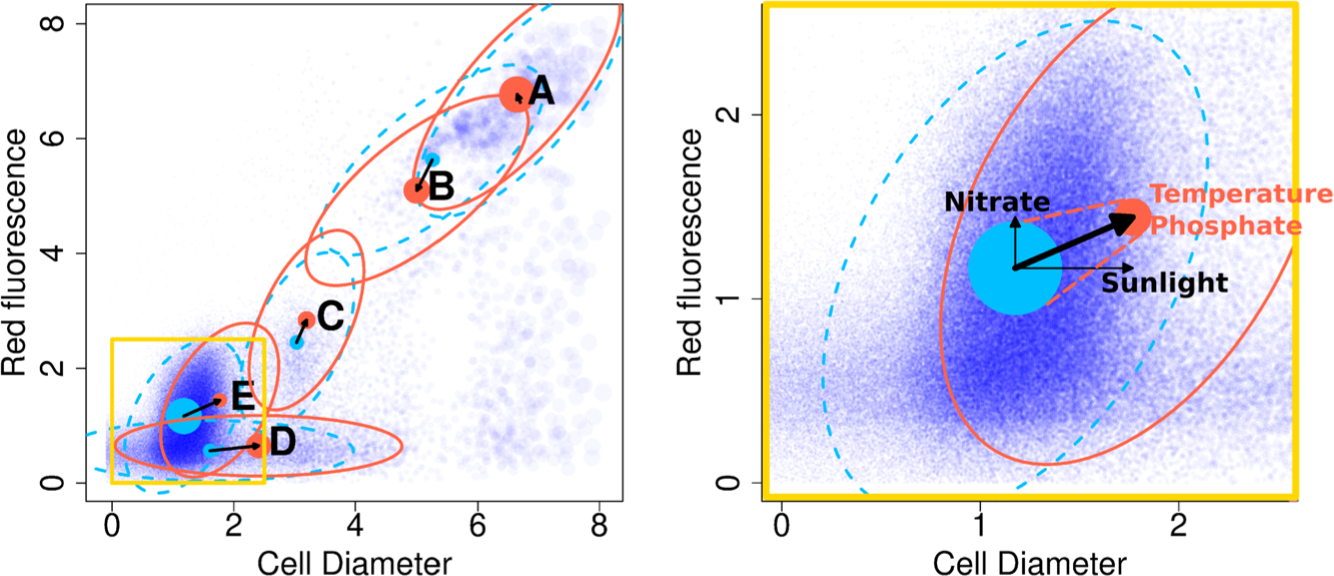
The ocean is filled with microscopic microalgae, called phytoplankton, which together are responsible for as much photosynthesis as all plants on land combined. Our ability to predict their response to the warming ocean relies on understanding how the dynamics of phytoplankton populations is influenced by changes in environmental conditions. One powerful technique to study the dynamics of phytoplankton is flow cytometry which measures the optical properties of thousands of individual cells per second. Today, oceanographers are able to collect flow cytometry data in real time onboard a moving ship, providing them with fine-scale resolution of the distribution of phytoplankton across thousands of kilometers. One of the current challenges is to understand how these small- and large-scale variations relate to environmental conditions, such as nutrient availability, temperature, light and ocean currents. In this paper we propose a novel sparse mixture of multivariate regressions model to estimate the time-varying phytoplankton subpopulations while simultaneously identifying the specific environmental covariates that are predictive of the observed changes to these subpopulations. We demonstrate the usefulness and interpretability of the approach using both synthetic data and real observations collected on an oceanographic cruise conducted in the northeast Pacific in the spring of 2017.
海洋中充满了被称为浮游植物的微小微藻,它们进行的光合作用总量与陆地上所有植物的光合作用总量相当。我们预测它们对海洋变暖反应的能力依赖于了解浮游植物种群动态如何受到环境条件变化的影响。研究浮游植物动态的一种强大技术是流式细胞术,它每秒可测量数千个单个细胞的光学特性。如今,海洋学家能够在移动的船上实时收集流式细胞术数据,为他们提供数千公里范围内浮游植物分布的高分辨率信息。当前的挑战之一是了解这些小尺度和大尺度变化如何与环境条件相关,例如营养物质可用性、温度、光照和洋流。在本文中,我们提出了一种新颖的多元回归稀疏混合模型,用于估计随时间变化的浮游植物亚群,同时识别可预测这些亚群观测变化的特定环境协变量。我们使用合成数据和2017年春季在东北太平洋进行的一次海洋学巡航收集的实际观测数据,证明了该方法的实用性和可解释性。