Community Health Sciences, The Aga Khan University, Karachi, Sindh, Pakistan
Community Health Sciences, The Aga Khan University, Karachi, Sindh, Pakistan.
BMJ Open. 2023 Jul 24;13(7):e074262. doi: 10.1136/bmjopen-2023-074262.
Although the number of disabled women entering motherhood is growing, there is little quantitative evidence about the utilisation of essential antenatal care (ANC) services by women with disabilities. We examined inequalities in the use of essential ANC services between women with and without disabilities.
DESIGN, SETTING AND ANALYSIS: A secondary analysis of cross-sectional data from recent Demographic and Health Survey of Pakistan 2017-2018 was performed using logistic regression.
A total weighted sample of 6791 ever-married women (age 15-49) who had a live birth in the 5 years before the survey were included.
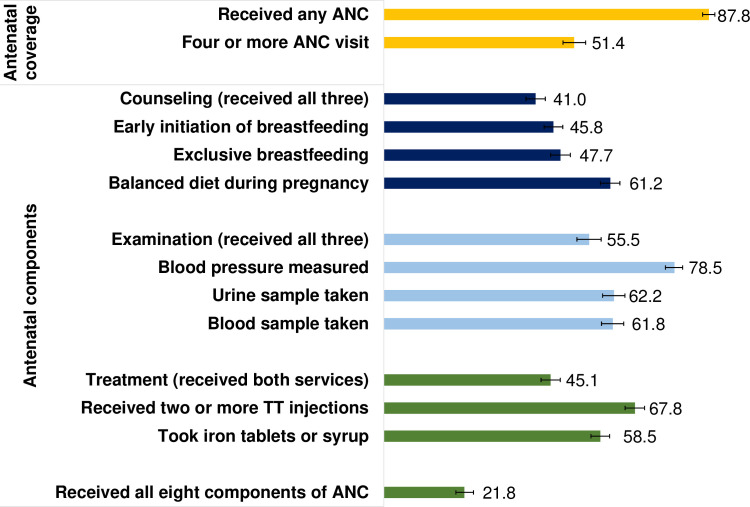
Utilisation of ANC: (A) antenatal coverage: (1) received ANC and (2) completed four or more ANC visits and (B) utilisation of essential components of ANC.
The percentage of women who were at risk of disability and those living with disability in one or more domains was 11.5% and 2.6%, respectively. The coverage of ANC did not differ by disability status. With utilisation of essential ANC components, consumption of iron was lower (adjusted OR, aOR=0.6; p<0.05), while advice on exclusive breast feeding (aOR=1.6; p<0.05) and urine test (aOR=1.7; p<0.05) was higher among women with disabilities as compared with their counterparts. Similarly, the odds of receiving advice on maintaining a balanced diet was higher (aOR=1.3; p<0.05) among women at risk of any disability as opposed to their counterparts. Differences were also found for these same indicators in subgroup analysis by wealth status (poor/non-poor) and place of residence (urban-rural).
Our study did not find glaring inequalities in the utilisation of ANC services between women with disabilities and non-disabled women. This was true for urban versus rural residence and among the poor versus non-poor women. Some measures, however, should be made to improve medication compliance among women with disabilities.
尽管残疾女性生育的人数不断增加,但关于残疾女性利用基本产前护理(ANC)服务的定量证据很少。我们研究了残疾女性与非残疾女性在利用基本 ANC 服务方面的不平等现象。
设计、地点和分析:使用逻辑回归对 2017-2018 年巴基斯坦最近的人口与健康调查的横断面数据进行了二次分析。
共纳入了 6791 名有过活产经历的已婚妇女(年龄在 15-49 岁之间),她们在调查前 5 年内有过活产经历。
有残疾风险和在一个或多个领域有残疾的妇女比例分别为 11.5%和 2.6%。ANC 的覆盖率不因残疾状况而不同。在利用基本 ANC 成分方面,铁的摄入量较低(调整后的比值比,aOR=0.6;p<0.05),而残疾妇女接受纯母乳喂养建议(aOR=1.6;p<0.05)和尿液检查建议(aOR=1.7;p<0.05)的比例较高。同样,有残疾风险的妇女获得均衡饮食建议的几率也较高(aOR=1.3;p<0.05)。在按财富状况(贫困/非贫困)和居住地(城乡)划分的亚组分析中,也发现了这些相同指标的差异。
我们的研究没有发现残疾女性与非残疾女性在 ANC 服务利用方面存在明显的不平等。这在城乡居住和贫富妇女中都是如此。然而,应该采取一些措施来提高残疾妇女的药物依从性。