Medical Oncology Department, Hospital Clinic of Barcelona, C. Villaroel 170, 08036, Barcelona, Spain.
Translational Genomics and Targeted Therapies in Solid Tumors, August Pi I Sunyer Biomedical Research Institute (IDIBAPS), Barcelona, Spain.
Sci Rep. 2023 Jul 24;13(1):11951. doi: 10.1038/s41598-023-38760-z.
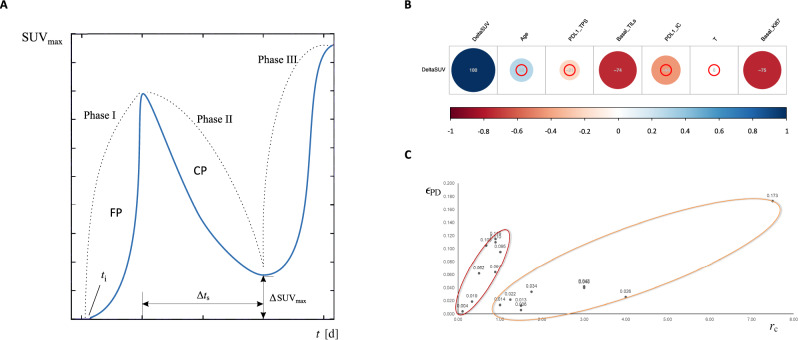
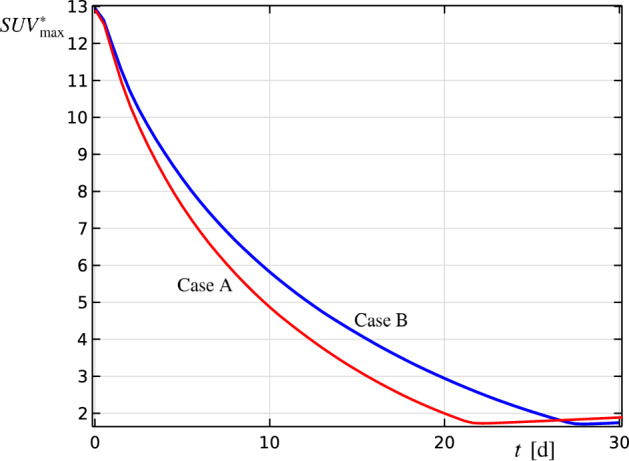
Mathematical models based on partial differential equations (PDEs) can be exploited to handle clinical data with space/time dimensions, e.g. tumor growth challenged by neoadjuvant therapy. A model based on simplified assessment of tumor malignancy and pharmacodynamics efficiency was exercised to discover new metrics of patient prognosis in the OLTRE trial. We tested in a 17-patients cohort affected by early-stage triple negative breast cancer (TNBC) treated with 3 weeks of olaparib, the capability of a PDEs-based reactive-diffusive model of tumor growth to efficiently predict the response to olaparib in terms of SUV detected at FDG-PET/CT scan, by using specific terms to characterize tumor diffusion and proliferation. Computations were performed with COMSOL Multiphysics. Driving parameters governing the mathematical model were selected with Pearson's correlations. Discrepancies between actual and computed SUV values were assessed with Student's t test and Wilcoxon rank sum test. The correlation between post-olaparib true and computed SUV was assessed with Pearson's r and Spearman's rho. After defining the proper mathematical assumptions, the nominal drug efficiency (ε) and tumor malignancy (r) were computationally evaluated. The former parameter reflected the activity of olaparib on the tumor, while the latter represented the growth rate of metabolic activity as detected by SUV. ε was found to be directly dependent on basal tumor-infiltrating lymphocytes (TILs) and Ki67% and was detectable through proper linear regression functions according to TILs values, while r was represented by the baseline Ki67-to-TILs ratio. Predicted post-olaparib SUV* did not significantly differ from original post-olaparib SUV in the overall, gBRCA-mutant and gBRCA-wild-type subpopulations (p > 0.05 in all cases), showing strong positive correlation (r = 0.9 and rho = 0.9, p < 0.0001 both). A model of simplified tumor dynamics was exercised to effectively produce an upfront prediction of efficacy of 3-week neoadjuvant olaparib in terms of SUV. Prospective evaluation in independent cohorts and correlation of these outcomes with more recognized efficacy endpoints is now warranted for model confirmation and tailoring of escalated/de-escalated therapeutic strategies for early-TNBC patients.
基于偏微分方程(PDEs)的数学模型可用于处理具有时空维度的临床数据,例如新辅助治疗下的肿瘤生长。我们在 OLTRE 试验中,基于对肿瘤恶性程度和药效动力学效率的简化评估,构建了一个模型,旨在为患者预后发现新的预测指标。我们在一个由 17 名早期三阴性乳腺癌(TNBC)患者组成的队列中进行了测试,这些患者接受了 3 周奥拉帕利治疗,我们使用特定术语来描述肿瘤扩散和增殖,利用基于 PDEs 的肿瘤生长反应扩散模型,来高效预测氟代脱氧葡萄糖正电子发射断层扫描(FDG-PET/CT 扫描)中 SUV 检测到的奥拉帕利反应。通过使用 COMSOL Multiphysics 进行计算。选择 Pearson 相关性来确定控制数学模型的驱动参数。通过学生 t 检验和 Wilcoxon 秩和检验评估实际 SUV 值与计算 SUV 值之间的差异。通过 Pearson r 和 Spearman rho 评估奥拉帕利治疗后实际 SUV 值与计算 SUV 值之间的相关性。在定义适当的数学假设后,我们计算了名义药物效率(ε)和肿瘤恶性程度(r)。前者参数反映了奥拉帕利对肿瘤的活性,而后者代表了 SUV 检测到的代谢活性的增长率。ε 与基础肿瘤浸润淋巴细胞(TILs)和 Ki67% 直接相关,并可根据 TILs 值通过适当的线性回归函数进行检测,而 r 则由基线 Ki67 与 TILs 的比值表示。在整个队列、gBRCA 突变和 gBRCA 野生型亚组中,预测的奥拉帕利治疗后 SUV*与原始的奥拉帕利治疗后 SUV 无显著差异(在所有情况下 p>0.05),具有很强的正相关性(r=0.9,rho=0.9,p<0.0001)。我们构建了一个简化的肿瘤动力学模型,以便有效地对 3 周新辅助奥拉帕利治疗的 SUV 进行疗效的初步预测。现在需要在独立队列中进行前瞻性评估,并将这些结果与更公认的疗效终点相关联,以验证模型并为早期 TNBC 患者量身定制升级/降级治疗策略。