School of Integrative Engineering, Chung-Ang University, Seoul, 06974, Republic of Korea.
Department of Chemical and Biomolecular Engineering, University of Pennsylvania, Philadelphia, PA, 19104, USA.
Sci Rep. 2023 Jul 24;13(1):11947. doi: 10.1038/s41598-023-38723-4.
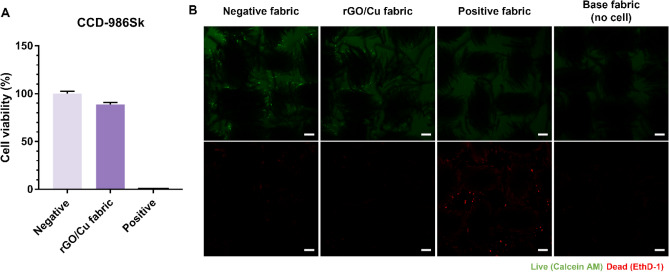
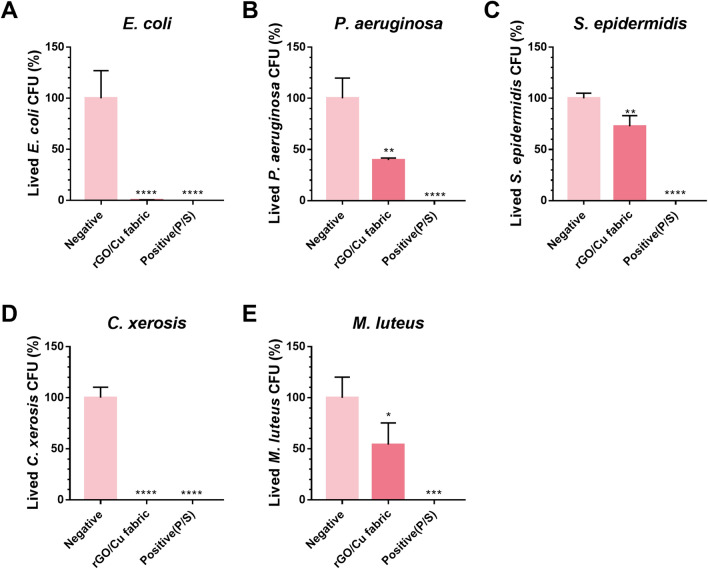
Infectious pathogens can be transmitted through textiles. Therefore, additional efforts are needed to develop functional fabrics containing antimicrobial substances to prevent the growth of antibiotic-resistant bacteria and their biofilms. Here, we developed a cotton fabric coated with reduced graphene oxide (rGO) and copper nanoparticles (Cu NPs), which possessed hydrophobic, antimicrobial, and anti-biofilm properties. Once the graphene oxide was dip-coated on a cellulose cotton fabric, Cu NPs were synthesized using a chemical reduction method to fabricate an rGO/Cu fabric, which was analyzed through FE-SEM, EDS, and ICP-MS. The results of our colony-forming unit assays indicated that the rGO/Cu fabric possessed high antibacterial and anti-biofilm properties against Escherichia coli, Pseudomonas aeruginosa, Staphylococcus epidermidis, Corynebacterium xerosis, and Micrococcus luteus. Particularly, the fabric could inhibit the growth of E. coli, C. xerosis, and M. luteus with a 99% efficiency. Furthermore, our findings confirmed that the same concentrations of rGO/Cu had no cytotoxic effects against CCD-986Sk and Human Dermal Fibroblast (HDF), human skin cells, and NIH/3T3, a mouse skin cell. The developed rGO/Cu fabric thus exhibited promising applicability as a cotton material that can maintain hygienic conditions by preventing the propagation of various bacteria and sufficiently suppressing biofilm formation while also being harmless to the human body.
传染性病原体可以通过纺织品传播。因此,需要额外努力开发含有抗菌物质的功能性织物,以防止抗生素耐药菌及其生物膜的生长。在这里,我们开发了一种涂有还原氧化石墨烯(rGO)和铜纳米粒子(Cu NPs)的棉织物,它具有疏水性、抗菌和抗生物膜特性。一旦将氧化石墨烯浸涂在纤维素棉织物上,就可以使用化学还原法合成 Cu NPs,从而制备出 rGO/Cu 织物,并通过 FE-SEM、EDS 和 ICP-MS 进行分析。我们的集落形成单位测定结果表明,rGO/Cu 织物对大肠杆菌、铜绿假单胞菌、表皮葡萄球菌、干性棒状杆菌和微球菌具有很高的抗菌和抗生物膜性能。特别是,该织物可以以 99%的效率抑制大肠杆菌、C. xerosis 和 M. luteus 的生长。此外,我们的研究结果证实,相同浓度的 rGO/Cu 对 CCD-986Sk 和人真皮成纤维细胞(HDF)、人皮肤细胞和 NIH/3T3(一种小鼠皮肤细胞)没有细胞毒性作用。因此,开发的 rGO/Cu 织物作为一种棉材料具有广阔的应用前景,它可以通过防止各种细菌的繁殖和充分抑制生物膜形成来保持卫生条件,同时对人体无害。