Department of Cardiology, University Medical Center Utrecht, Heidelberglaan 100, 3584 CX, Utrecht, The Netherlands.
Department of Paediatric Cardiology, Wilhelmina Children's Hospital, Utrecht, The Netherlands.
Pediatr Cardiol. 2024 Dec;45(8):1627-1635. doi: 10.1007/s00246-023-03238-2. Epub 2023 Jul 24.
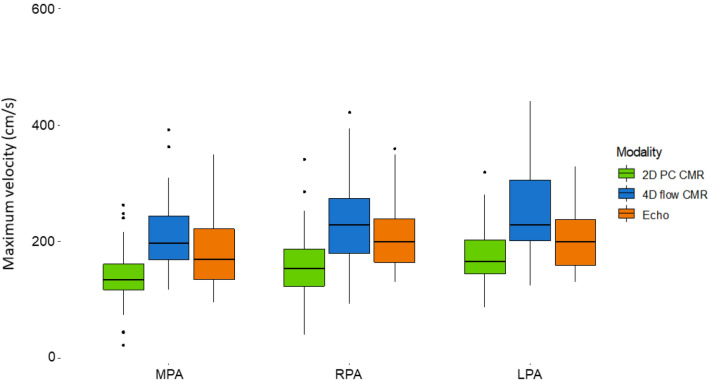
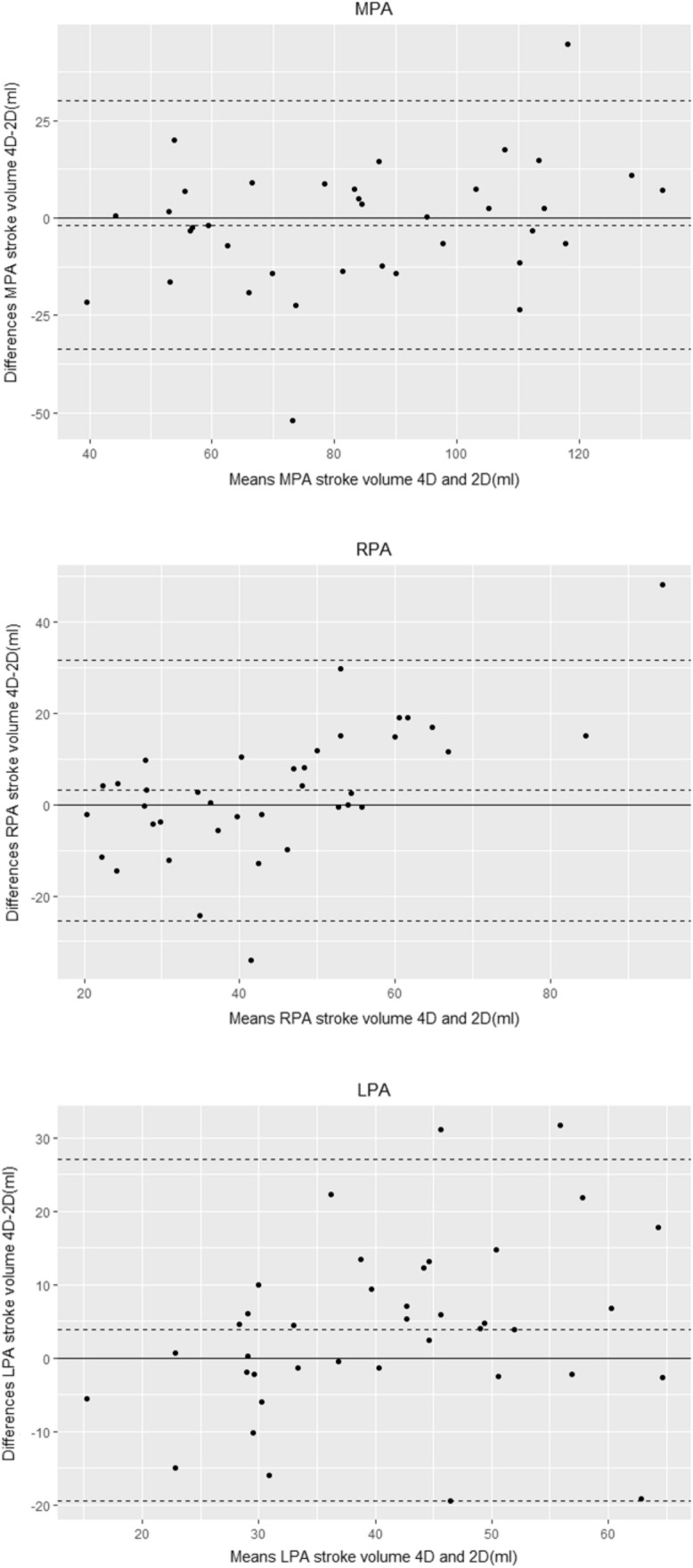
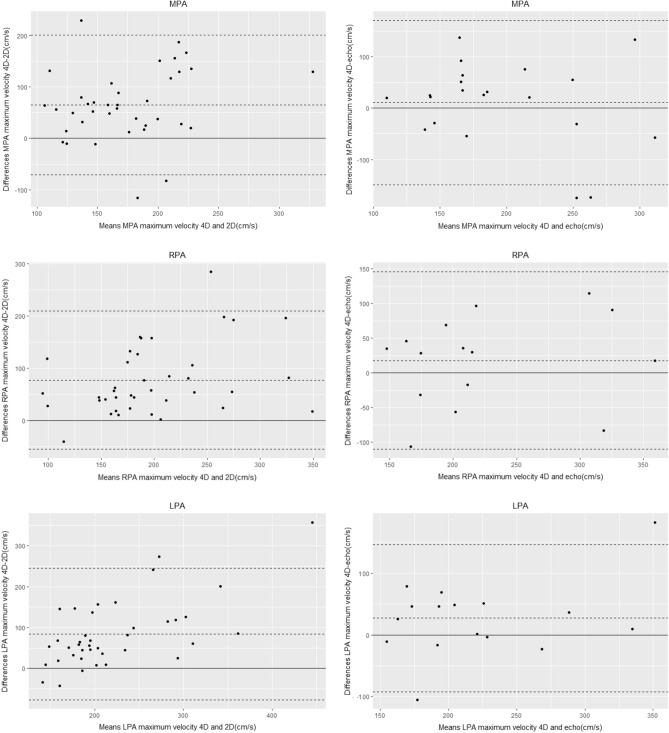
Pulmonary artery (PA) stenosis is a common complication after the arterial switch operation (ASO) for transposition of the great arteries (TGA). Four-dimensional flow (4D flow) CMR provides the ability to quantify flow within an entire volume instead of a single plane. The aim of this study was to compare PA maximum velocities and stroke volumes between 4D flow CMR, two-dimensional phase-contrast (2D PCMR) and echocardiography. A prospective study including TGA patients after ASO was performed between December 2018 and October 2020. All patients underwent echocardiography and CMR, including 2D PCMR and 4D flow CMR. Maximum velocities and stroke volumes were measured in the main, right, and left PA (MPA, LPA, and RPA, respectively). A total of 39 patients aged 20 ± 8 years were included. Maximum velocities in the MPA, LPA, and RPA measured by 4D flow CMR were significantly higher compared to 2D PCMR (p < 0.001 for all). PA assessment by echocardiography was not possible in the majority of patients. 4D flow CMR maximum velocity measurements were consistently higher than those by 2D PCMR with a mean difference of 65 cm/s for the MPA, and 77 cm/s for both the RPA and LPA. Stroke volumes showed good agreement between 4D flow CMR and 2D PCMR. Maximum velocities in the PAs after ASO for TGA are consistently lower by 2D PCMR, while echocardiography only allows for PA assessment in a minority of cases. Stroke volumes showed good agreement between 4D flow CMR and 2D PCMR.
肺动脉狭窄是大动脉转位(TGA)患者动脉调转手术后(ASO)的常见并发症。四维血流(4D flow)CMR 能够定量分析整个容积内的血流,而不仅仅是一个单一平面。本研究旨在比较 4D flow CMR、二维相位对比(2D PCMR)和超声心动图测量的肺动脉最大流速和搏出量。2018 年 12 月至 2020 年 10 月进行了一项前瞻性研究,纳入了 TGA 患者 ASO 后。所有患者均行超声心动图和 CMR 检查,包括 2D PCMR 和 4D flow CMR。分别在主肺动脉(MPA)、右肺动脉(RPA)和左肺动脉(LPA)测量最大流速和搏出量。共纳入 39 例年龄 20±8 岁的患者。4D flow CMR 测量的 MPA、LPA 和 RPA 的最大流速明显高于 2D PCMR(p<0.001)。大多数患者无法进行超声心动图 PA 评估。4D flow CMR 最大速度测量值始终高于 2D PCMR,MPA 平均差值为 65cm/s,RPA 和 LPA 平均差值均为 77cm/s。4D flow CMR 和 2D PCMR 的搏出量具有良好的一致性。TGA 患者 ASO 后肺动脉最大流速用 2D PCMR 测量值始终较低,而超声心动图仅能评估少数患者的 PA。4D flow CMR 和 2D PCMR 的搏出量具有良好的一致性。