Cancer Survival Group, Department of Non-Communicable Disease Epidemiology, London School of Hygiene and Tropical Medicine, London WC1E 7HT, Greater London, United Kingdom.
Department of Radiology, Radiotherapy and Oncology, Northern State Medical University, Arkhangelsk, Arkhangelsk Oblast, Russia.
Cancer Commun (Lond). 2023 Sep;43(9):963-980. doi: 10.1002/cac2.12457. Epub 2023 Jul 24.
Esophageal cancer survival is poor worldwide, though there is some variation. Differences in the distribution of anatomical sub-site and morphological sub-type may help explain international differences in survival for all esophageal cancers combined. We estimated survival by anatomic sub-site and morphological sub-type to understand further the impact of topography and morphology on international comparisons of esophageal cancer survival.
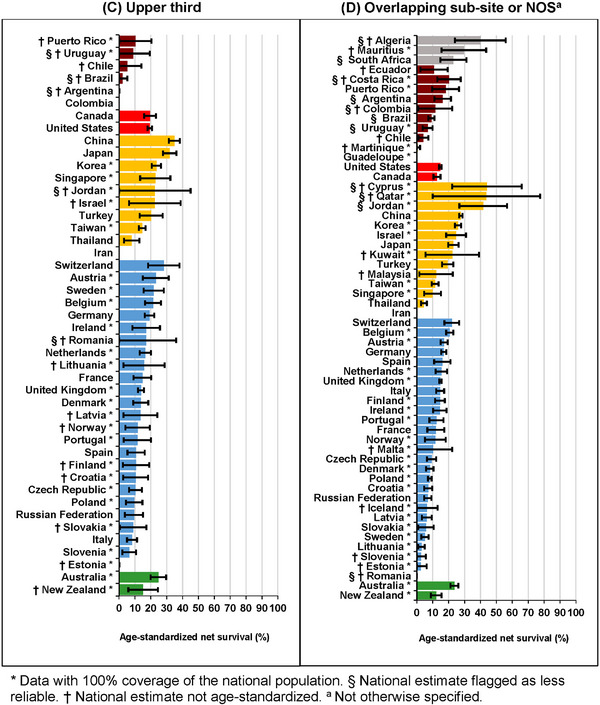
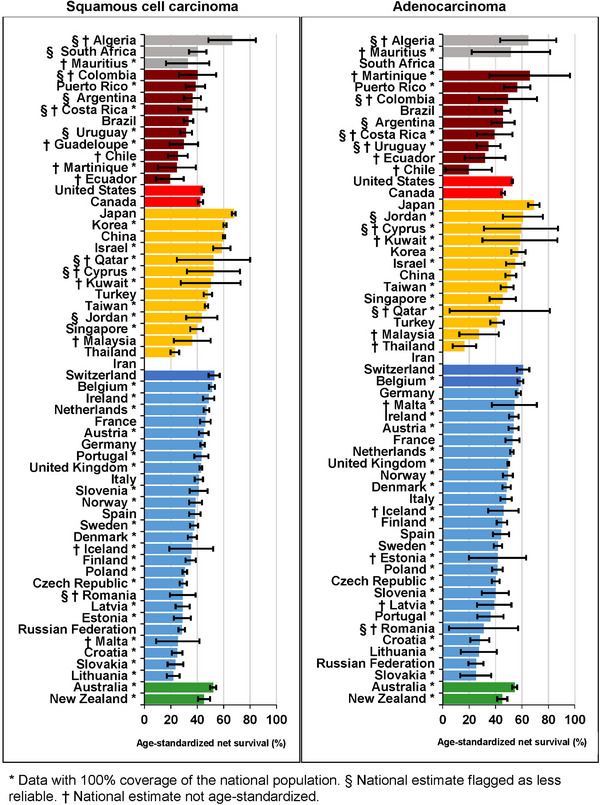
We estimated age-standardized one-year and five-year net survival among adults (15-99 years) diagnosed with esophageal cancer in each of 60 participating countries to monitor survival trends by calendar period of diagnosis (2000-2004, 2005-2009, 2010-2014), sub-site, morphology, and sex.
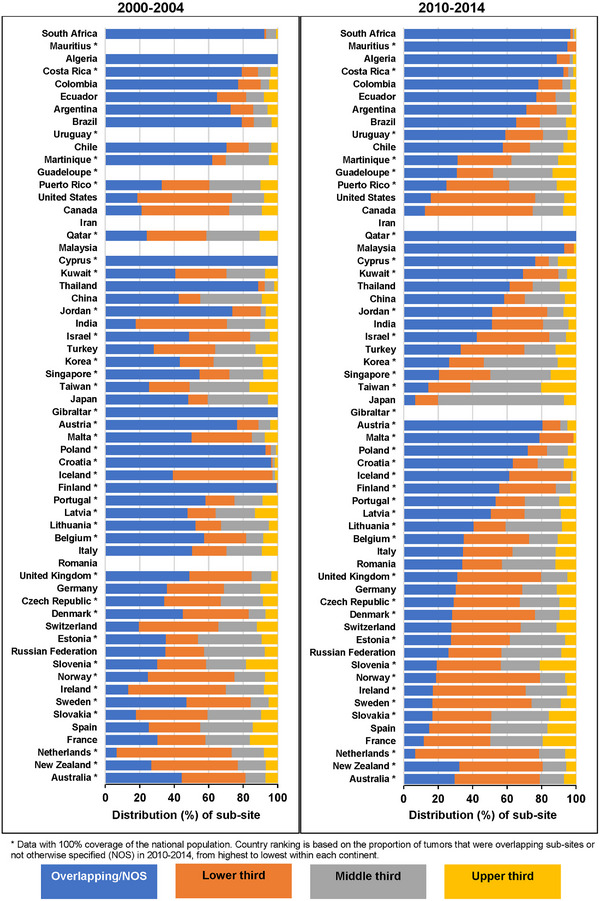
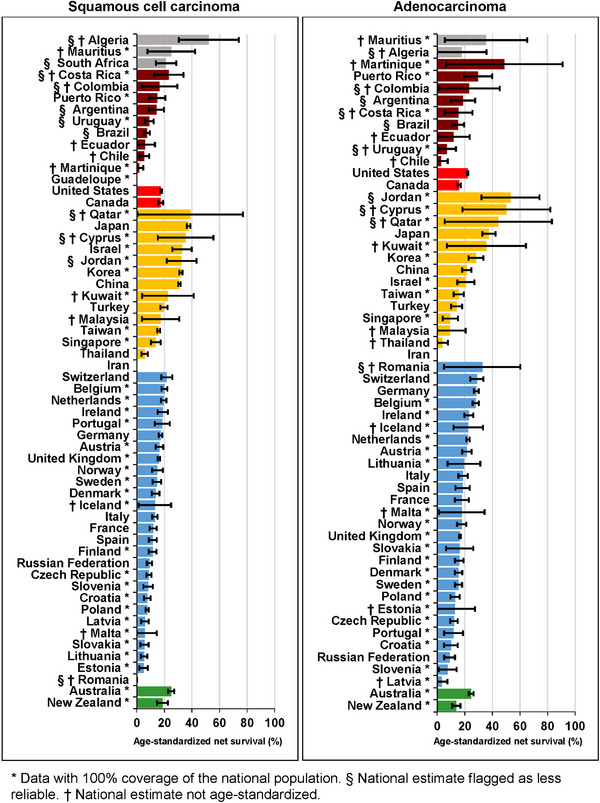
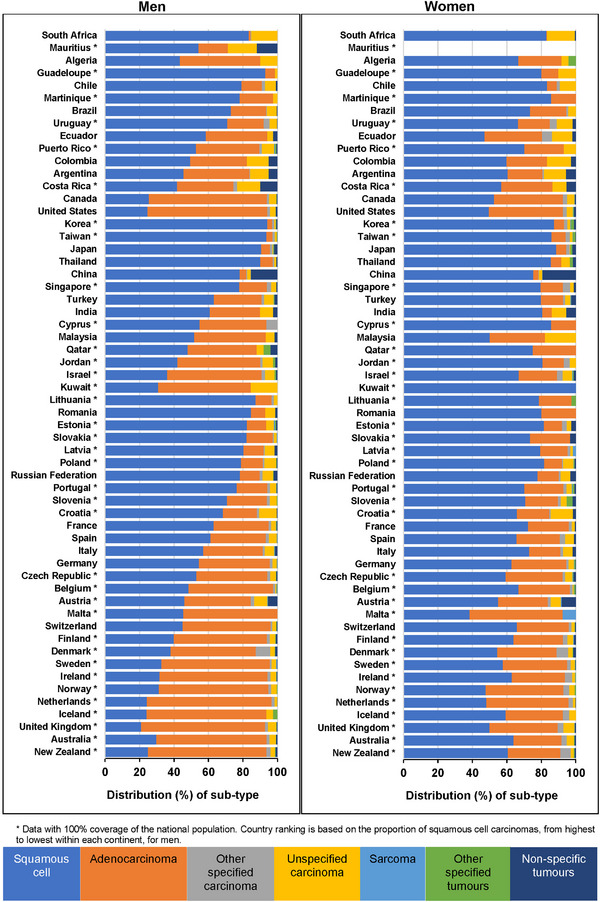
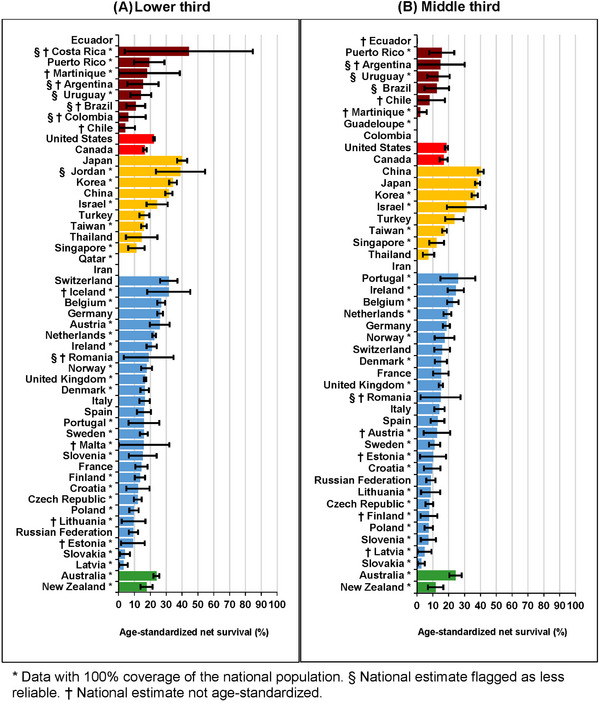
For adults diagnosed during 2010-2014, tumors in the lower third of the esophagus were the most common, followed by tumors of overlapping sub-site and sub-site not otherwise specified. The proportion of squamous cell carcinomas diagnosed during 2010-2014 was generally higher in Asian countries (50%-90%), while adenocarcinomas were more common in Europe, North America and Oceania (50%-60%). From 2000-2004 to 2010-2014, the proportion of squamous cell carcinoma generally decreased, and the proportion of adenocarcinoma increased. Over time, there were few improvements in age-standardized five-year survival for each sub-site. Age-standardized one-year survival was highest in Japan for both squamous cell carcinoma (67.7%) and adenocarcinoma (69.0%), ranging between 20%-60% in most other countries. Age-standardized five-year survival from squamous cell carcinoma and adenocarcinoma was similar for most countries included, around 15%-20% for adults diagnosed during 2010-2014, though international variation was wider for squamous cell carcinoma. In most countries, survival for both squamous cell carcinoma and adenocarcinoma increased by less than 5% between 2000-2004 and 2010-2014.
Esophageal cancer survival remains poor in many countries. The distributions of sub-site and morphological sub-type vary between countries, but these differences do not fully explain international variation in esophageal cancer survival.
尽管存在一些差异,但全球范围内食管癌的生存率仍然很低。解剖亚部位和形态亚型分布的差异可能有助于解释所有食管癌综合生存率的国际差异。我们通过解剖亚部位和形态亚型来估计生存率,以进一步了解地形和形态对国际间食管癌生存率比较的影响。
我们估计了 60 个参与国家中每一个国家成年(15-99 岁)食管癌患者的年龄标准化一年和五年净生存率,以监测按诊断日期(2000-2004 年、2005-2009 年、2010-2014 年)、亚部位、形态和性别划分的生存率趋势。
对于 2010-2014 年诊断的成年人,食管下段肿瘤最为常见,其次是重叠亚部位和未特指亚部位的肿瘤。2010-2014 年诊断的鳞状细胞癌比例在亚洲国家通常较高(50%-90%),而欧洲、北美和大洋洲则更常见腺癌(50%-60%)。从 2000-2004 年到 2010-2014 年,鳞状细胞癌的比例普遍下降,腺癌的比例上升。随着时间的推移,每个亚部位的年龄标准化五年生存率都很少有改善。在日本,无论是鳞状细胞癌(67.7%)还是腺癌(69.0%),年龄标准化一年生存率都最高,而在大多数其他国家,生存率在 20%-60%之间。2010-2014 年诊断的成年人中,大多数国家的年龄标准化五年生存率来自鳞状细胞癌和腺癌的情况相似,约为 15%-20%,但鳞状细胞癌的国际差异更大。在大多数国家,2000-2004 年至 2010-2014 年期间,鳞状细胞癌和腺癌的生存率均增加不到 5%。
在许多国家,食管癌的生存率仍然很低。亚部位和形态亚型的分布在国家之间有所不同,但这些差异并不能完全解释食管癌生存率的国际差异。