Song Seunghyeok, Kim Gushik, Kim Hyunjoong
Korea Pediatric Integrative Manual Therapy Association, 302 Gwanggyojungang-ro, Yongin 16943, Republic of Korea.
Gyeonggi Branch, Korea Physical Therapy Association, 1030 Gyeongsu-daero, Suwon 16203, Republic of Korea.
J Funct Morphol Kinesiol. 2023 Jun 29;8(3):92. doi: 10.3390/jfmk8030092.
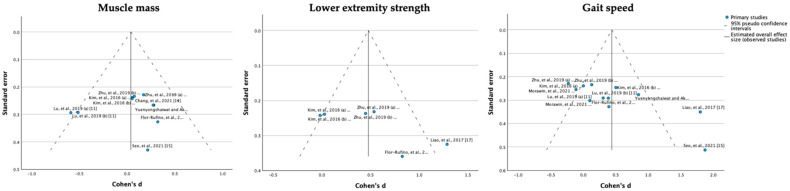
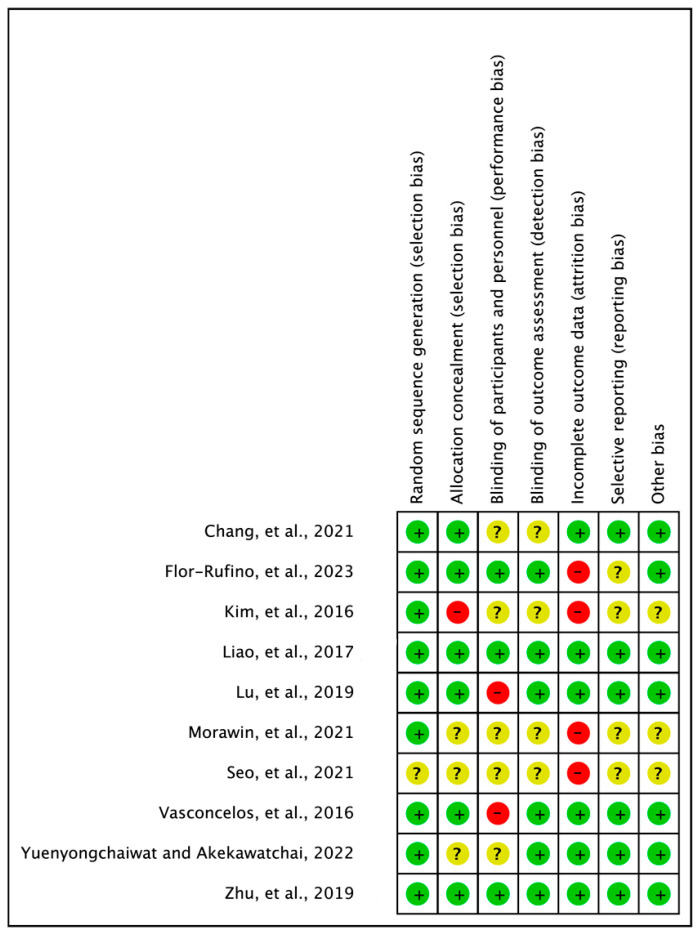
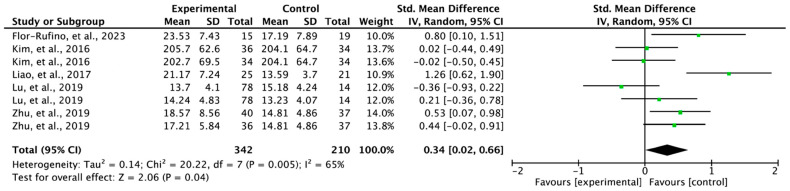
Sarcopenia, in addition to aging and reduced physical activity, is a progressive skeletal muscle disorder that causes the loss of muscle mass and strength. The most prominent functional change is mobility, which contributes to a decrease in the quality of life. Therefore, we aimed to perform qualitative and quantitative analyses by synthesizing randomized controlled trials (RCTs) that evaluated exercises that affected locomotion in patients with sarcopenia. The RCTs were retrieved in April 2023 from three international electronic databases (Embase, MEDLINE, and PubMed). RCTs published after 2013 were compared with a control group that did not include exercise. Qualitative and quantitative analyses were performed on the identified studies using RevMan 5.4 and risk of bias assessment provided by Cochrane. RCTs involving 594 patients with sarcopenia were included in this study. The analysis model was synthesized as a random effects model, and the standard mean difference (SMD) was used as the effect measure. Exercise interventions were found to not change muscle mass in individuals with sarcopenia (SMD = 0.04; 95% CI: -0.15 to 0.22). However, they had positive effects on lower extremity muscle strength (SMD = 0.34; 95% CI: 0.02 to 0.66) and walking speed (SMD = 0.42; 95% CI: 0.11 to 0.72). For community-dwelling elderly people with sarcopenia, exercise intervention did not lead to an increase in reduced muscle mass, but it brought positive improvements in lower extremity strength and gait speed to improve locomotion.
除衰老和身体活动减少外,肌肉减少症是一种进行性骨骼肌疾病,会导致肌肉质量和力量的丧失。最显著的功能变化是活动能力,这会导致生活质量下降。因此,我们旨在通过综合评估影响肌肉减少症患者运动的锻炼的随机对照试验(RCT)来进行定性和定量分析。这些RCT于2023年4月从三个国际电子数据库(Embase、MEDLINE和PubMed)中检索。将2013年后发表的RCT与不包括锻炼的对照组进行比较。使用RevMan 5.4对纳入的研究进行定性和定量分析,并由Cochrane提供偏倚风险评估。本研究纳入了594例肌肉减少症患者的RCT。分析模型合成为随机效应模型,并使用标准均值差(SMD)作为效应量度。研究发现,运动干预对肌肉减少症患者的肌肉质量没有影响(SMD = 0.04;95% CI:-0.15至0.22)。然而,它们对下肢肌肉力量(SMD = 0.34;95% CI:0.02至0.66)和步行速度(SMD = 0.42;95% CI:0.11至0.72)有积极影响。对于社区居住的肌肉减少症老年人,运动干预并未导致减少的肌肉质量增加,但它在下肢力量和步速方面带来了积极改善,以改善运动能力。