Jardine William T, Aisbett Brad, Kelly Monica K, Burke Louise M, Ross Megan L, Condo Dominique, Périard Julien D, Carr Amelia J
School of Exercise and Nutrition Sciences, Centre for Sport Research, Deakin University, 221 Burwood Highway, Burwood, VIC, 3125, Australia.
Mary MacKillop Institute for Health Research, Exercise and Nutrition Research Program, Australian Catholic University, Watson, ACT, 2602, Australia.
Sports Med. 2023 Nov;53(11):2111-2134. doi: 10.1007/s40279-023-01885-2. Epub 2023 Jul 25.
Fluid loss during prolonged exercise in hot conditions poses thermoregulatory and cardiovascular challenges for athletes that can lead to impaired performance. Pre-exercise hyperhydration using nutritional aids is a strategy that may prevent or delay the adverse effects of dehydration and attenuate the impact of heat stress on exercise performance.
The aim of this systematic review was to examine the current literature to determine the effect of pre-exercise hyperhydration on performance, key physiological responses and gastrointestinal symptoms.
English language, full-text articles that compared the intervention with a baseline or placebo condition were included. An electronic search of Medline Complete, SPORTDiscus and Embase were used to identify articles with the final search conducted on 11 October 2022. Studies were assessed using the American Dietetic Association Quality Criteria Checklist.
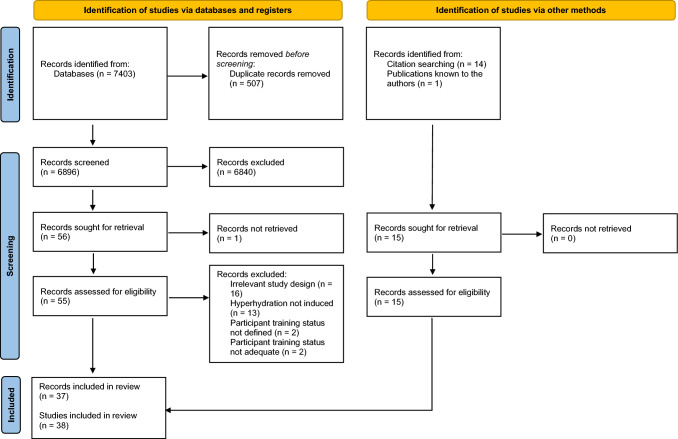
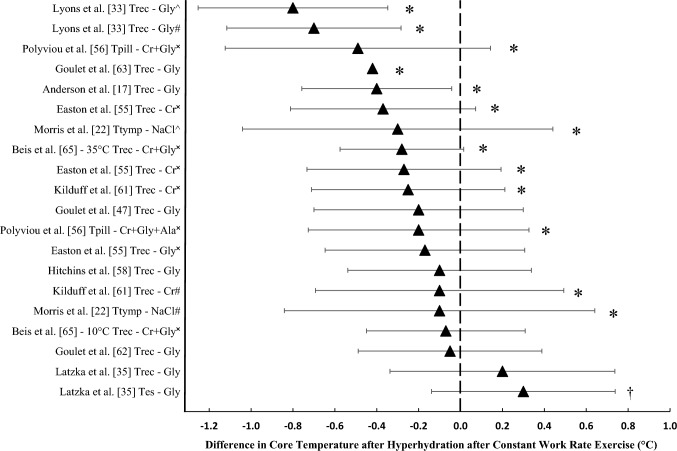
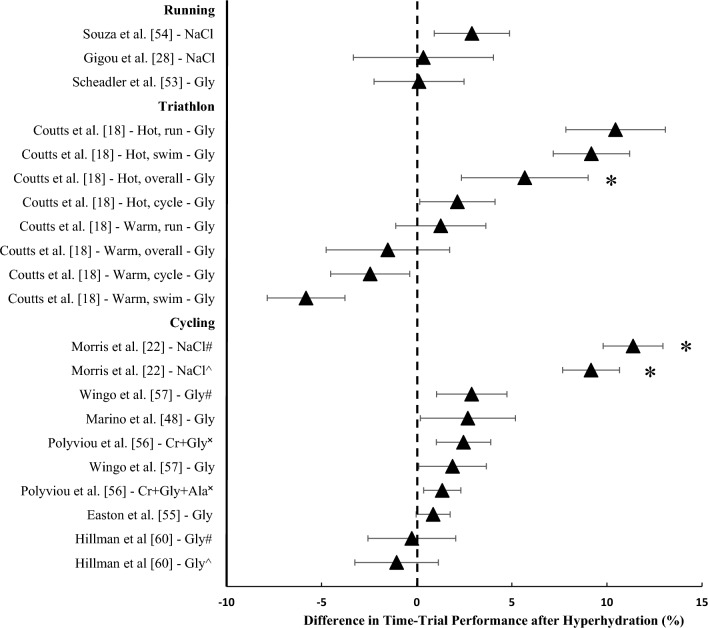
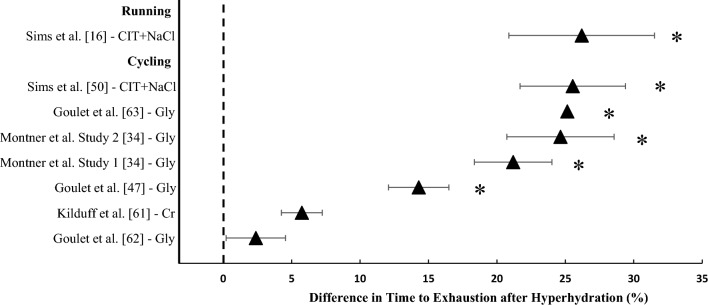
Thirty-eight studies involving 403 participants (n = 361 males) were included in this review (n = 22 assessed exercise performance or capacity). Two studies reported an improvement in time-trial performance (range 5.7-11.4%), three studies reported an improvement in total work completed (kJ) (range 4-5%) and five studies reported an increase in exercise capacity (range 14.3-26.2%). During constant work rate exercise, nine studies observed a reduced mean heart rate (range 3-11 beats min), and eight studies reported a reduced mean core temperature (range 0.1-0.8 °C). Ten studies reported an increase in plasma volume (range 3.5-12.6%) compared with a control. Gastrointestinal symptoms were reported in 26 studies, with differences in severity potentially associated with factors within the ingestion protocol of each study (e.g. treatment, dose, ingestion rate).
Pre-exercise hyperhydration may improve exercise capacity during constant work rate exercise due to a reduced heart rate and core temperature, stemming from an acute increase in plasma volume. The combination of different osmotic aids (e.g. glycerol and sodium) may enhance fluid retention and this area should continue to be explored. Future research should utilise valid and reliable methods of assessing gastrointestinal symptoms. Furthermore, studies should investigate the effect of hyperhydration on different exercise modalities whilst implementing a strong level of blinding. Finally, females are vastly underrepresented, and this remains a key area of interest in this area.
在炎热环境下长时间运动时的体液流失给运动员带来了体温调节和心血管方面的挑战,可能导致运动表现受损。使用营养辅助剂进行运动前过度补水是一种可以预防或延缓脱水不良影响并减轻热应激对运动表现影响的策略。
本系统评价的目的是研究当前文献,以确定运动前过度补水对运动表现、关键生理反应和胃肠道症状的影响。
纳入将干预措施与基线或安慰剂条件进行比较的英文全文文章。通过对Medline Complete、SPORTDiscus和Embase进行电子检索来识别文章,最终检索于2022年10月11日进行。使用美国饮食协会质量标准清单对研究进行评估。
本评价纳入了38项研究,涉及403名参与者(n = 361名男性)(n = 22项评估了运动表现或能力)。两项研究报告计时赛表现有所改善(范围为5.7 - 11.4%),三项研究报告完成的总功(千焦)有所改善(范围为4 - 5%),五项研究报告运动能力有所提高(范围为14.3 - 26.2%)。在恒定工作率运动期间,九项研究观察到平均心率降低(范围为每分钟3 - 11次心跳),八项研究报告平均核心体温降低(范围为0.1 - 0.8°C)。与对照组相比,十项研究报告血浆量增加(范围为3.5 - 12.6%)。26项研究报告了胃肠道症状,严重程度的差异可能与每项研究摄入方案中的因素(如治疗、剂量、摄入速率)有关。
运动前过度补水可能会因血浆量急性增加导致心率和核心体温降低,从而在恒定工作率运动期间提高运动能力。不同渗透辅助剂(如甘油和钠)的组合可能会增强液体潴留,这一领域应继续探索。未来的研究应采用有效且可靠的方法评估胃肠道症状。此外,研究应在实施严格盲法的同时,调查过度补水对不同运动方式的影响。最后,女性参与者的比例极低,这仍然是该领域的一个关键关注领域。