University of Utah, The School of Computing, Scientific Computing and Imaging Institute, Salt Lake City, UT.
The School of Computing, University of Utah, Salt Lake City, UT.
JCO Clin Cancer Inform. 2023 Jul;7:e2300057. doi: 10.1200/CCI.23.00057.
To determine prognostic and predictive clinical outcomes in metastatic hormone-sensitive prostate cancer (mHSPC) and metastatic castrate-resistant prostate cancer (mCRPC) on the basis of a combination of plasma-derived genomic alterations and lipid features in a longitudinal cohort of patients with advanced prostate cancer.
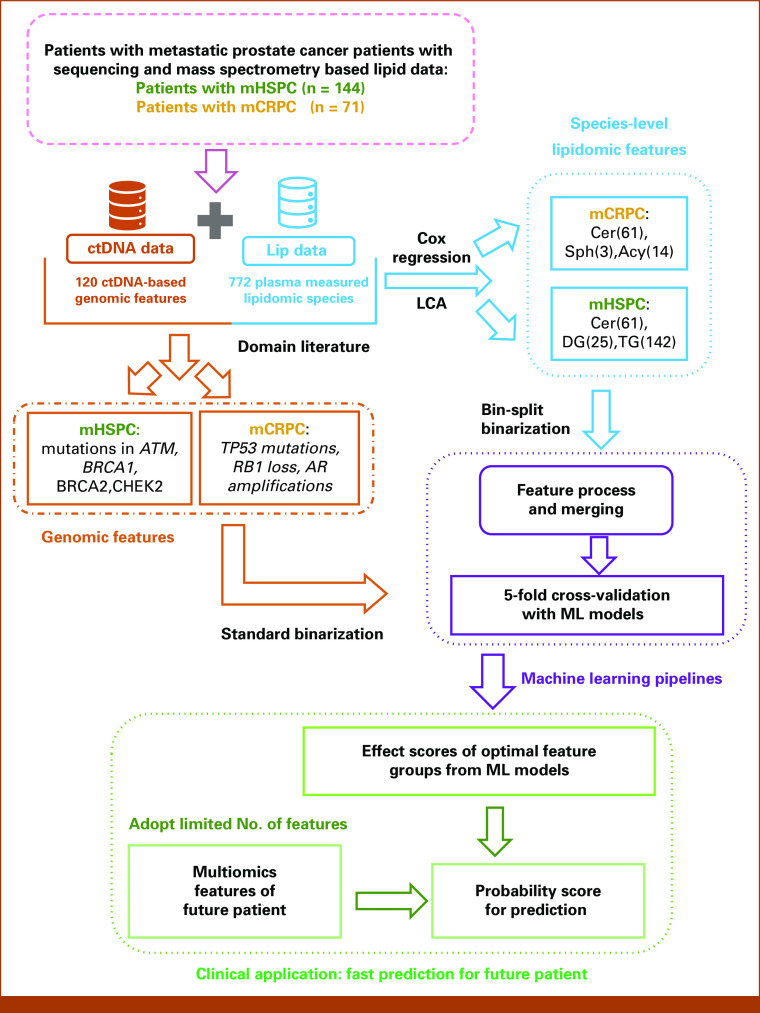
A multifeature classifier was constructed to predict clinical outcomes using plasma-based genomic alterations detected in 120 genes and 772 lipidomic species as informative features in a cohort of 71 patients with mHSPC and 144 patients with mCRPC. Outcomes of interest were collected over 11 years of follow-up. These included in mHSPC state early failure of androgen-deprivation therapy (ADT) and exceptional responders to ADT; early death (poor prognosis) and long-term survivors in mCRPC state. The approach was to build binary classification models that identified discriminative candidates with optimal weights to predict outcomes. To achieve this, we built multi-omic feature-based classifiers using traditional machine learning (ML) methods, including logistic regression with sparse regularization, multi-kernel Gaussian process regression, and support vector machines.
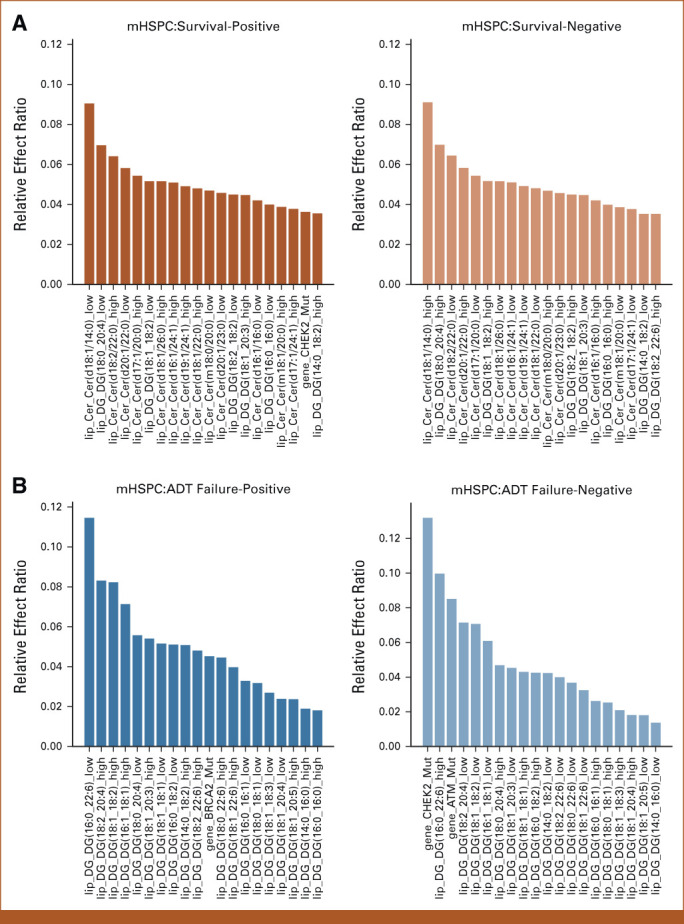
The levels of specific ceramides (d18:1/14:0 and d18:1/17:0), and the presence of mutations, amplification, and deletion were identified as the most crucial factors associated with clinical outcomes. Using ML models, the optimal multi-omics feature combination determined resulted in AUC scores of 0.751 for predicting mHSPC survival and 0.638 for predicting ADT failure; and in mCRPC state, 0.687 for prognostication and 0.727 for exceptional survival. The models were observed to be superior than using a limited candidate number of features for developing multi-omic prognostic and predictive signatures.
Using a ML approach that incorporates multiple omic features improves the prediction accuracy for metastatic prostate cancer outcomes significantly. Validation of these models will be needed in independent data sets in future.
基于晚期前列腺癌患者的纵向队列中血浆衍生的基因组改变和脂质特征的组合,确定转移性激素敏感前列腺癌(mHSPC)和转移性去势抵抗性前列腺癌(mCRPC)的预后和预测临床结果。
构建了一个多特征分类器,使用 mHSPC 队列中的 120 个基因和 772 种脂质组学物种中的血浆基因组改变作为信息特征,对 71 例 mHSPC 和 144 例 mCRPC 患者进行了分析。在 11 年的随访中收集了感兴趣的结果。其中包括 mHSPC 状态下雄激素剥夺治疗(ADT)早期失败和 ADT 异常反应者;mCRPC 状态下的早期死亡(预后不良)和长期幸存者。方法是构建二进制分类模型,确定具有最佳权重的有区别的候选者以预测结果。为此,我们使用传统机器学习(ML)方法构建了基于多组学特征的分类器,包括具有稀疏正则化的逻辑回归、多核高斯过程回归和支持向量机。
鉴定出特定神经酰胺(d18:1/14:0 和 d18:1/17:0)的水平,以及 突变、扩增和缺失的存在,是与临床结果最相关的关键因素。使用 ML 模型,确定的最佳多组学特征组合的 AUC 评分分别为 0.751,用于预测 mHSPC 生存;0.638,用于预测 ADT 失败;在 mCRPC 状态下,0.687 用于预后判断,0.727 用于异常生存。与使用有限数量的特征开发多组学预后和预测特征相比,这些模型表现出更好的预测精度。
使用包含多个组学特征的 ML 方法可以显著提高转移性前列腺癌结果的预测准确性。未来需要在独立的数据集中验证这些模型。