Annenberg School for Communication, University of Pennsylvania, Philadelphia, USA.
Desautels Faculty of Management, McGill University, Montreal, Canada.
Sci Rep. 2023 Jul 25;13(1):12045. doi: 10.1038/s41598-023-38478-y.
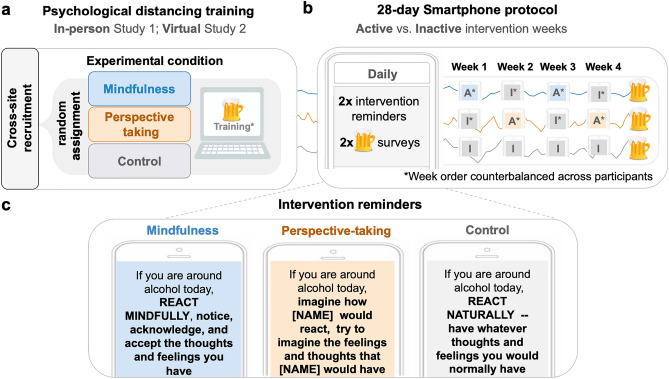
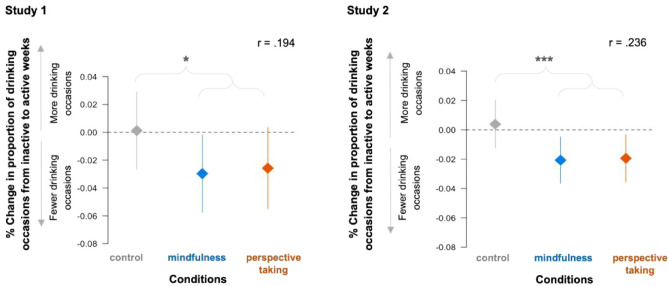
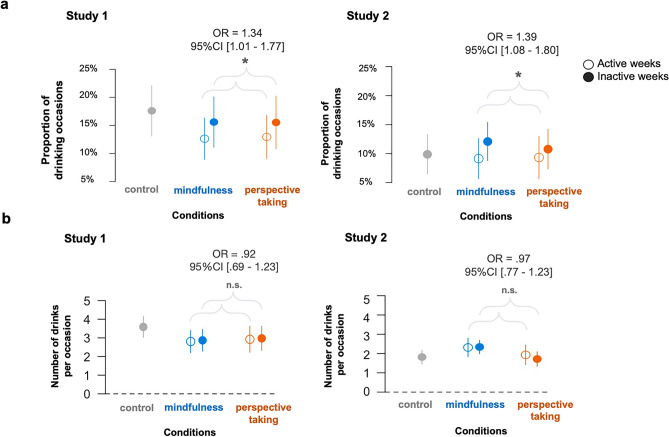
Modifying behaviors, such as alcohol consumption, is difficult. Creating psychological distance between unhealthy triggers and one's present experience can encourage change. Using two multisite, randomized experiments, we examine whether theory-driven strategies to create psychological distance-mindfulness and perspective-taking-can change drinking behaviors among young adults without alcohol dependence via a 28-day smartphone intervention (Study 1, N = 108 participants, 5492 observations; Study 2, N = 218 participants, 9994 observations). Study 2 presents a close replication with a fully remote delivery during the COVID-19 pandemic. During weeks when they received twice-a-day intervention reminders, individuals in the distancing interventions reported drinking less frequently than on control weeks-directionally in Study 1, and significantly in Study 2. Intervention reminders reduced drinking frequency but did not impact amount. We find that smartphone-based mindfulness and perspective-taking interventions, aimed to create psychological distance, can change behavior. This approach requires repeated reminders, which can be delivered via smartphones.
改变行为,例如饮酒,是困难的。在不健康的诱因和当下体验之间创造心理距离可以鼓励改变。我们通过两个多地点、随机实验来检验,是否有理论驱动的策略可以通过为期 28 天的智能手机干预(研究 1,N=108 名参与者,5492 次观察;研究 2,N=218 名参与者,9994 次观察)来改变没有酒精依赖的年轻人的饮酒行为,这些策略包括创造心理距离——正念和换位思考。研究 2 在 COVID-19 大流行期间提供了完全远程交付的密切复制。在他们每天收到两次干预提醒的周内,与控制周相比,在距离干预组中,个体饮酒频率较低——在研究 2 中则显著较低。干预提醒减少了饮酒频率,但没有影响饮酒量。我们发现,旨在创造心理距离的基于智能手机的正念和换位思考干预可以改变行为。这种方法需要重复提醒,这可以通过智能手机来实现。