Tang Yijun, Chen Yao, Wang Jiayi, Zhang Qianwen, Wang Yirou, Xu Yufei, Li Xin, Wang Jian, Wang Xiumin
Department of Endocrinology and Metabolism, Shanghai Children's Medical Center, School of Medicine, Shanghai Jiao Tong University, Shanghai, China.
Department of Urology, Ren Ji Hospital, School of Medicine, Shanghai Jiao Tong University, Shanghai, China.
Endocr Connect. 2023 Sep 4;12(10). doi: 10.1530/EC-23-0029. Print 2023 Oct 1.
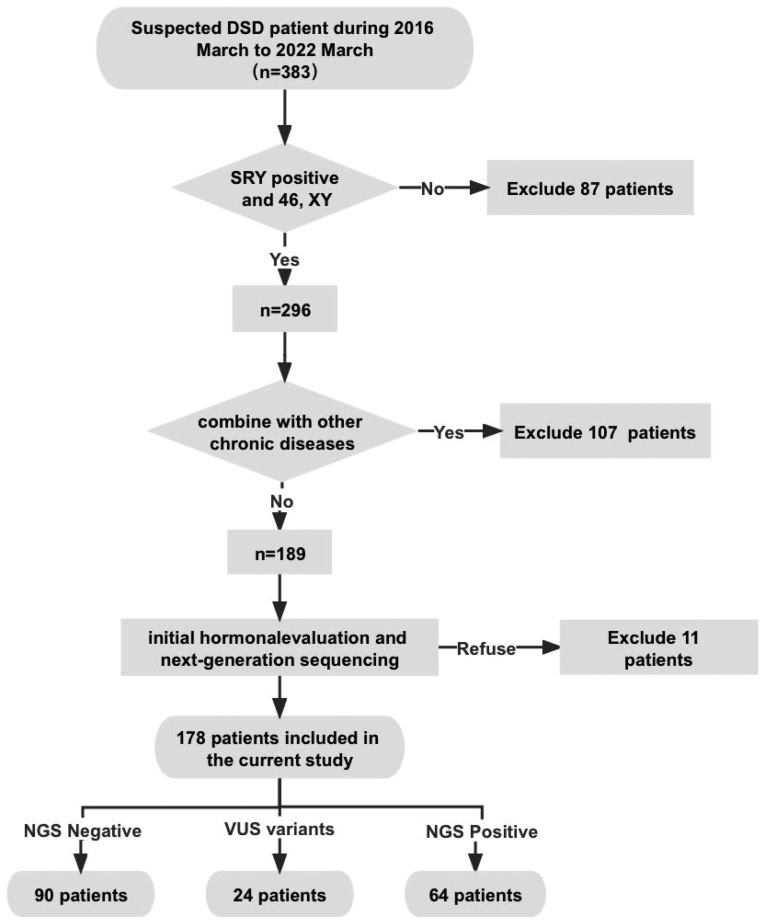
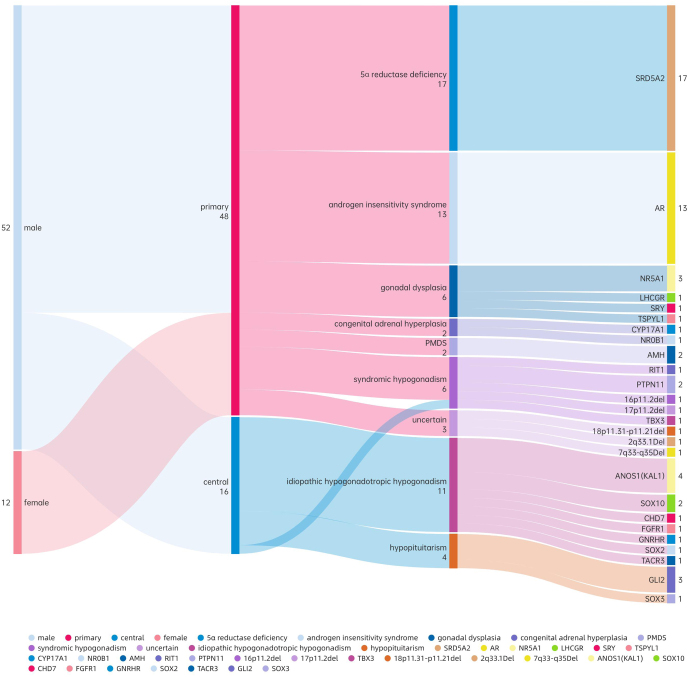
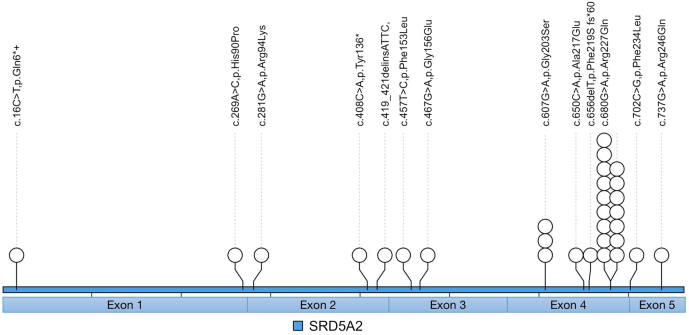
Diagnosis and management strategy of disorders of sex development (DSD) are difficult and various due to heterogeneous phenotype and genotype. Under widespread use of genomic sequencing technologies, multiple genes and mechanisms have been identified and proposed as genetic causes of 46,XY DSD. In this study, 178 46,XY DSD patients were enrolled and underwent gene sequencing (either whole-exome sequencing or targeted panel gene sequencing). Detailed clinical phenotype and genotype information were summarized which showed that the most common clinical manifestations were micropenis (56.74%, 101/178), cryptorchidism (34.27%, 61/178), and hypospadias (17.42%, 31/178). Androgen synthesis/action disorders and idiopathic hypogonadotropic hypogonadism were the most frequent clinical diagnoses, accounting, respectively, for 40.90 and 21.59%. From all next-generation sequencing results, 103 candidate variants distributed across 32 genes were identified in 88 patients. The overall molecular detection rate was 49.44% (88/178), including 35.96% (64/178) pathogenic/likely pathogenic variants and 13.48% (24/178) variants of uncertain significance. Of all, 19.42% (20/103) variants were first reported in 46,XY DSD patients. Mutation c.680G>A (p.R227Q) on SRD5A2 (steroid 5-alpha-reductase 2) (36.67%, 11/30) was a hotspot mutation in the Chinese population. Novel candidate genes related to DSD (GHR (growth hormone receptor) and PHIP (pleckstrin homology domain-interacting protein)) were identified. Overall, this was a large cohort of 46,XY DSD patients with a common clinical classification and phenotype spectrum of Chinese patients. Targeted gene panel sequencing covered most of the genes contributing to DSD, whereas whole-exome sequencing detected more candidate genes.
性发育障碍(DSD)的诊断和管理策略因表型和基因型的异质性而困难且多样。在基因组测序技术广泛应用的情况下,已鉴定出多个基因和机制,并提出它们是46,XY DSD的遗传原因。在本研究中,纳入了178例46,XY DSD患者并进行了基因测序(全外显子组测序或靶向基因panel测序)。总结了详细的临床表型和基因型信息,结果显示最常见的临床表现为小阴茎(56.74%,101/178)、隐睾症(34.27%,61/178)和尿道下裂(17.42%,31/178)。雄激素合成/作用障碍和特发性低促性腺激素性性腺功能减退是最常见的临床诊断,分别占40.90%和21.59%。从所有下一代测序结果中,在88例患者中鉴定出分布于32个基因的103个候选变异。总体分子检测率为49.44%(88/178),包括35.96%(64/178)的致病/可能致病变异和13.48%(24/178)意义未明的变异。其中,19.42%(20/103)的变异是首次在46,XY DSD患者中报道。SRD5A2(类固醇5-α还原酶2)上的突变c.680G>A(p.R227Q)(36.67%,11/30)是中国人群中的热点突变。鉴定出了与DSD相关的新候选基因(生长激素受体(GHR)和普列克底物蛋白同源结构域相互作用蛋白(PHIP))。总体而言,这是一个包含46,XY DSD患者的大型队列,具有中国患者常见的临床分类和表型谱。靶向基因panel测序覆盖了大多数导致DSD的基因,而全外显子组测序检测到了更多的候选基因。