School of Health Science, Western Sydney University, Penrith, NSW, Australia.
Department of People Determination and Sustainable Development, Organization of People Determination and Sustainable Development, Benghazi, Libya.
Glob Health Action. 2023 Dec 31;16(1):2240158. doi: 10.1080/16549716.2023.2240158.
Undernutrition remains a major public health issue in low- and middle-income countries. Objective Our aim for this study was to identify the factors contributing to undernutrition in children under five years old in North Africa.
We searched five electronic bibliographic databases (Ovid MEDLINE, Web of Science, Embase (Ovid), ProQuest, and CINAHL) for eligible observational studies published after 2006. STATA version 17 software was used to calculate the odds ratios between associated factors and indicators of undernutrition, with 95% confidence intervals. For each factor, the overall odds were pooled using a forest plot. Due to the significant heterogeneity among the studies (I2 > 50%), a random-effects model was used, and sensitivity analysis was conducted to examine the effect of outliers.
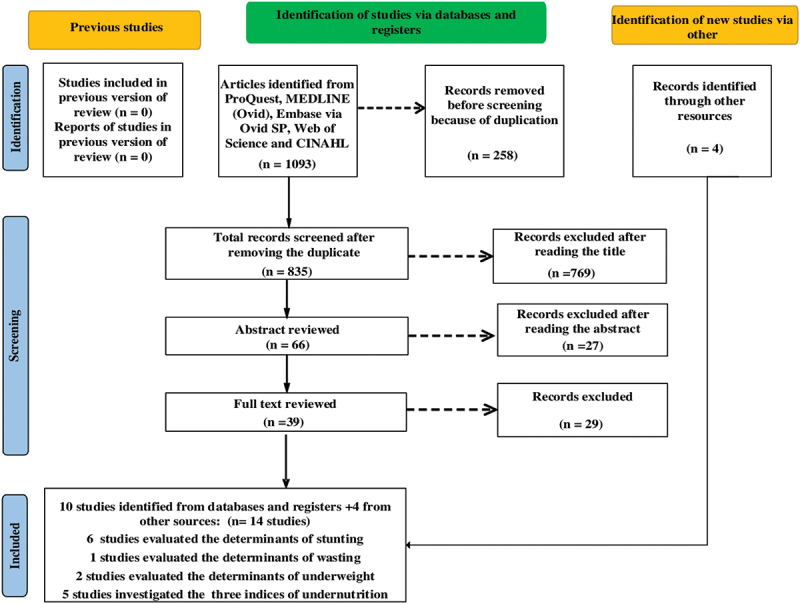
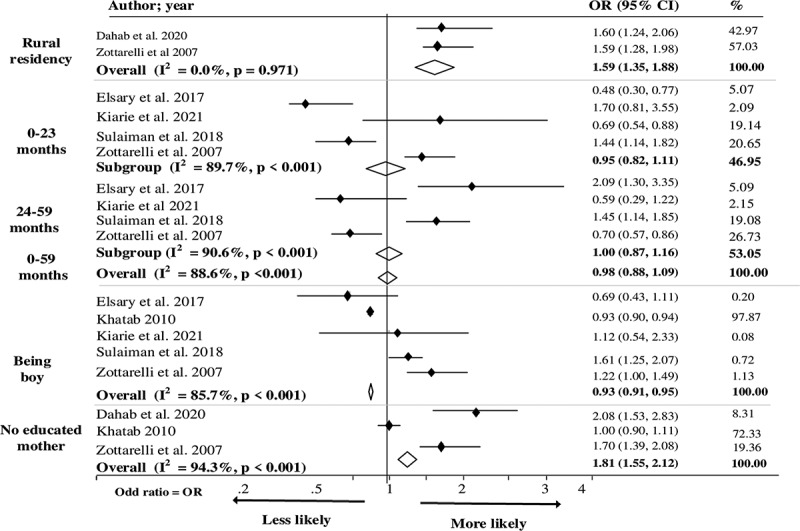
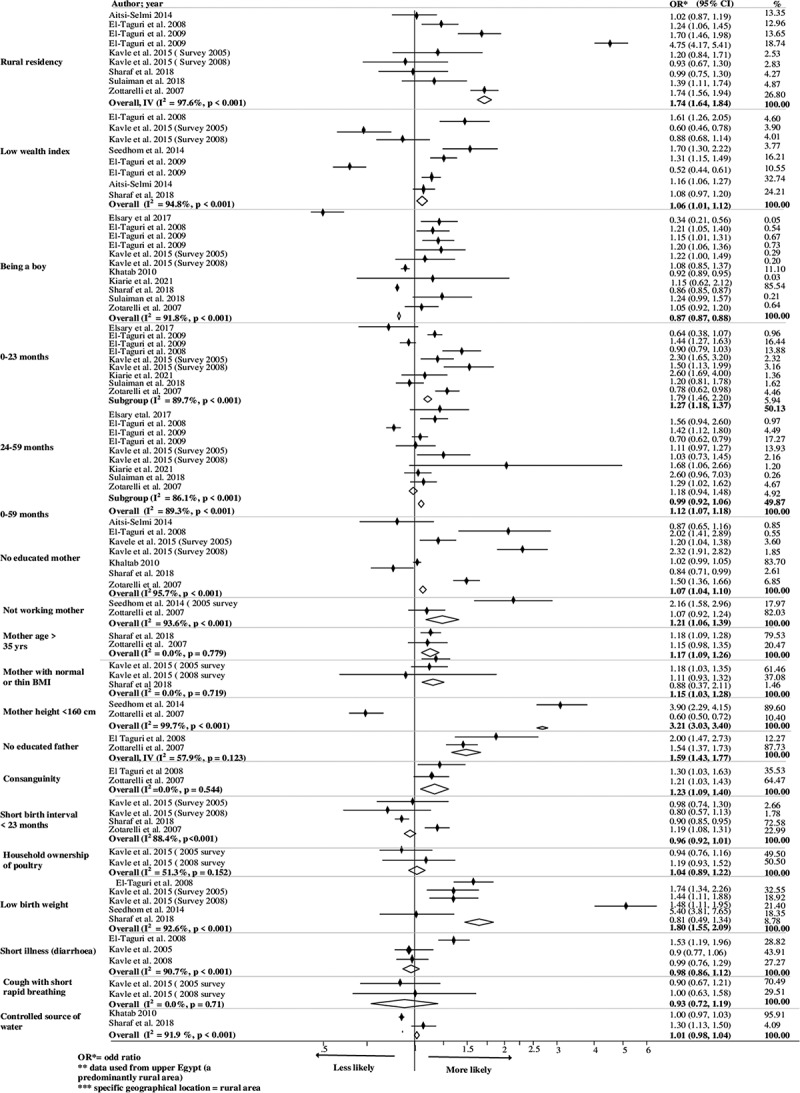
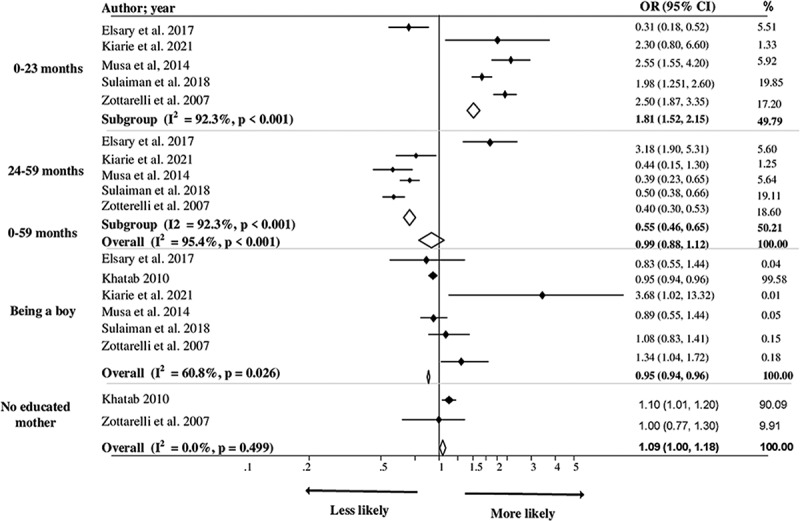
Out of 1093 initially identified studies, 14 met the selection criteria. Our meta-analysis revealed that uneducated mothers were the most common factor associated with undernutrition in North African children. Children aged 0-23 months were significantly associated with stunting (odds ratios (OR) = 1.27; 95% CI: 1.18; 1.37) and wasting (OR = 1.68; 95% CI: 1.42; 1.99). Children living in rural areas were also at higher odds of being stunted (OR = 1.74; 95% CI: 1.64; 1.84) and underweight (OR = 1.59; 95% CI: 1.35; 1.88). These analyses also indicated that a lower wealth index, mothers' nutritional health, uneducated fathers, and low birth weight were other factors significantly associated with stunting.
Addressing undernutrition in Northern Africa requires a multidisciplinary approach prioritising mothers and young children, especially families in underprivileged areas.
在中低收入国家,营养不良仍是一个主要的公共卫生问题。目的 本研究旨在确定北非五岁以下儿童营养不良的相关因素。
我们检索了五个电子文献数据库(Ovid MEDLINE、Web of Science、Embase(Ovid)、ProQuest 和 CINAHL),以获取 2006 年后发表的合格观察性研究。使用 STATA 版本 17 软件计算相关因素与营养不良指标之间的比值比(OR),置信区间为 95%。对于每个因素,使用森林图汇总总体 OR。由于研究之间存在显著的异质性(I2>50%),因此使用随机效应模型,并进行敏感性分析以检查异常值的影响。
在最初确定的 1093 项研究中,有 14 项符合选择标准。我们的荟萃分析表明,母亲未受教育是北非儿童营养不良的最常见相关因素。0-23 月龄儿童与发育迟缓(OR=1.27;95%CI:1.18;1.37)和消瘦(OR=1.68;95%CI:1.42;1.99)显著相关。生活在农村地区的儿童发生发育迟缓(OR=1.74;95%CI:1.64;1.84)和体重不足(OR=1.59;95%CI:1.35;1.88)的风险也更高。这些分析还表明,较低的财富指数、母亲的营养健康状况、父亲未受教育和低出生体重也是与发育迟缓显著相关的其他因素。
解决北非的营养不良问题需要采取多学科方法,优先考虑母亲和幼儿,特别是贫困地区的家庭。