
荷叶提取物通过抑制细胞凋亡来减轻产蛋鸡输卵管炎。
Lotus leaf extract can attenuate salpingitis in laying hens by inhibiting apoptosis.
机构信息
School of Animal Science, Yangtze University, Jingzhou 434020, China.
School of Animal Science, Yangtze University, Jingzhou 434020, China.
出版信息
Poult Sci. 2023 Oct;102(10):102865. doi: 10.1016/j.psj.2023.102865. Epub 2023 Jul 11.
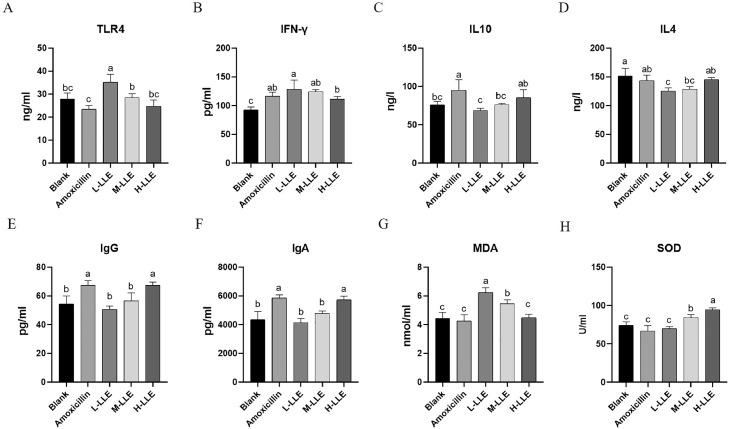
This study aimed to determine whether the lotus leaf extract (LLE) had the effect of treating salpingitis in laying hens. First, the salpingitis model was established by the method of bacterial infection. Differential genes between salpingitis and healthy laying hens were identified by transcriptome sequencing, and GO and KEGG enrichment analyses were performed. Groups of treatment of antibiotics and LLE were established to verify the feasibility of the lotus leaf extract in treating salpingitis. Furthermore, the active component and pharmacological effects of LLE were identified using the UPLC-Q-TOF-MS and network pharmacology technique. At last, the mechanism of LLE treating salpingitis was further evaluated by DF-1 cells infected with bacteria. The results showed that LLE significantly reduced the levels of TLR4 and IFN-γ (P < 0.05), accelerated the levels of IgA and IgG (P < 0.05), regulated the levels of SOD and MDA (P < 0.05) in laying hens with salpingitis. A total of 1,874 differential genes were obtained according to the transcriptome sequencing. It was revealed a significant role in cell cycle and apoptosis by enrichment analysis. In addition, among the 28 components identified by UPLC-Q-TOF-MS, 20 components acted on 58 genes, including CDK1, BIRC5, and CA2 for treating salpingitis. After bacterial infection, cells were damaged and unable to complete the normal progression of the cell cycle, leading to cell cycle arrest and further apoptosis formation. However, with the intervention of LLE, bacterial infection was resisted. The cells proliferation was extensively restored, and the expression of NO was increased. The addition of LLE significantly decreased cell apoptosis. The G1 phase increased, the S phase and the G2 phase decreased in the model group; after the intervention of LLE, the G1 phase gradually returned to the average level, and G2 and S phases increased. The mRNA expression levels of BIRC5, CDK1, and CA2 were consistent with the predicted results in network pharmacology. At the same time, the mRNA expression levels of Caspase-3 and Caspase-7 were reduced after added with LLE. The mRNA expression levels of TNF-α, TRADD, FADD, Caspase-8, Caspase-10, and Caspase-9 (P < 0.05), which would inhibit death receptor activation and decrease the apoptotic cascade, were upregulated after bacterial infection. However, the results in LLE groups were downregulated (P < 0.05). Meanwhile, the mRNA expression levels of BCL-2 in LLE groups were increased significantly compared with it in model group (P < 0.05). Notably, LLE administration inhibited apoptosis and regulated the cell cycle distribution in the salpingitis induced by bacterial infection. These results indicated that the LLE attenuated bacterial-induced salpingitis by modulating apoptosis and immune function in laying hens.
本研究旨在确定荷叶提取物(LLE)是否具有治疗产蛋鸡输卵管炎的作用。首先,通过细菌感染的方法建立输卵管炎模型。通过转录组测序鉴定输卵管炎和健康产蛋鸡之间的差异基因,并进行 GO 和 KEGG 富集分析。建立抗生素和 LLE 的治疗组以验证荷叶提取物治疗输卵管炎的可行性。此外,使用 UPLC-Q-TOF-MS 和网络药理学技术鉴定 LLE 的活性成分和药理作用。最后,通过感染细菌的 DF-1 细胞进一步评估 LLE 治疗输卵管炎的机制。结果表明,LLE 可显著降低 TLR4 和 IFN-γ 的水平(P<0.05),加速 IgA 和 IgG 的水平(P<0.05),调节 SOD 和 MDA 的水平(P<0.05),从而减轻产蛋鸡的输卵管炎。根据转录组测序获得了 1874 个差异基因。通过富集分析,发现其在细胞周期和细胞凋亡中具有重要作用。此外,通过 UPLC-Q-TOF-MS 鉴定出的 28 种成分中,有 20 种成分作用于 58 种基因,包括 CDK1、BIRC5 和 CA2,这些基因参与了输卵管炎的治疗。细菌感染后,细胞受损且无法正常完成细胞周期进程,导致细胞周期停滞和进一步的细胞凋亡形成。然而,在 LLE 的干预下,细菌感染得到了抵抗。细胞增殖得到广泛恢复,NO 的表达增加。加入 LLE 后,细胞凋亡显著减少。G1 期增加,模型组的 S 期和 G2 期减少;LLE 干预后,G1 期逐渐恢复到平均水平,G2 和 S 期增加。BIRC5、CDK1 和 CA2 的 mRNA 表达水平与网络药理学的预测结果一致。同时,加入 LLE 后 Caspase-3 和 Caspase-7 的 mRNA 表达水平降低。TNF-α、TRADD、FADD、Caspase-8、Caspase-10 和 Caspase-9 的 mRNA 表达水平(P<0.05)在细菌感染后升高,这些基因会抑制死亡受体的激活并减少凋亡级联反应,而 LLE 组的结果呈下调(P<0.05)。同时,LLE 组的 BCL-2mRNA 表达水平与模型组相比显著增加(P<0.05)。值得注意的是,LLE 可抑制细菌感染引起的输卵管炎中的细胞凋亡并调节细胞周期分布。这些结果表明,LLE 通过调节产蛋鸡的免疫功能来减轻由细菌引起的输卵管炎。



 Zotero 插件