Department of Cardiology, Affiliated Hospital of Nanjing University of Chinese Medicine, Nanjing, China.
Department of Cardiology, Jiangsu Province Hospital of Chinese Medicine, No. 155, Hanzhong Road, Nanjing, 210004, China.
Eur J Med Res. 2023 Jul 27;28(1):259. doi: 10.1186/s40001-023-01214-3.
Previous studies have shown that there may be a positive correlation between serum uric acid levels and hyperthyroidism. However, the relationship between thyroid function and serum uric acid in healthy people is unclear. This study analyzed the relationship between impaired thyroid hormone sensitivity and serum uric acid levels, and presented them in quantitative form.
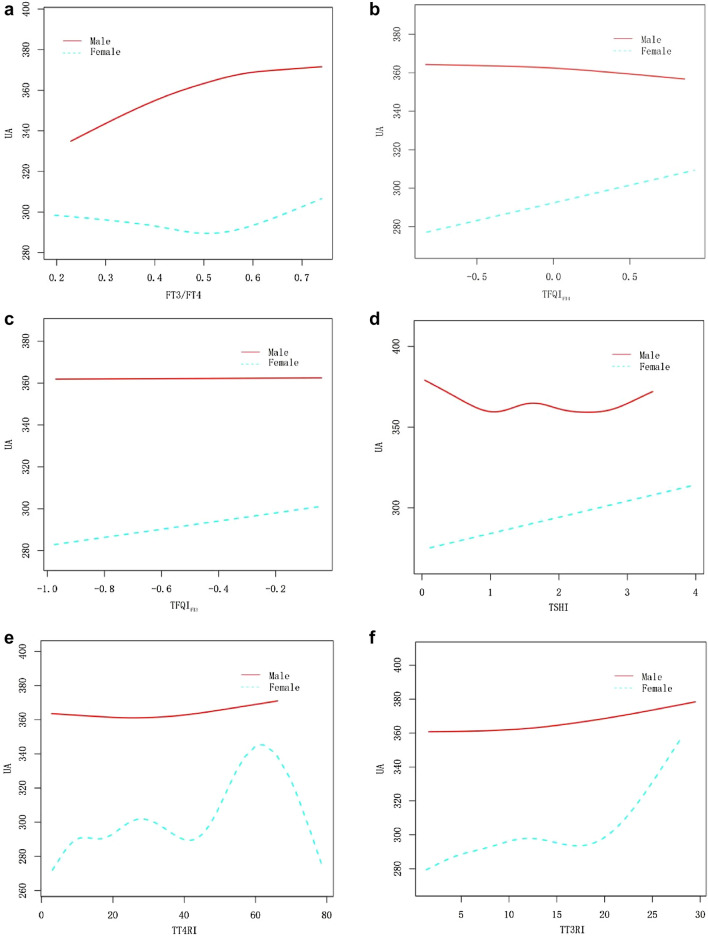
This is a cross-sectional study of 4460 adults (male: 2300; female: 2160) who participated in the National Health and Nutrition Examination Survey (NHANES) from 2007 to 2010. Parameters representing central sensitivity to thyroid hormones were calculated as: thyroid feedback quantile-based index (TFQI), thyroid stimulating hormone index (TSHI), and total thyroxine (T4) resistance index (TT4RI); Peripheral sensitivity to thyroid hormone was evaluated by FT3/FT4 ratio. In addition, we have innovated total triiodothyronine (T3) resistance index (TT3RI) and TFQI indexes based on FT3 and TSH. Multiple linear regression models were used to evaluate the correlation between thyroid resistance index and serum uric acid, and the results were presented graphically as smooth curve fittings.
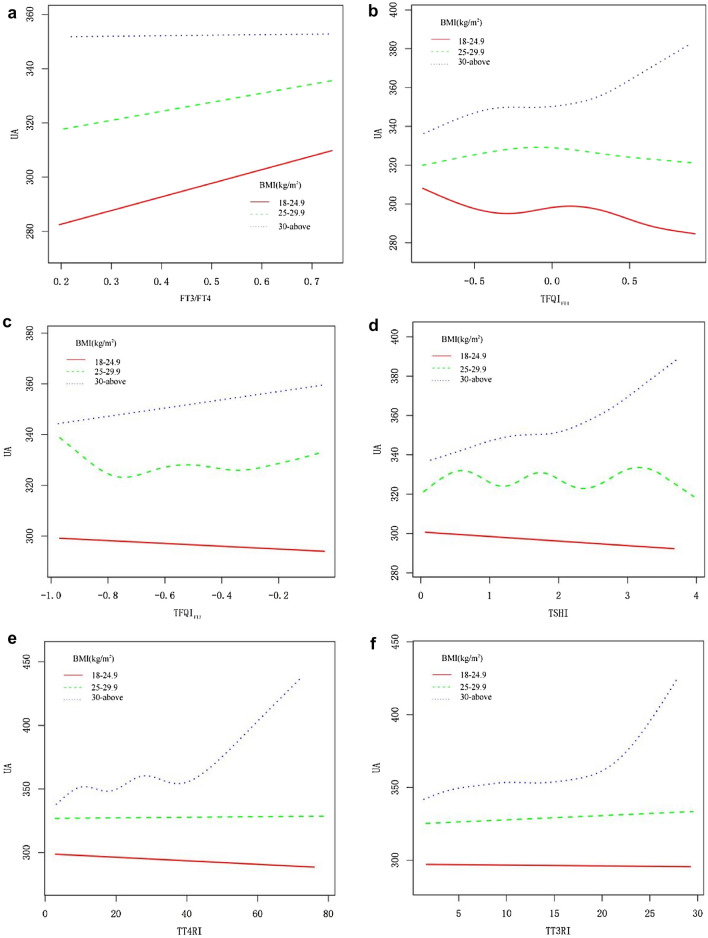
Higher levels of serum uric acid were associated with decreased sensitivity to thyroid hormones in euthyroid individuals. In conjunction with an increase in the thyroid hormone sensitivity index value, uric acid levels gradually increased as well. Furthermore, we found a segmented relationship between TT3RI and serum uric acid changes. The saturation and threshold analyses indicated that 18.85 was the turning point (logarithmic likelihood ratio test = 0.036). When TT3RI < 18.85, the relationship between serum uric acid and TT3RI was not significant [β(95% CI) 0.47 (- 0.05, 1.00), P = 0.077], but when TT3RI > 18.85, there was a significant rise in serum uric acid with an increase in TT3RI [β(95% CI) 3.94 (0.94, 6.95), P = 0.010]. A further finding of the interaction test was that impaired thyroid hormone sensitivity and uric acid changes vary among different age groups and BMI levels.
Decreased sensitivity to thyroid hormones was associated with high levels of serum uric acid in people with normal thyroid function. The interaction test shows that different age groups and BMI groups impact the association between impaired thyroid hormone sensitivity and serum uric acid. Furthermore, smooth curve fitting revealed a segmental relationship between TT3RI and serum uric acid levels.
既往研究表明,血清尿酸水平与甲状腺功能亢进之间可能存在正相关。然而,健康人群中甲状腺功能与血清尿酸之间的关系尚不清楚。本研究旨在分析甲状腺激素敏感性受损与血清尿酸水平之间的关系,并以定量形式呈现。
这是一项横断面研究,纳入了 2007 年至 2010 年参加国家健康与营养调查(NHANES)的 4460 名成年人(男性 2300 名,女性 2160 名)。计算代表甲状腺激素中枢敏感性的参数为:甲状腺反馈定量指数(TFQI)、促甲状腺激素指数(TSHI)和总甲状腺素(T4)抵抗指数(TT4RI);外周甲状腺激素敏感性通过 FT3/FT4 比值进行评估。此外,我们基于 FT3 和 TSH 创新了总三碘甲状腺原氨酸(T3)抵抗指数(TT3RI)和 TFQI 指数。采用多元线性回归模型评估甲状腺抵抗指数与血清尿酸之间的相关性,并以平滑曲线拟合的形式呈现结果。
在甲状腺功能正常的个体中,血清尿酸水平与甲状腺激素敏感性降低相关。随着甲状腺激素敏感性指数值的增加,尿酸水平也逐渐升高。此外,我们发现 TT3RI 与血清尿酸变化之间存在分段关系。饱和和阈值分析表明,18.85 是转折点(对数似然比检验=0.036)。当 TT3RI<18.85 时,血清尿酸与 TT3RI 之间的关系不显著[β(95%CI)0.47(-0.05,1.00),P=0.077],但当 TT3RI>18.85 时,随着 TT3RI 的增加,血清尿酸显著升高[β(95%CI)3.94(0.94,6.95),P=0.010]。交互检验的进一步发现是,甲状腺激素敏感性受损和尿酸变化在不同年龄组和 BMI 水平之间存在差异。
甲状腺功能正常人群中,甲状腺激素敏感性降低与血清尿酸水平升高相关。交互检验显示,不同年龄组和 BMI 组影响甲状腺激素敏感性受损与血清尿酸之间的关联。此外,平滑曲线拟合显示 TT3RI 与血清尿酸水平之间存在分段关系。