Zhou Hang, Xu Mingming, Xu Zhunan, Li Muwei, Ren Congzhe, Chen Xiangyu, Liu Xiaoqiang
Department of Urology, Tianjin Medical University General Hospital, Tianjin, 300052, China.
Sex Med. 2023 Jul 25;11(3):qfad036. doi: 10.1093/sexmed/qfad036. eCollection 2023 Jun.
The relationship between erectile dysfunction (ED) and physical activity has been established in several previous studies, but there is little information on the specific forms of activity that affect ED.
The objective of this study was to evaluate the relationship of 4 exercise categories and 2 activity intensities with ED in US men.
We used data sets from the National Health and Nutrition Examination Survey, 2001-2004. We used odds ratios (ORs) and multivariate logistic regression models to investigate the relationship between physical activity and ED. We also conducted subgroup analyses by age and controlled for potential confounder variables using propensity score matching analyses.
The primary outcome was ED as assessed through self-reporting.
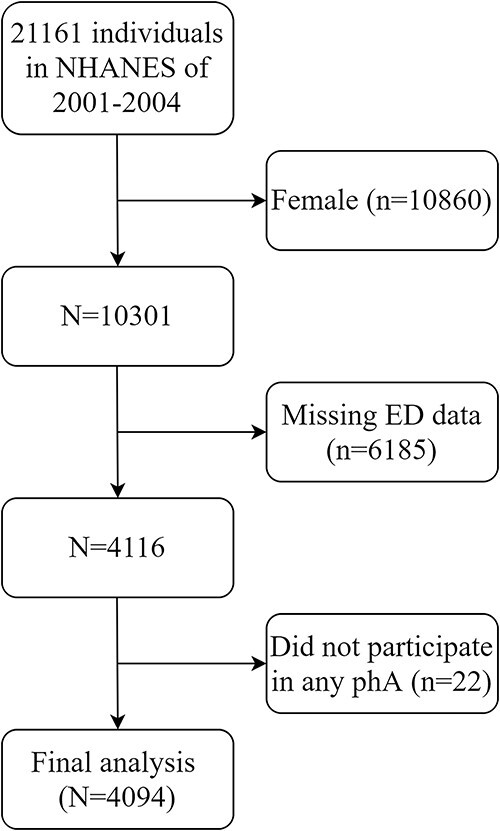
An overall 4094 adult men were included in the study. Adjusted multivariate regression models indicated that men who participated in monthly muscle-strengthening activities (OR = 0.75, = .031), leisure activities (OR = 0.76, = .024), or vigorous activities (OR = 0.64, = .001) had a lower risk of ED. The subgroup analysis showed that among those ≥40 years old, muscle-strengthening activity (OR = 0.67, = .005), leisure activity (OR = 0.72, = .006), and vigorous activity (OR = 0.50, < .001) were negatively associated with ED. After adjustment of propensity score matching, leisure activity and vigorous activity were also associated with a lower risk of ED, and muscle-strengthening activity was not significantly associated with ED.
Our findings could provide guidance to clinicians in helping patients with ED develop exercise programs.
We explored the relationship of 4 types and 2 intensities of exercise with ED, using a large sample size and sampling weights to produce representative data. However, this is only a cross-sectional study.
Active monthly participation in leisure and vigorous activity is associated with the maintenance of erectile function, while the relevance of muscle-strengthening activities needs further study.
先前的多项研究已证实勃起功能障碍(ED)与身体活动之间存在关联,但关于影响ED的具体活动形式的信息却很少。
本研究旨在评估美国男性中4种运动类别和2种活动强度与ED之间的关系。
我们使用了2001 - 2004年国家健康与营养检查调查的数据集。我们使用优势比(OR)和多变量逻辑回归模型来研究身体活动与ED之间的关系。我们还按年龄进行了亚组分析,并使用倾向得分匹配分析控制了潜在的混杂变量。
通过自我报告评估的ED作为主要结果。
该研究共纳入4094名成年男性。调整后的多变量回归模型表明,每月参与肌肉强化活动(OR = 0.75,P = 0.031)、休闲活动(OR = 0.76,P = 0.024)或剧烈活动(OR = 0.64,P = 0.001)的男性患ED的风险较低。亚组分析显示,在年龄≥40岁的人群中,肌肉强化活动(OR = 0.67,P = 0.005)、休闲活动(OR = 0.72,P = 0.006)和剧烈活动(OR = 0.50,P < 0.001)与ED呈负相关。在调整倾向得分匹配后,休闲活动和剧烈活动也与较低的ED风险相关,而肌肉强化活动与ED无显著关联。
我们的研究结果可为临床医生帮助ED患者制定运动计划提供指导。
我们使用大样本量和抽样权重来生成具有代表性的数据,探讨了4种运动类型和2种强度与ED的关系。然而,这只是一项横断面研究。
每月积极参与休闲和剧烈活动与维持勃起功能有关,而肌肉强化活动的相关性需要进一步研究。