Luo Xie, Liu Yining, Li Siyue, He Xinhua
School of Environmental Ecology and Biological Engineering, Institute of Changjiang Water Environment and Ecological Security, Key Laboratory for Green Chemical Process of Ministry of Education, Hubei Key Laboratory of Novel Reactor and Green Chemical Technology, Wuhan Institute of Technology, Wuhan, China.
National Base of International Science and Technology (S&T) Collaboration on Water Environmental Monitoring and Simulation in the Three Gorges Reservoir Region and Centre of Excellence for Soil Biology, College of Resources and Environment, Southwest University, Chongqing, China.
Front Plant Sci. 2023 Jul 12;14:1169310. doi: 10.3389/fpls.2023.1169310. eCollection 2023.
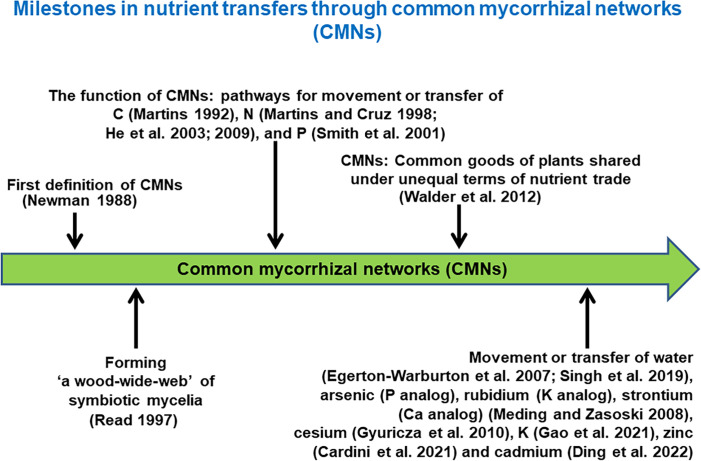
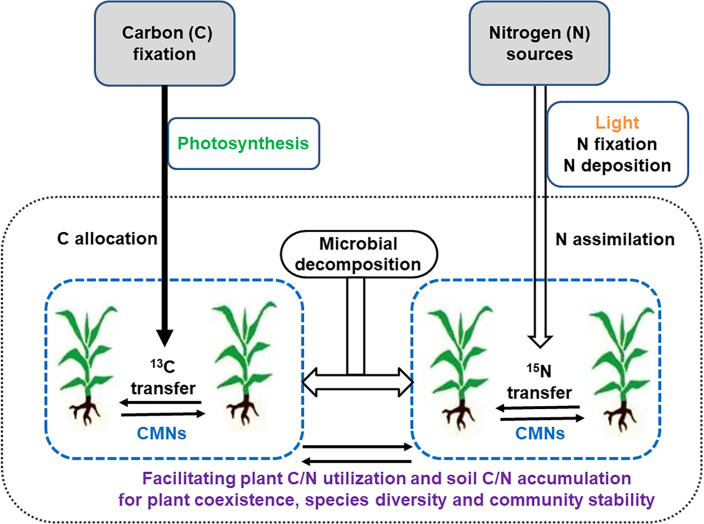
Arbuscular mycorrhizal fungi (AMF) are ubiquitous in soil and form nutritional symbioses with ~80% of vascular plant species, which significantly impact global carbon (C) and nitrogen (N) biogeochemical cycles. Roots of plant individuals are interconnected by AMF hyphae to form common AM networks (CAMNs), which provide pathways for the transfer of C and N from one plant to another, promoting plant coexistence and biodiversity. Despite that stable isotope methodologies (C, C and N tracer techniques) have demonstrated CAMNs are an important pathway for the translocation of both C and N, the functioning of CAMNs in ecosystem C and N dynamics remains equivocal. This review systematically synthesizes both laboratory and field evidence in interplant C and N transfer through CAMNs generated through stable isotope methodologies and highlights perspectives on the system functionality of CAMNs with implications for plant coexistence, species diversity and community stability. One-way transfers from donor to recipient plants of 0.02-41% C and 0.04-80% N of recipient C and N have been observed, with the reverse fluxes generally less than 15% of donor C and N. Interplant C and N transfers have practical implications for plant performance, coexistence and biodiversity in both resource-limited and resource-unlimited habitats. Resource competition among coexisting individuals of the same or different species is undoubtedly modified by such C and N transfers. Studying interplant variability in these transfers with C and N tracer application and natural abundance measurements could address the eco physiological significance of such CAMNs in sustainable agricultural and natural ecosystems.
丛枝菌根真菌(AMF)在土壤中广泛存在,与约80%的维管植物物种形成营养共生关系,这对全球碳(C)和氮(N)生物地球化学循环产生重大影响。植物个体的根系通过AMF菌丝相互连接,形成共同的AM网络(CAMNs),为碳和氮从一种植物转移到另一种植物提供途径,促进植物共存和生物多样性。尽管稳定同位素方法(碳、碳和氮示踪技术)已证明CAMNs是碳和氮转移的重要途径,但CAMNs在生态系统碳和氮动态中的功能仍不明确。本综述系统地综合了通过稳定同位素方法产生的CAMNs在植物间碳和氮转移方面的实验室和实地证据,并强调了关于CAMNs系统功能的观点,这些观点对植物共存、物种多样性和群落稳定性具有重要意义。已观察到从供体植物到受体植物的单向转移量分别为受体碳和氮的0.02 - 41%的碳和0.04 - 80%的氮,反向通量通常小于供体碳和氮的15%。植物间的碳和氮转移对资源有限和资源无限生境中的植物表现、共存和生物多样性都具有实际意义。同一或不同物种共存个体之间的资源竞争无疑会因这种碳和氮转移而改变。利用碳和氮示踪应用以及自然丰度测量研究这些转移过程中的植物间变异性,可以揭示这种CAMNs在可持续农业和自然生态系统中的生态生理意义。