Invencao Cabral Thais, Pan Xueliang, Tripathi Tanya, Ma Jianing, Heathcock Jill C
School of Health and Rehabilitation Sciences, The Ohio State University, Columbus, OH 43220, USA.
Department of Biomedical Informatics, The Ohio State University, Columbus, OH 43210, USA.
Behav Sci (Basel). 2023 Jun 29;13(7):542. doi: 10.3390/bs13070542.
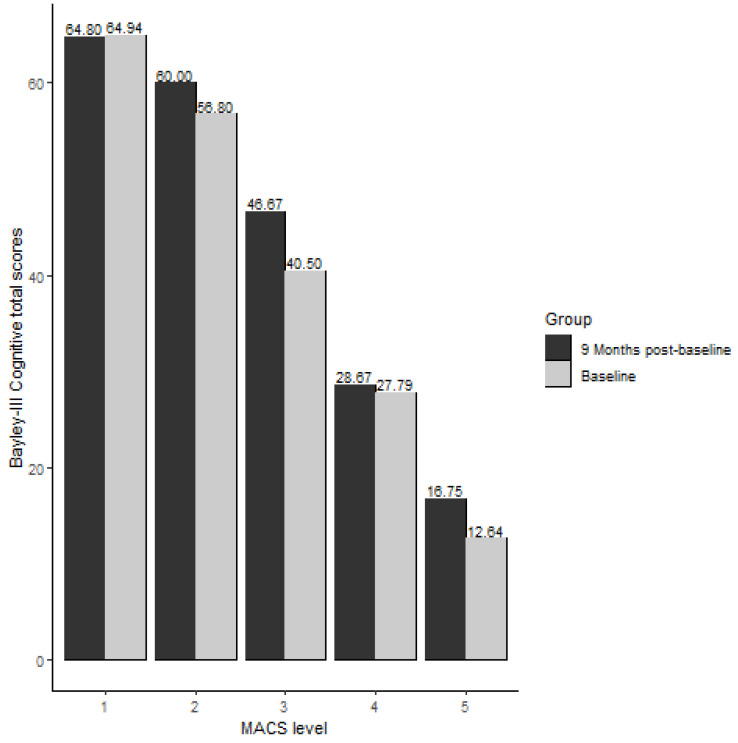
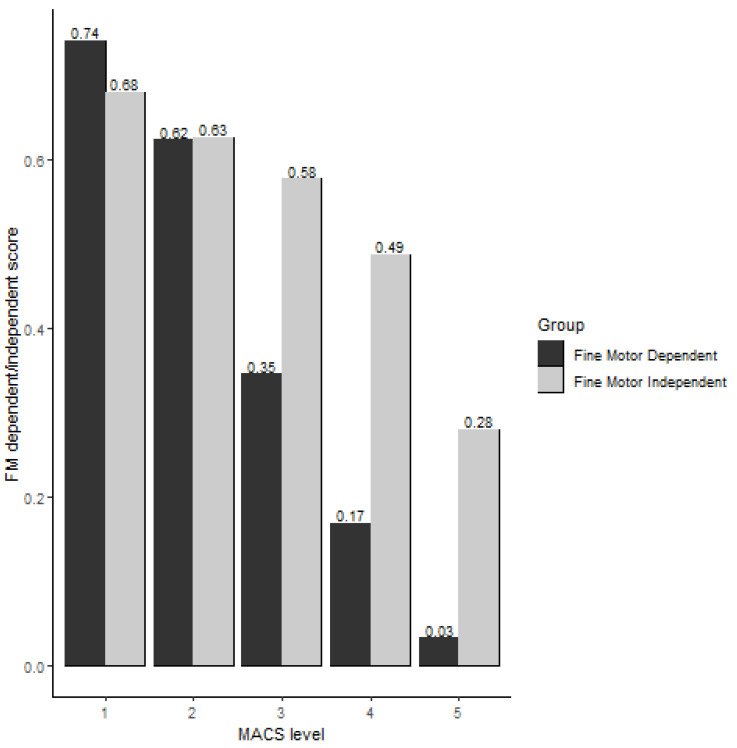
Manual ability may be an important consideration when measuring cognition in children with CP because many items on cognitive tests require fine motor skills. This study investigated the association of fine motor dependent (FMD) and fine motor independent (FMI) items within the cognitive domain (COG) of the Bayley Scales of Infant Development-Third Edition (Bayley-III) and Manual Ability Classification System (MACS) in children with cerebral palsy. Children aged 2 to 8 (3.96 ± 1.68) years were included in this study. MACS levels were assigned at baseline. COG was administrated at baseline (n = 61) and nine months post-baseline (n = 28). The 91 items were classified into FMD (52) and FMI (39). Total raw score, FMD, and FMI scores were calculated. The association between MACS and cognitive scores (total, FMD, and FMI) were evaluated using linear regression and Spearman correlation coefficients. We found total, FMD, and FMI scores decrease significantly as the MACS level increases at the baseline. Both FMD and FMI scores decreased as MACS levels increased (worse function). There was a significant difference between the two slopes, with the FMD scores having a steeper slope. Similar patterns were observed nine months post-baseline. Children with lower manual ability scored lower in the cognitive domain at baseline and 9 months post-baseline. The significant difference in the performance of FMD items and FMI items across MACS levels with a steeper slope of changes in FMD items suggests fine motor skills impact cognition.
在评估脑瘫儿童的认知能力时,手动能力可能是一个重要的考量因素,因为认知测试中的许多项目都需要精细运动技能。本研究调查了《贝利婴幼儿发展量表第三版》(Bayley-III)认知领域(COG)中依赖精细运动(FMD)和独立于精细运动(FMI)的项目与脑瘫儿童手动能力分类系统(MACS)之间的关联。本研究纳入了年龄在2至8岁(3.96±1.68)的儿童。在基线时确定MACS水平。在基线时(n = 61)和基线后9个月(n = 28)进行COG测试。将91个项目分为FMD(52个)和FMI(39个)。计算总原始分数、FMD和FMI分数。使用线性回归和Spearman相关系数评估MACS与认知分数(总分数、FMD和FMI)之间的关联。我们发现,在基线时,随着MACS水平的升高,总分数、FMD和FMI分数显著下降。随着MACS水平升高(功能越差),FMD和FMI分数均下降。两个斜率之间存在显著差异,FMD分数的斜率更陡。在基线后9个月观察到类似模式。手动能力较低的儿童在基线时和基线后9个月的认知领域得分较低。FMD项目和FMI项目在MACS水平上的表现存在显著差异,且FMD项目变化的斜率更陡,这表明精细运动技能会影响认知。