Division of General Medical Sciences, Department of Internal Medicine, Washington University in St. Louis School of Medicine, Saint Louis, MO, USA.
Comprehensive Cancer Center, College of Health Sciences, The Ohio State University, Columbus, OH, USA.
BMC Med Inform Decis Mak. 2023 Jul 28;23(1):140. doi: 10.1186/s12911-023-02236-x.
BREASTChoice is a web-based breast reconstruction decision aid. The previous clinical trial-prior to the adaptation of this refined tool in which we explored usability-measured decision quality, quality of life, patient activation, shared decision making, and treatment choice. The current usability study was designed to elicit patients' and clinicians' perspectives on barriers and facilitators for implementing BREASTChoice into the clinical workflow.
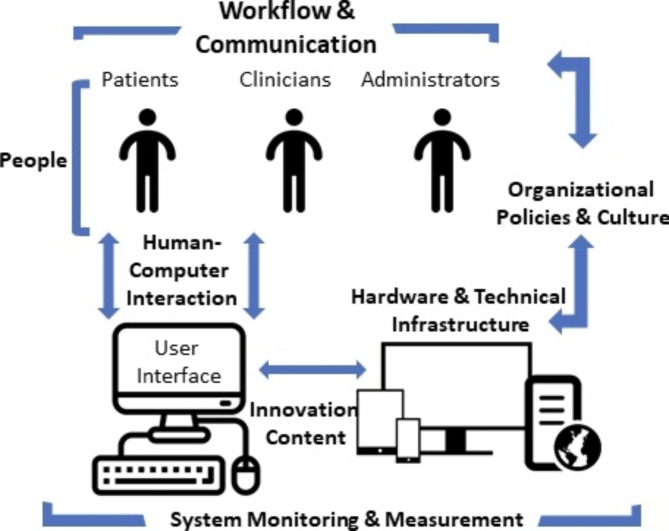
We conducted qualitative interviews with patients and clinicians from two Midwestern medical specialty centers from August 2020 to April 2021. Interviews were first double coded until coders achieved a kappa > 0.8 and percent agreement > 95%, then were coded independently. We used a sociotechnical framework to evaluate BREASTChoice's implementation and sustainability potential according to end-users, human-computer interaction, and contextual factors.
Twelve clinicians and ten patients completed interviews. Using the sociotechnical framework we determined the following. People Using the Tool: Patients and clinicians agreed that BREASTChoice could help patients make more informed decisions about their reconstruction and prepare better for their first plastic surgery appointment. Workflow and Communications: They felt that BREASTChoice could improve communication and process if the patient could view the tool at home and/or in the waiting room. Clinicians suggested the information from BREASTChoice about patients' risks and preferences be included in the patient's chart or the clinician electronic health record (EHR) inbox for accessibility during the consultation. Human Computer Interface: Patients and clinicians stated that the tool contains helpful information, does not require much time for the patient to use, and efficiently fills gaps in knowledge. Although patients found the risk profile information helpful, they reported needing time to read and digest.
BREASTChoice was perceived as highly usable by patients and clinicians and has the potential for sustainability. Future research will implement and test the tool after integrating the stakeholder-suggested changes to its delivery process and content. It is critical to conduct usability assessments such as these prior to decision aid implementation to ensure success of the tool to improve risk communication.
BREASTChoice 是一个基于网络的乳房重建决策辅助工具。之前的临床试验——在我们探索可用性、决策质量、生活质量、患者激活、共同决策和治疗选择的这个工具的改进版本之前——已经测量了这个工具。目前的可用性研究旨在了解患者和临床医生对将 BREASTChoice 纳入临床工作流程的障碍和促进因素的看法。
我们于 2020 年 8 月至 2021 年 4 月在两个中西部医学专业中心对患者和临床医生进行了定性访谈。访谈首先进行了双重编码,直到编码员的 κ 值>0.8 和百分比一致性>95%,然后独立编码。我们根据最终用户、人机交互和上下文因素,使用社会技术框架来评估 BREASTChoice 的实施和可持续性潜力。
12 名临床医生和 10 名患者完成了访谈。使用社会技术框架,我们确定了以下内容。使用工具的人:患者和临床医生都认为 BREASTChoice 可以帮助患者对他们的重建做出更明智的决定,并为他们的第一次整形手术预约做好更好的准备。工作流程和沟通:他们认为,如果患者可以在家中或候诊室查看工具,那么 BREASTChoice 可以改善沟通和流程。临床医生建议将 BREASTChoice 中有关患者风险和偏好的信息包含在患者的图表或临床医生的电子健康记录(EHR)收件箱中,以便在咨询期间访问。人机界面:患者和临床医生表示,该工具包含有用的信息,患者不需要太多时间使用,并且有效地填补了知识空白。虽然患者认为风险概况信息很有帮助,但他们报告说需要时间阅读和消化。
患者和临床医生认为 BREASTChoice 非常易用,并且具有可持续性。未来的研究将在整合利益相关者对其交付流程和内容的建议更改后实施和测试该工具。在决策辅助工具实施之前进行可用性评估非常重要,以确保工具成功,从而改善风险沟通。