Department of Veterinary Medicine and Animal Productions, University of Naples Federico II, Via Federico Delpino n.1, Naples, 80137, Italy.
Friedrich-Loeffler-Institut, Südufer 10, 17493, Greifswald-Insel Riems, Germany.
BMC Vet Res. 2023 Jul 28;19(1):95. doi: 10.1186/s12917-023-03666-5.
Schmallenberg virus (SBV) is a vector-borne pathogen that mainly affects ruminants. Schmallenberg disease has never been described in southern Italy, although this geographic area displays climatic features suitable for Culicoides biting midges, which transmit the pathogen. An observational study was carried out in the Campania region in 2020 to evaluate the seroprevalence in cattle and water buffalo as well as to identify the risk factors involved in the distribution of SBV.
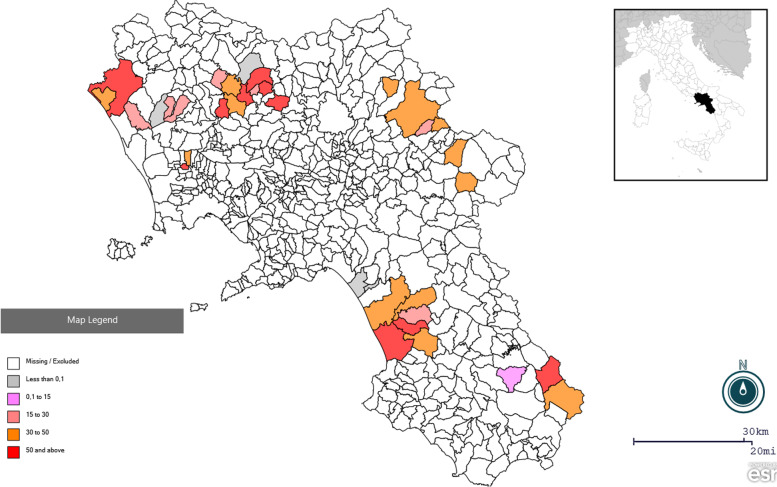
Relatively high seroprevalences of 38.2% (cattle) and 43% (water buffalo) were found by using a commercial SBV ELISA, which is comparable to the prevalence obtained in other countries under post-epidemic conditions. A virus neutralization assay performed on positive samples showed high titers in a large percentage of animals which is assumed to indicate recent exposure. Bivariate analysis of several variables revealed some environmental factors associated with higher seroprevalence, such as mean annual temperature, distance from the coast, and altitude. Multivariate logistic regression confirmed the statistical association only for mean annual temperature, that was found to be the main factor responsible for the distribution of the virus in southern Italy. In addition, molecular diagnosis attempts were performed on serum samples and resulted in the detection of SBV RNA in two herds and six animals.
In this work we have demonstrated the circulation of SBV in southern Italy using both molecular and serological assays. This study emphasized the essential role of monitoring in preventing the re-emergence of vector-borne diseases in ruminants.
沙尔病毒(SBV)是一种主要影响反刍动物的虫媒病原体。沙尔病从未在意大利南部描述过,尽管该地理区域具有适合传播病原体的蠓叮咬的气候特征。2020 年在坎帕尼亚地区进行了一项观察性研究,以评估牛和水牛的血清流行率,并确定与 SBV 分布相关的风险因素。
使用商业 SBV ELISA 发现相对较高的血清流行率为 38.2%(牛)和 43%(水牛),这与其他国家在疫情后条件下获得的流行率相当。对阳性样本进行的病毒中和测定显示,大部分动物的滴度较高,这被认为表明最近有接触。对几个变量的双变量分析显示了一些与较高血清流行率相关的环境因素,例如年平均温度、离海岸的距离和海拔。多变量逻辑回归仅证实了年平均温度的统计学关联,发现年平均温度是导致 SBV 在意大利南部分布的主要因素。此外,还对血清样本进行了分子诊断尝试,结果在两个牛群和六只动物中检测到了 SBV RNA。
在这项工作中,我们使用分子和血清学检测方法证明了 SBV 在意大利南部的传播。本研究强调了监测在预防反刍动物媒介传播疾病再次出现方面的重要作用。