Bio-X Institutes, Key Laboratory for the Genetics of Developmental and Neuropsychiatric Disorders, Ministry of Education, Shanghai Jiao Tong University, Shanghai, China.
Department of Nephrology, Sixth People's Hospital, Shanghai Jiao Tong University, Shanghai, 200240, China.
Stem Cell Res Ther. 2023 Jul 28;14(1):188. doi: 10.1186/s13287-023-03376-7.
Mesenchymal stem cells (MSCs) are widely used in a variety of tissue regeneration and clinical trials due to their multiple differentiation potency. However, it remains challenging to maintain their replicative capability during in vitro passaging while preventing their premature cellular senescence. Forkhead Box P1 (FOXP1), a FOX family transcription factor, has been revealed to regulate MSC cell fate commitment and self-renewal capacity in our previous study.
Mass spectra analysis was performed to identify acetylation sites in FOXP1 protein. Single and double knockout mice of FOXP1 and HDAC7 were generated and analyzed with bone marrow MSCs properties. Gene engineering in human embryonic stem cell (hESC)-derived MSCs was obtained to evaluate the impact of FOXP1 key modification on MSC self-renewal potency.
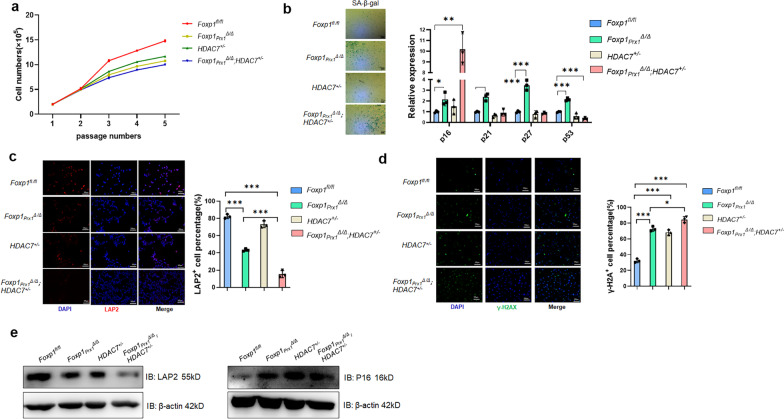
FOXP1 is deacetylated and potentiated by histone deacetylase 7 (HDAC7) in MSCs. FOXP1 and HDAC7 cooperatively sustain bone marrow MSC self-renewal potency while attenuating their cellular senescence. A mutation within human FOXP1 at acetylation site (T176G) homologous to murine FOXP1 T172G profoundly augmented MSC expansion capacity during early passages.
These findings reveal a heretofore unanticipated mechanism by which deacetylation of FOXP1 potentiates self-renewal of MSC and protects them from cellular senescence. Acetylation of FOXP1 residue T172 as a critical modification underlying MSC proliferative capacity. We suggest that in vivo gene editing of FOXP1 may provide a novel avenue for manipulating MSC capability during large-scale expansion in clinical trials.
间充质干细胞(MSCs)由于其多向分化潜能,广泛应用于多种组织再生和临床试验中。然而,在体外传代过程中维持其复制能力,同时防止其过早的细胞衰老仍然具有挑战性。叉头框蛋白 P1(FOXP1)是 FOX 家族转录因子的一种,在我们之前的研究中,已被揭示可调节 MSC 细胞命运决定和自我更新能力。
通过质谱分析鉴定 FOXP1 蛋白中的乙酰化位点。生成 FOXP1 和 HDAC7 的单和双敲除小鼠,并对骨髓间充质干细胞特性进行分析。通过基因工程获得人胚胎干细胞(hESC)衍生的间充质干细胞,以评估 FOXP1 关键修饰对间充质干细胞自我更新能力的影响。
FOXP1 在间充质干细胞中被组蛋白去乙酰化酶 7(HDAC7)去乙酰化和激活。FOXP1 和 HDAC7 协同维持骨髓间充质干细胞自我更新能力,同时减弱其细胞衰老。与鼠 FOXP1 T172G 同源的人 FOXP1 乙酰化位点(T176G)的突变,在早期传代时显著增强了间充质干细胞的扩增能力。
这些发现揭示了 FOXP1 去乙酰化增强间充质干细胞自我更新并保护其免受细胞衰老的一种前所未知的机制。FOXP1 残基 T172 的乙酰化是间充质干细胞增殖能力的关键修饰。我们建议,在体内对 FOXP1 进行基因编辑可能为在临床试验中大规模扩增时操纵间充质干细胞能力提供新途径。