Multiple Sclerosis Center of Catalonia, Department of Neurology-Neuroimmunology, Vall d'Hebron University Hospital, 08035 Barcelona, Spain.
Cells. 2023 Jul 22;12(14):1911. doi: 10.3390/cells12141911.
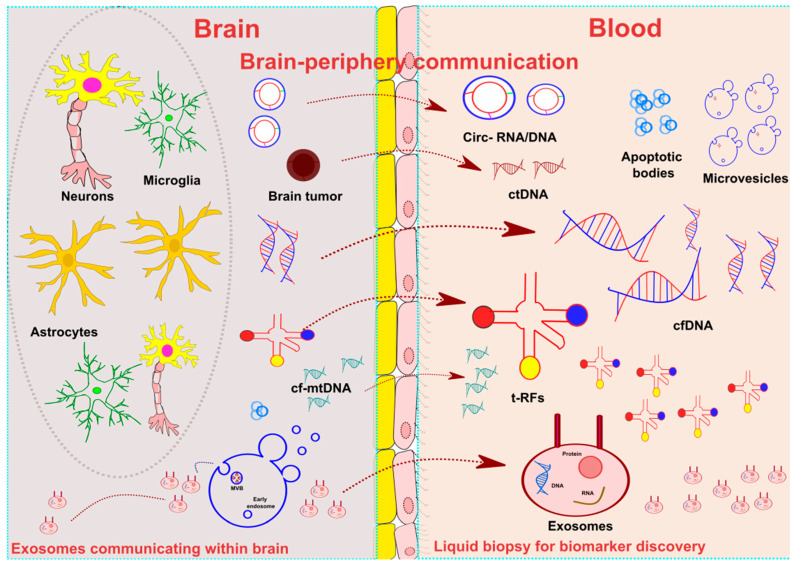
The most recent and non-invasive approach for studying early-stage biomarkers is liquid biopsy. This implies the extraction and analysis of non-solid biological tissues (serum, plasma, saliva, urine, and cerebrospinal fluid) without undergoing invasive procedures to determine disease prognosis. Liquid biopsy can be used for the screening of several components, such as extracellular vesicles, microRNAs, cell-free DNA, cell-free mitochondrial and nuclear DNA, circulating tumour cells, circulating tumour DNA, transfer RNA, and circular DNA or RNA derived from body fluids. Its application includes early disease diagnosis, the surveillance of disease activity, and treatment response monitoring, with growing evidence for validating this methodology in cancer, liver disease, and central nervous system (CNS) disorders. This review will provide an overview of mentioned liquid biopsy components, which could serve as valuable biomarkers for the evaluation of complex neurological conditions, including Alzheimer's disease, Parkinson's disease, amyotrophic lateral sclerosis, multiple sclerosis, epilepsy, stroke, traumatic brain injury, CNS tumours, and neuroinfectious diseases. Furthermore, this review highlights the future directions and potential limitations associated with liquid biopsy.
目前,研究早期生物标志物最先进且无创的方法是液体活检。这意味着在不进行侵入性程序的情况下提取和分析非固体生物组织(血清、血浆、唾液、尿液和脑脊液),以确定疾病预后。液体活检可用于筛选多种成分,如细胞外囊泡、microRNAs、无细胞 DNA、无细胞线粒体和核 DNA、循环肿瘤细胞、循环肿瘤 DNA、转移 RNA 以及源自体液的环状 DNA 或 RNA。其应用包括早期疾病诊断、疾病活动监测和治疗反应监测,越来越多的证据证实了这种方法在癌症、肝病和中枢神经系统 (CNS) 疾病中的有效性。本综述将概述上述液体活检成分,这些成分可作为评估包括阿尔茨海默病、帕金森病、肌萎缩侧索硬化症、多发性硬化症、癫痫、中风、创伤性脑损伤、CNS 肿瘤和神经感染性疾病在内的复杂神经状况的有价值的生物标志物。此外,本综述还强调了液体活检相关的未来方向和潜在局限性。