Ma Guoqin, Cai Jing, Zhong Rijian, He Weichao, Ye Haoxi, Duvvuri Chaitanya, Song Chengjin, Feng Jinping, An Lin, Qin Jia, Huang Yanping, Xu Jingjiang, Twa Michael D, Lan Gongpu
School of Mechatronic Engineering and Automation, Foshan University, Foshan 528000, China.
Guangdong-Hong Kong-Macao Intelligent Micro-Nano Optoelectronic Technology Joint Laboratory, School of Physics and Optoelectronic Engineering, Foshan University, Foshan 528000, China.
Bioengineering (Basel). 2023 Jun 24;10(7):754. doi: 10.3390/bioengineering10070754.
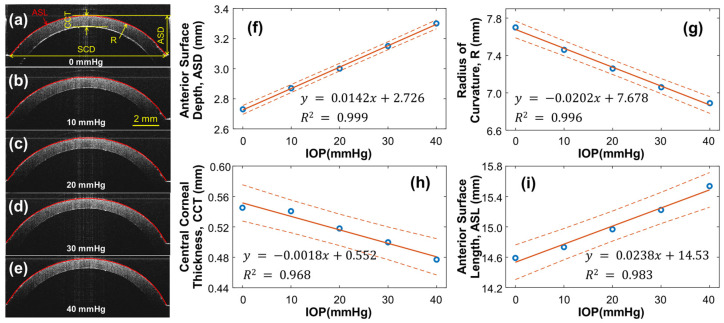
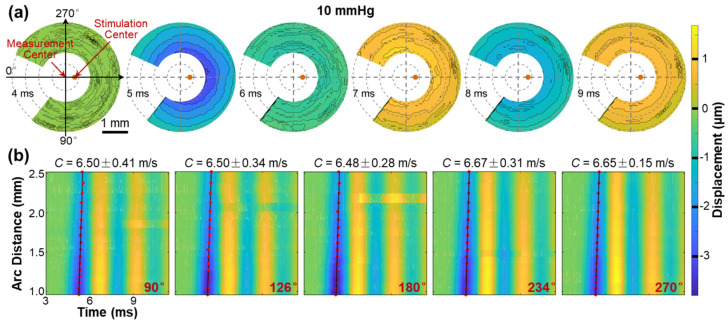
Assessing corneal biomechanics in vivo has long been a challenge in the field of ophthalmology. Despite recent advances in optical coherence tomography (OCT)-based elastography (OCE) methods, controversy remains regarding the effect of intraocular pressure (IOP) on mechanical wave propagation speed in the cornea. This could be attributed to the complexity of corneal biomechanics and the difficulties associated with conducting in vivo corneal shear-wave OCE measurements. We constructed a simplified artificial eye model with a silicone cornea and controllable IOPs and performed surface wave OCE measurements in radial directions (54-324°) of the silicone cornea at different IOP levels (10-40 mmHg). The results demonstrated increases in wave propagation speeds (mean ± STD) from 6.55 ± 0.09 m/s (10 mmHg) to 9.82 ± 0.19 m/s (40 mmHg), leading to an estimate of Young's modulus, which increased from 145.23 ± 4.43 kPa to 326.44 ± 13.30 kPa. Our implementation of an artificial eye model highlighted that the impact of IOP on Young's modulus (ΔE = 165.59 kPa, IOP: 10-40 mmHg) was more significant than the effect of stretching of the silicone cornea (ΔE = 15.79 kPa, relative elongation: 0.98-6.49%). Our study sheds light on the potential advantages of using an artificial eye model to represent the response of the human cornea during OCE measurement and provides valuable insights into the impact of IOP on wave-based OCE measurement for future in vivo corneal biomechanics studies.
长期以来,在眼科领域,体内评估角膜生物力学一直是一项挑战。尽管基于光学相干断层扫描(OCT)的弹性成像(OCE)方法最近取得了进展,但关于眼内压(IOP)对角膜中机械波传播速度的影响仍存在争议。这可能归因于角膜生物力学的复杂性以及进行体内角膜剪切波OCE测量所面临的困难。我们构建了一个带有硅胶角膜和可控眼内压的简化人工眼模型,并在不同眼内压水平(10 - 40 mmHg)下,对硅胶角膜的径向方向(54 - 324°)进行了表面波OCE测量。结果表明,波传播速度(平均值±标准差)从6.55±0.09 m/s(10 mmHg)增加到9.82±0.19 m/s(40 mmHg),由此估计杨氏模量从145.23±4.43 kPa增加到326.44±13.30 kPa。我们对人工眼模型的应用突出表明,眼内压对杨氏模量的影响(ΔE = 165.59 kPa,眼内压:10 - 40 mmHg)比硅胶角膜拉伸的影响(ΔE = 15.79 kPa,相对伸长:0.98 - 6.49%)更为显著。我们的研究揭示了在OCE测量期间使用人工眼模型来代表人类角膜反应的潜在优势,并为未来体内角膜生物力学研究中眼内压对基于波的OCE测量的影响提供了有价值的见解。